 English
 Lietuvių
 Latviešu
 Eesti
 Polski
 Русский
 Українська
 Deutsch
 Nederlands
 Čeština
 Slovenčina
 Svenska
 Norsk
 Dansk
 Suomi


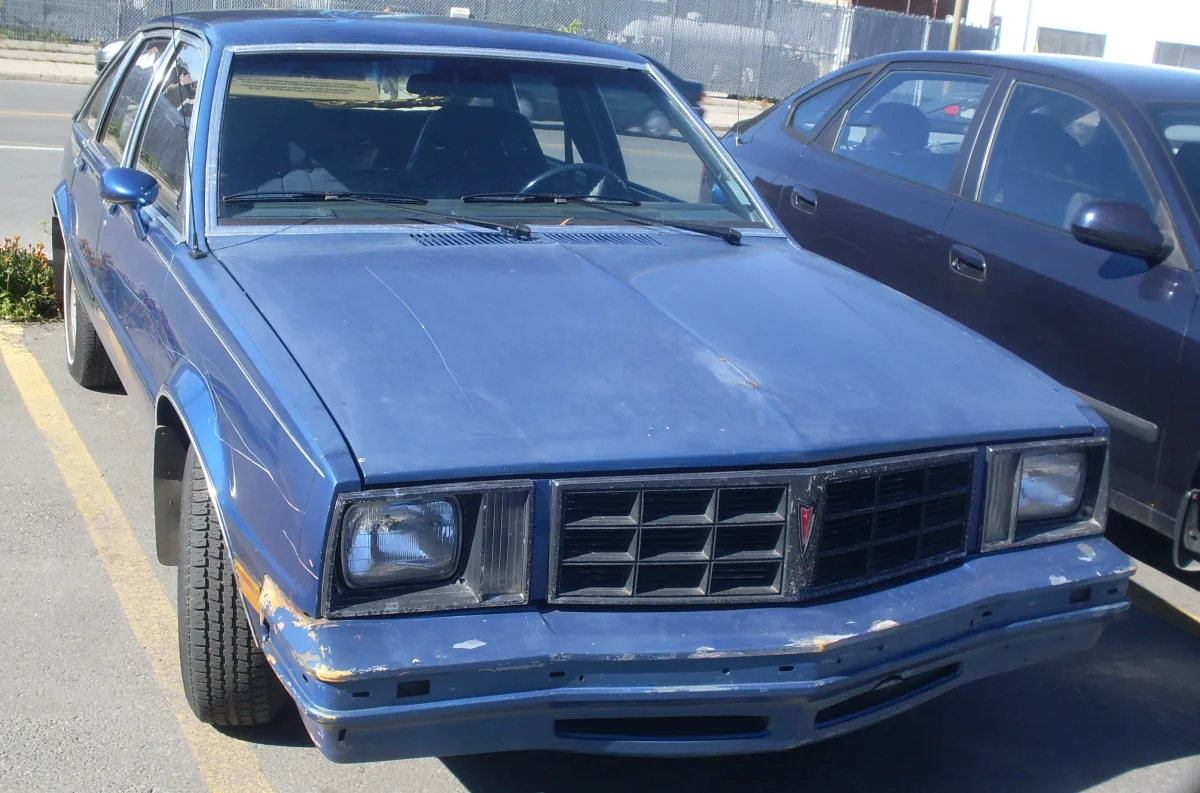
Pontiac Phoenix: two generations, engines and features
The Pontiac Phoenix is a compact Pontiac model produced from 1977 to 1984, replacing the Ventura. In this article, we look at both generations, the engines, and what to check if you're considering buying this classic car in Lithuania.






Phoenix in brief
The Phoenix replaced the Ventura and in 1985 made way for the Grand Am. It was built on the GM 'X' platform, which was shared with the Chevrolet Nova and Buick Skylark.
This is a straightforward, compact American car of its time. Today, it's of interest to classic car enthusiasts and in Lithuania, it only appears as a private import from North America.
Generations — what's the difference
The first generation (1977–1979) had rear-wheel drive and was similar to the Ventura and Nova. It was offered as a two-door coupe, four-door sedan, and (from 1978) a three-door hatchback, with a wide range of engines from four-cylinder to V8.
The second generation (1980–1984) was the first Pontiac with front-wheel drive as standard. It was more compact, with a transversely mounted engine, and was available as a coupe and five-door hatchback. Early X platform cars had recall campaigns for brakes, so it's worth checking if this was done.
Engines and gearboxes
The first generation featured the 2.5-litre Iron Duke four-cylinder, 3.8-litre Buick V6, and 5.0 and 5.7-litre Chevrolet V8 engines. The gearbox was manual or automatic.
The second-generation models offer the 2.5-litre “Iron Duke” four-cylinder and 2.8-litre V6 engines. Their power is modest, with a four-speed manual and a three-speed automatic gearbox.
What to check when buying a Phoenix
The most important thing is the body condition. Rust on sills, floors, wings, and boot floors is a common issue, especially in cars used in northern countries where salt is spread in winter.
Test the engine and gearbox — there should be no leaks, hesitation, or excessive smoking. Check the brakes and suspension, and for second-generation models, ensure that any manufacturer recall campaigns have been carried out.
Finding parts is easier since many are shared with other GM “X” models, but interior and body parts may need to be sourced through clubs and overseas suppliers.


Trim levels
Names and equipment vary by market and year; we list the versions most commonly found in Europe.
Phoenix
1977–1979 m.Rear-wheel-drive version.
- A wide range of engines, including V8s
- Often comes with an automatic gearbox
- Coupe, sedan, and hatchback body styles
Phoenix
1980–1984 m.Front-wheel-drive version.
- Four-cylinder or V6 engine
- Transverse-mounted engine
- Coupe or five-door hatchback body styles
Comparing generations
| 1977–1979 m. | 1980–1984 m. | |
|---|---|---|
| Who it's for | For those wanting rear-wheel drive and a V8 | For a practical daily driver |
| Transmission | Rear-wheel drive | Front-wheel drive |
| Engine | From four-cylinder to V8 | 2.5-litre four-cylinder or 2.8-litre V6 |
| Price in the used market (relatively) | Mid-range | Budget |
If you want a classic rear-wheel-drive car, go for the first generation. The second generation is simpler and cheaper, but less powerful.
Pros
- Simple and uncomplicated mechanics
- Shares many parts with other GM X cars
- More compact than most American cars of the time
- An interesting history – the first front-wheel-drive Pontiac (second generation)
Cons
- Rust and body condition
- Second-gen engines lack power
- Interior parts can be tricky to find
Frequently asked questions
How does the first-gen Phoenix differ from the second?
The first had rear-wheel drive and a wide range of engines, the second had front-wheel drive and smaller engines.
Is the Phoenix suitable for daily driving?
More suited to enthusiasts and shows. It lacks modern safety features.
Can a Phoenix be registered in Lithuania?
Yes, if the car has all the necessary documents. Before buying, check the current registration process.
Updated 2026-10-21 · Trim levels and equipment vary by market and model year — check the equipment of the specific car. · Translated automatically


