 English
 Lietuvių
 Latviešu
 Eesti
 Polski
 Русский
 Українська
 Deutsch
 Nederlands
 Čeština
 Slovenčina
 Svenska
 Norsk
 Dansk
 Suomi


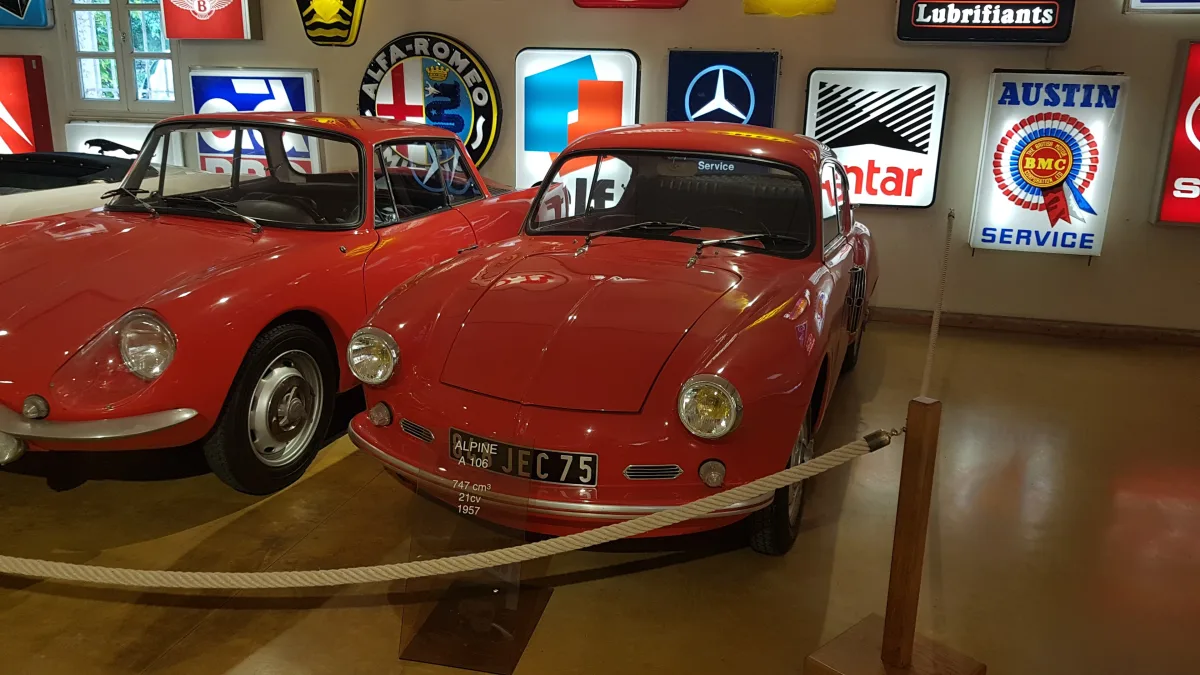
Alpine A106: a French glass-fibre coupe, versions and what to know
The Alpine A106 was a small French sports car produced from 1955 to 1961 with a glass-fibre body and Renault 4CV technology. In this article, we look at its versions, engines, and what to consider if you're seriously thinking about this rare classic.






The A106 in brief
The A106 was one of the first series-production Alpine cars, built in Dieppe, France. It's based on Renault 4CV mechanics: the engine and gearbox are mounted at the rear, and the lightweight glass-fibre body was designed according to Giovanni Michelotti's sketches.
Around 650 units were produced, making the A106 a true rarity. This isn't a daily driver but a choice for collectors and classic rally enthusiasts: it's light, has a small engine, and a sporting history.
Versions — what's the difference
The A106 was produced as a closed coupe and as a convertible. The closed body later evolved into the Alpine A108, followed by the famous A110.
The sportiest version was called the “Mille Miles” — it received a more powerful engine, better suspension, and sporty carburetors. These cars are the most sought-after, but also the hardest to find in original condition.
Engines and gearboxes
The main engine is the Renault 4CV 747 cm³ four-cylinder with overhead valves. Depending on the tuning, its power ranged from about 21 to about 43 hp (the most powerful being the Mille Miles). Later, a larger, approximately 0.9-litre engine from the Renault Dauphine appeared, with power reaching about 59 hp.
Standard 3-speed manual; some cars got a 5-speed box, but there aren't many of those. Drive is to the rear wheels.
What to check when buying an Alpine A106
The key is originality and paperwork: check the chassis and engine numbers, purchase history, and whether the car hasn't been converted to another version. Due to the low production volume, this greatly affects the value.
Look for cracks, signs of previous repairs, and altered body geometry in the fibreglass body. Also, thoroughly inspect the metal base and fasteners — corrosion can be hidden here.
Before buying, consult with a classic car specialist, as finding parts and mechanics can take time.


Trim levels
Production years and versions are listed generally; check the specific car's origin via the documents.
A106 kupė
1955–1961The closed coupé body is the most common version.
- Fibreglass body
- Rear engine and Renault 4CV-derived mechanics
- A small, light car
A106 kabrioletas
1955–1961Open body for those who enjoy driving with the top down.
- Open body with a soft top
- The same Renault 4CV-derived mechanics
- Finding such a car is tricky
Mille Miles
1955–1961A sportier version with a more powerful engine.
- Engine up to around 43 hp
- Sportier suspension and carburetors
- Sometimes — a 5-speed gearbox
Su apie 0,9 l varikliu
Later yearsVersion with a larger Dauphine-derived engine.
- Power up to around 59 hp
- More power than the 747 cc variants
- More practical if you drive frequently
Comparing versions
| Kupė | Kabrioletas | Mille Miles | |
|---|---|---|---|
| Who it's for | For collections and shows | For open-top driving | For sporty driving and rallies |
| Engine | 747 cm³, around 21–30 hp | 747 cm³, around 21–30 hp | 747 cm³, up to around 43 hp |
| Price in the used market (relatively) | High-end | High-end | High-end |
For most collectors, the best choice is a car whose provenance and condition are best documented. The Mille Miles is the most valuable version, but it also demands the most commitment to originality.
Pros
- Rare, collectible car
- Very lightweight fibreglass body
- Simple mechanics derived from the Renault 4CV
- Sports and rallying history
Cons
- Very limited supply and high collectible value
- Weak engine by today's standards
- Body and parts restoration requires specialists
Frequently asked questions
Is the Alpine A106 suitable for daily driving?
This is primarily a collectible car. It's light and low-powered, with no modern safety features, so it's usually used for shows, outings and classic events.
How does the A106 differ from the A110?
The A110 is the later and most iconic Alpine model, which came after the A106 and A108. The A106 is based on the Renault 4CV, while the A110 has its own unique construction.
How many Alpine A106s were produced?
In total, around 650 cars were made, so original, well-preserved examples are few and far between.
Updated 2026-10-21 · Trim levels and equipment vary by market and model year — check the equipment of the specific car. · Translated automatically


