 English
 Lietuvių
 Latviešu
 Eesti
 Polski
 Русский
 Українська
 Deutsch
 Nederlands
 Čeština
 Slovenčina
 Svenska
 Norsk
 Dansk
 Suomi


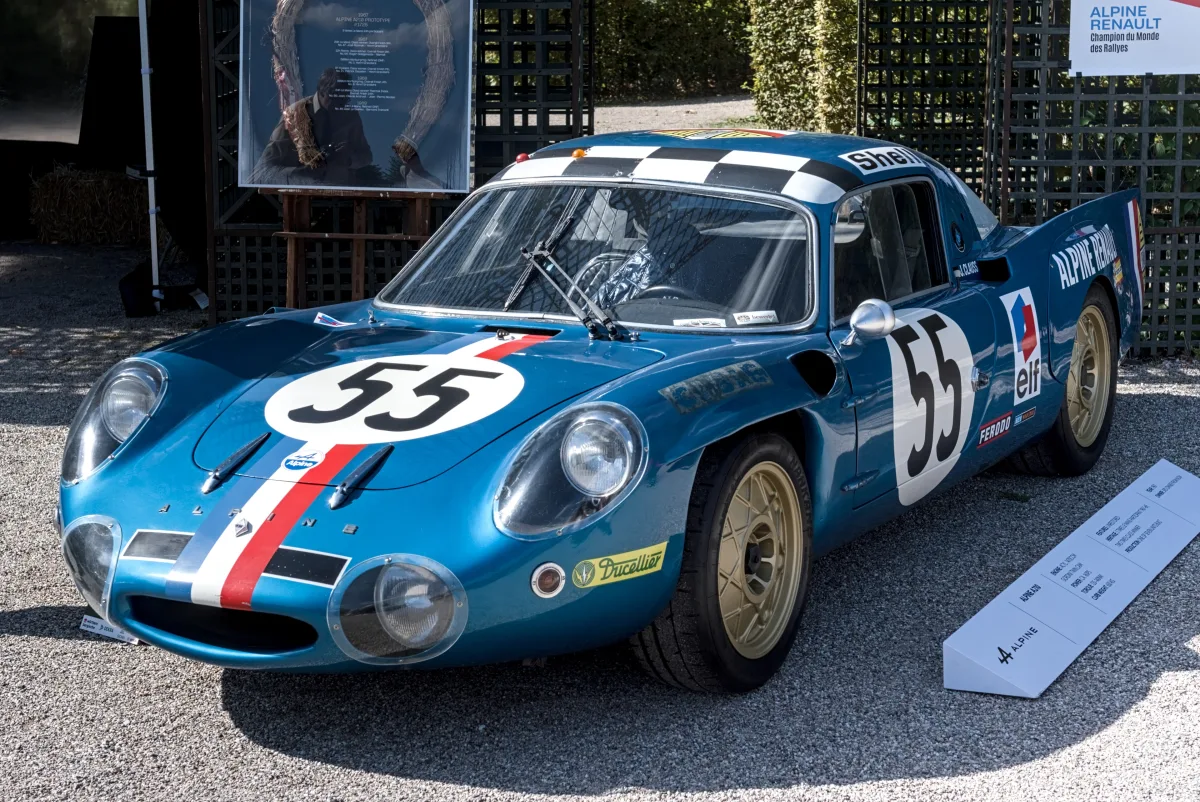
Alpine A210: a Le Mans track prototype
Alpine A210 — a French racing prototype that competed in endurance races, particularly the 24 Hours of Le Mans, from 1966 to 1969. We look at its origins, technology, and significance in Alpine’s history.






A210 in brief
The Alpine A210 was a small-displacement sports prototype designed for endurance racing. It was created by the French manufacturer Alpine, in close collaboration with Renault and Gordini.
The car stood out with its low, lightweight, and aerodynamic body, typical of Alpine prototypes from that era.
History and development
The A210 evolved from earlier M series prototypes — the M63, M64, and M65. It first appeared in races in 1966, and its program continued until 1969.
Later, Alpine developed more powerful versions, including the A211 with a larger V8 engine and the A220, but these did not achieve the same success as the lightweight, small-displacement prototypes.
Technology
The A210’s engines were Renault four-cylinder units, enhanced by Gordini. Depending on the version, their displacement ranged roughly from 1.0 to 1.5 litres.
Alpine tradition — a lightweight fibreglass body and effective aerodynamics. While power wasn’t high, the low weight and streamlined shape allowed for high speeds on straights.
Significance and where to see it
The A210’s greatest achievements are linked to efficiency index classifications at Le Mans: in 1966, Alpine took the top spots in this classification. Overall victories were not achieved.
Surviving A210s are exhibited in museums and classic car events in France, and some are shown at events like Retromobile.


The evolution of the A series prototypes
These are race cars, so there are no trims; we provide the main lines.
A210
1966–1969A lightweight prototype with Renault–Gordini engines.
- Approximately 1.0–1.5-litre four-cylinder engines
- Fibreglass body
- Designed for Le Mans and similar races
A211
Later versionMore powerful variant with a V8 engine.
- 3.0-litre V8 Gordini engine
- Aimed at the higher class
- Less successful than the A210
The A210 and other small-displacement prototypes of the time
| Alpine A210 | Porsche 906 | Abarth Simca 1300 Bialbero | |
|---|---|---|---|
| Origin | France | Germany | Italy |
| Body | Glass fibre | Glass fibre | Lightweight sports body |
| Purpose | Endurance prototype | Sports prototype and GT | Small-displacement prototype |
The A210 best embodies Alpine's philosophy — lightness and efficiency over raw power.
Pros
- Light and aerodynamic
- Built for Le Mans conditions
- Demonstrated the efficiency philosophy
- Key to Alpine and Renault's motorsport history
Cons
- Overall victories were not achieved
- Low production volume
- Today it's hardly found on the market
Frequently asked questions
Did the Alpine A210 win Le Mans?
Overall victories were not won, but in 1966 it took the top spots in the efficiency index classification.
Can you buy an A210?
This is a very rare historic race car; it only appears at specialist auctions.
How does the A210 differ from the A110?
The A110 is a road-going sports model, while the A210 is a racing prototype.
Updated 2026-10-21 · Trim levels and equipment vary by market and model year — check the equipment of the specific car. · Translated automatically


