 English
 Lietuvių
 Latviešu
 Eesti
 Polski
 Русский
 Українська
 Deutsch
 Nederlands
 Čeština
 Slovenčina
 Svenska
 Norsk
 Dansk
 Suomi


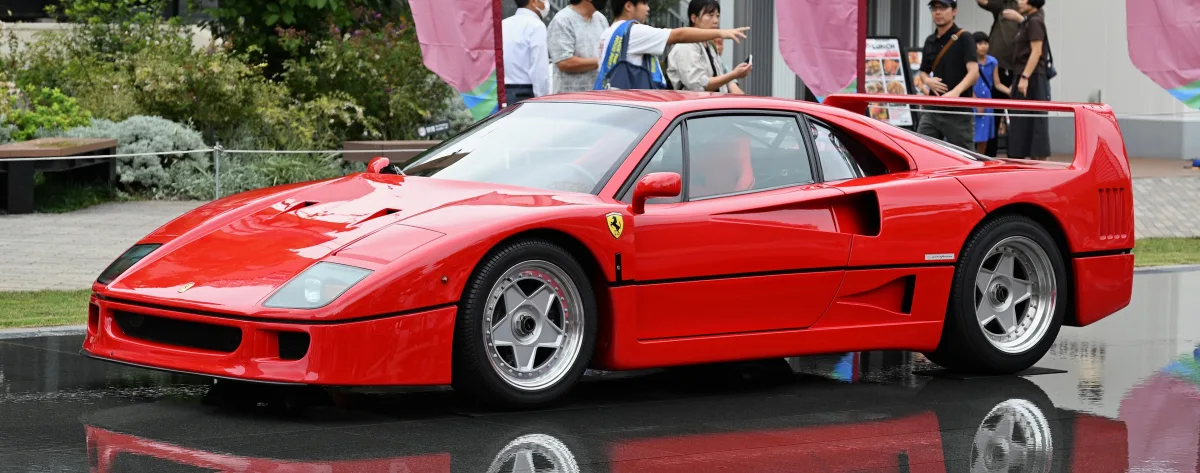
Ferrari F40: features, engine and what to know before buying
The Ferrari F40 is a 1987 supercar with a twin-turbo V8, created to celebrate Ferrari's 40th anniversary. We look at the tech, versions and what you need to know when considering buying this collectible car.






F40 in brief
The F40 was produced from 1987 to 1992 and is considered the last Ferrari model that Enzo Ferrari himself approved. The car was designed to be as simple and lightweight as possible: no power steering, no electronic driving aids, plastic windows and minimal interior trim.
Around 1,300 units were made. Today, it's a collectible car worth buying only if you know its full history. The F40 is practically unheard of in Lithuania, so you'll usually have to look for it at foreign auctions or specialist dealers.
Versions and differences
All road-going F40s share the same core tech: rear-wheel drive and a central twin-turbo V8. Differences mainly come down to market-specific details, such as catalytic converters and exhaust systems in some countries.
Alongside the road cars, there were also race versions like the F40 LM and Competizione. These are much rarer, and buying, documenting and using them is a whole different ball game compared to a classic road-going F40.
Engine and gearbox
The 2.9-litre twin-turbocharged V8 petrol engine of the F40 produces around 478 bhp. It was one of the first production road cars to reach a top speed of approximately 320 km/h.
The gearbox is a five-speed manual. The car is rear-wheel drive only, with no ABS or power steering, making the driving experience very direct and demanding of skill.
What to check when buying an F40
The key thing is documentation: service history, ownership chain, proof of originality, and factory documents. Ask for information about engine and turbo maintenance, fuel tank and pipe lifespans, as these parts have time, not just mileage, restrictions.
Inspect the body (plastic bodywork and composite parts), plastic windows, and interior details. If possible, before purchasing, consult an independent Ferrari classic specialist.


Trim levels
Names and equipment vary by market and year; we list the most commonly found trims in Europe.
F40 (gatvinė versija)
1987–1992The classic road-going F40 with minimal equipment.
- 2.9-litre twin-turbocharged V8, around 478 bhp
- Five-speed manual gearbox
- Plastic windows, no power steering
F40 su katalizatoriumi
Later productionSome cars had a catalytic converter due to market requirements.
- Exhaust system with catalytic converter
- For buyers with stricter requirements
- Important to check against the car's documents
F40 LM
1989 model yearA racing version with noticeably increased power.
- Aerodynamic add-ons
- Racing suspension and interior
- Often — without any road equipment
F40 Competizione
1990 model yearAn even more radical track-focused version, produced in very limited numbers.
- Racing engines and systems
- Lacks road equipment
- Extremely rare and collectible
Comparison of F40 versions
| F40 gatvinis | F40 LM | F40 Competizione | |
|---|---|---|---|
| Who it's for | For collectors and enthusiasts | For racing history enthusiasts | Track enthusiasts |
| Purpose | Roads and track | Racing | Racing |
| Rarity | Around 1300 | Very rare | Extremely rare |
| Price in the used market (relatively) | €€€ | €€€ | €€€ |
A realistic choice for almost all buyers is the road-going F40: it's rare, but at least occasionally for sale. The LM and Competizione are only for specialist collectors.
Pros
- Legendary design and historical significance
- Very direct, 'pure' driving
- Rich racing heritage
- Collector's value and rarity
Cons
- Practically unheard of in Lithuania
- Extremely expensive maintenance and parts
- No ABS or power steering, requires experience
Frequently asked questions
How many F40s were produced?
Around 1,300 cars. The exact number varies slightly depending on the source, so when buying, rely on the specific car's documents.
Can the F40 be used daily?
Not really: it was designed as a straightforward, no-frills car, lacking comfort. Most owners use it sparingly and keep it as a collector's item.
What should you look out for first?
The documents and service history, the age of the fuel tanks and pipes, the condition of the engine and turbochargers. It's also important to check if the car is original.
Updated 2026-10-19 · Trim levels and equipment vary by market and model year — check the equipment of the specific car. · Translated automatically


