 English
 Lietuvių
 Latviešu
 Eesti
 Polski
 Русский
 Українська
 Deutsch
 Nederlands
 Čeština
 Slovenčina
 Svenska
 Norsk
 Dansk
 Suomi


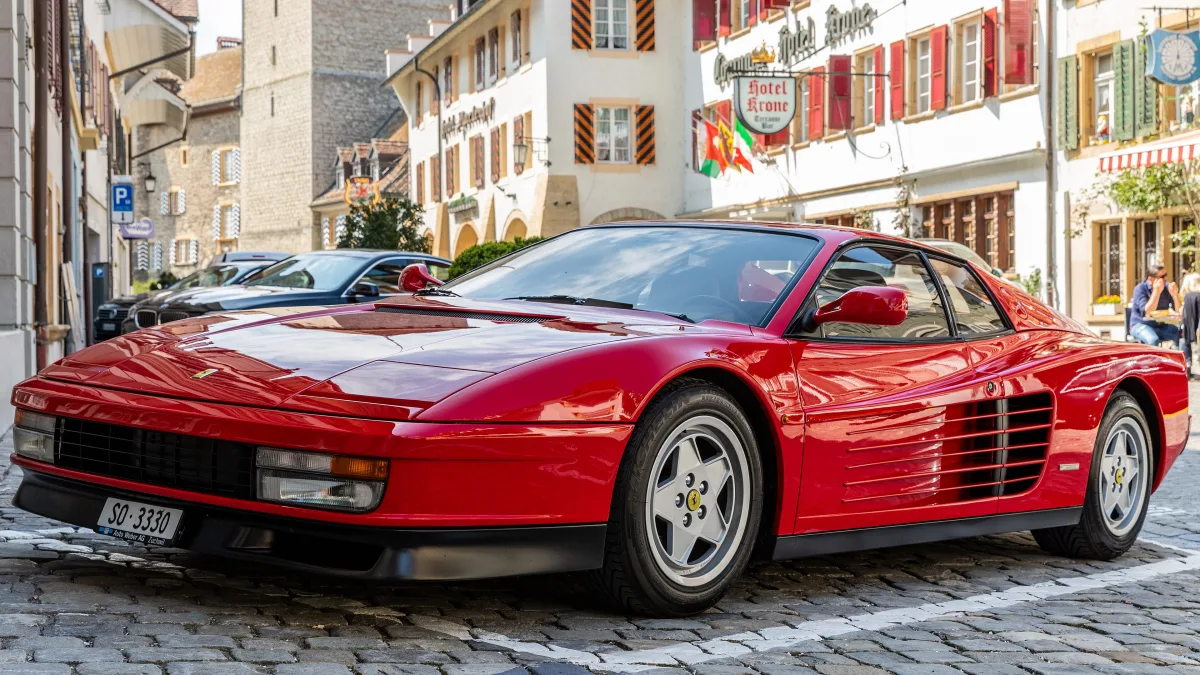
Ferrari Testarossa: generations, engine and what to know before buying
The Ferrari Testarossa is a mid-engined supercar introduced in 1984, featuring a flat-12 engine and distinctive side air intakes that became a symbol of the 1980s. In this article, we'll explore the model's lineage, technology, and what you need to know if you're considering adding this collectible Ferrari to your garage.






Testarossa in brief
The Testarossa was designed by Pininfarina and replaced the Berlinetta Boxer model. Its wide body with long side air intakes became an iconic Ferrari feature, and the engine is positioned behind the driver and passenger, over the rear axle.
The name 'Testarossa' translates to 'redhead,' a nod to an earlier Ferrari racing model whose engine covers were painted red. Today, the Testarossa is valued as a collectible car, with its price heavily dependent on condition and history.
Which version to choose
The first Testarossa (from 1984) stands out with some early details, such as a single high-mounted mirror, and wheels secured by a single central bolt. These cars are particularly prized by collectors for their originality.
Later models feature two mirrors and wheels with five lug nuts. The 512 TR, introduced in 1991, and later the 512 M are evolutions of the model with an updated engine, improved aerodynamics, and sportier handling, but they are considered separate versions.
Engine and transmission
The Testarossa features a 4.9-litre flat-12 engine producing around 390 bhp. The engine has four valves per cylinder and is renowned for its distinctive sound.
The gearbox is a five-speed manual; automatic versions were not offered. Driving requires some physical effort, as the clutch and steering are heavy, making the car more suited to enthusiasts.
What to check when buying a used Testarossa
Request a detailed service history from a Ferrari specialist. Timing belt replacement is an expensive and labour-intensive procedure, often requiring extensive work, so ask when it was last done. Check the clutch, exhaust manifold, and fuel system hoses.
Inspect the body for signs of accidents and corrosion, and check the air conditioning and electrical systems. Due to the high cost of repairs, it's essential to consult a specialist familiar with this model before purchasing.


Trim levels
Names and equipment vary by market and year; we list the most commonly found trims in Europe.
Testarossa (ankstyvoji)
from 1984The first cars with a single side mirror and a central locking hub.
- 4.9-litre flat V12, around 390 hp
- A single high-mounted side mirror
- Often — wheels with central locking
Testarossa (vėlesnė)
later productionCars with two side mirrors and five-spoke wheels.
- The same 4.9-litre engine
- Two exterior mirrors
- Often — wheels with five spokes
512 TR
From 1991Updated version with an improved engine and sportier setup.
- Around 428 HP
- Redesigned front and rear
- Improved aerodynamics
512 M
1994–1996The final evolution of the model with fixed headlights.
- Around 440 HP
- New front design
- Very limited numbers
Comparison of Testarossa versions
| Testarossa (ankstyvoji) | Testarossa (vėlesnė) | 512 TR | 512 M | |
|---|---|---|---|---|
| Who it's for | For collectors | For Enthusiasts | For Sportier Driving | For Classic Car Lovers |
| Engine | 4.9 l V12 (boxer) | 4.9 l V12 (boxer) | 4.9 l V12 (boxer) | 4.9 l V12 (boxer) |
| Power (approx.) | 390 HP | 390 HP | 428 HP | 440 HP |
| Gearbox | 5-speed manual | 5-speed manual | 5-speed manual | 5-speed manual |
| Price in the used market (relatively) | €€€ | €€€ | €€€ | €€€ |
For most buyers, the best choice is a well-maintained later-production Testarossa. Collectors often opt for the earlier versions for their originality, while the 512 TR and 512 M offer more power.
Pros
- Iconic design of the 1990s
- Distinctive flat V12 sound
- The genuine supersports car experience
- Collector's value
Cons
- Very high maintenance costs
- Heavy steering and suspension, low comfort
- Expensive seatbelt pre-tensioner replacement procedure
Frequently asked questions
What does „Testarossa“ mean?
In Italian, it’s „redhead“. The name evokes an earlier Ferrari race car, whose engine covers were painted red.
Is the Testarossa suitable for daily use?
Not really: the car is wide, hard to handle in the city, and maintenance costs are high. It’s usually used as a collector’s item or a weekend car.
How do the Testarossa, 512 TR, and 512 M differ?
The 512 TR and 512 M are updated Testarossa versions with a more powerful engine and revised styling. They are considered more refined, but collectors often value the original Testarossa too.
Updated 2026-10-19 · Trim levels and equipment vary by market and model year — check the equipment of the specific car. · Translated automatically


