 English
 Lietuvių
 Latviešu
 Eesti
 Polski
 Русский
 Українська
 Deutsch
 Nederlands
 Čeština
 Slovenčina
 Svenska
 Norsk
 Dansk
 Suomi


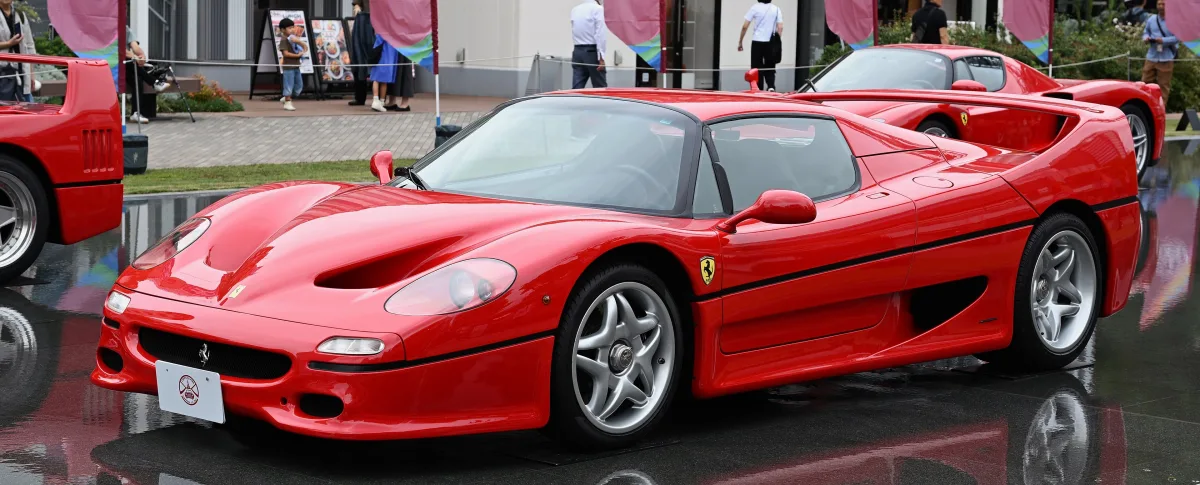
Ferrari F50: features, V12 engine and what to know before buying
Ferrari F50 — the supersports car launched in 1995 with an atmospheric V12 engine, whose lineage is linked to the Formula 1 engine. In this article, we review the technology, versions, and what you need to know when considering the purchase of such a collectible car.






F50 in brief
The F50 was created to celebrate Ferrari's 50th anniversary and replaced the F40. The car was produced from 1995 to 1997, with a total of 349 units made. Its design and technology are geared towards maximum connection with Formula 1 race cars: the engine is directly derived from the F1 engine of that era.
The body is a coupé with a removable roof (targa type), and the monocoque is made from carbon fibre. Due to its extremely limited production run, the F50 is a collectible car and is practically unheard of in Lithuania.
How it differs from the F40
The F40 has a twin-turbo V8, while the F50 has an atmospheric V12. The F50 is more refined and comfortable than the F40, yet it maintains a very direct driving feel and gearbox.
The F40 is often praised for its pure, direct character, while the F50 is celebrated for its F1-derived engine and unique sound. Both are collectible and extremely rare, with the choice coming down to personal preference.
The engine and gearbox
The F50 is powered by a 4.7-litre atmospheric V12 petrol engine, with around 520 hp. It is a structural part of the chassis — the rear suspension and gearbox are directly mounted to the engine. The car is rear-wheel drive.
Gearbox — 6-speed manual. There are no modern electronic aids like stability control, so the driving experience is very direct and requires skill.
What to know when buying an F50
The main thing — documentation and service history: factory and service records, ownership chain, proof of originality. Pay attention to the condition of the engine and gearbox, the age of the fuel system and rubber parts, and the condition of the roof mechanism.
A pre-purchase inspection by an independent Ferrari classic specialist is essential. Due to the low production run, parts are expensive and not always easy to find.


Trim levels
Names and equipment vary by market and year; we list the most commonly found trim levels in Europe.
F50 (gatvinis)
1995–1997The base version with a 4.7-litre V12 and removable roof.
- Around 520 hp
- 6-speed manual gearbox
- Carbon fibre monocoque
F50 GT
1996Race-focused version, produced in very limited numbers.
- Race-oriented
- More powerful engine
- Limited production run
F40 vs F50 comparison
| F40 | F50 | |
|---|---|---|
| Who it's for | For purists of driving pleasure | For collectors and F1 enthusiasts |
| Engine | 2.9-litre V8 with twin turbochargers | 4.7-litre naturally aspirated V12 |
| Power (approx.) | 478 hp | 520 hp |
| Production years | 1987–1992 | 1995–1997 |
| Price in the used market (relatively) | €€€ | €€€ |
These cars are collectible. The F40 is prized for its purity and turbo character, while the F50 is celebrated for its V12 and F1 heritage.
Pros
- An atmospheric V12 with F1 lineage
- Carbon-fibre monocoque and removable roof
- Extremely direct and pure driving experience
- A highly rare collectible car
Cons
- Practically unattainable in the market
- Extremely expensive maintenance and parts
- Lacks modern electronic aids
Frequently asked questions
How many F50s were produced?
349 cars, produced between 1995 and 1997
How does the F50 differ from the F40?
The F50 features an atmospheric 4.7-litre V12 with around 520hp, while the F40 has a twin-turbo V8 with around 478hp. The F50 is more comfortable, the F40 is more 'pure'.
Does the F50 have a manual gearbox?
Yes, the F50 has a 6-speed manual gearbox and there is no automatic version.
Updated 2026-10-19 · Trim levels and equipment vary by market and model year — check the equipment of the specific car. · Translated automatically


