 English
 Lietuvių
 Latviešu
 Eesti
 Polski
 Русский
 Українська
 Deutsch
 Nederlands
 Čeština
 Slovenčina
 Svenska
 Norsk
 Dansk
 Suomi


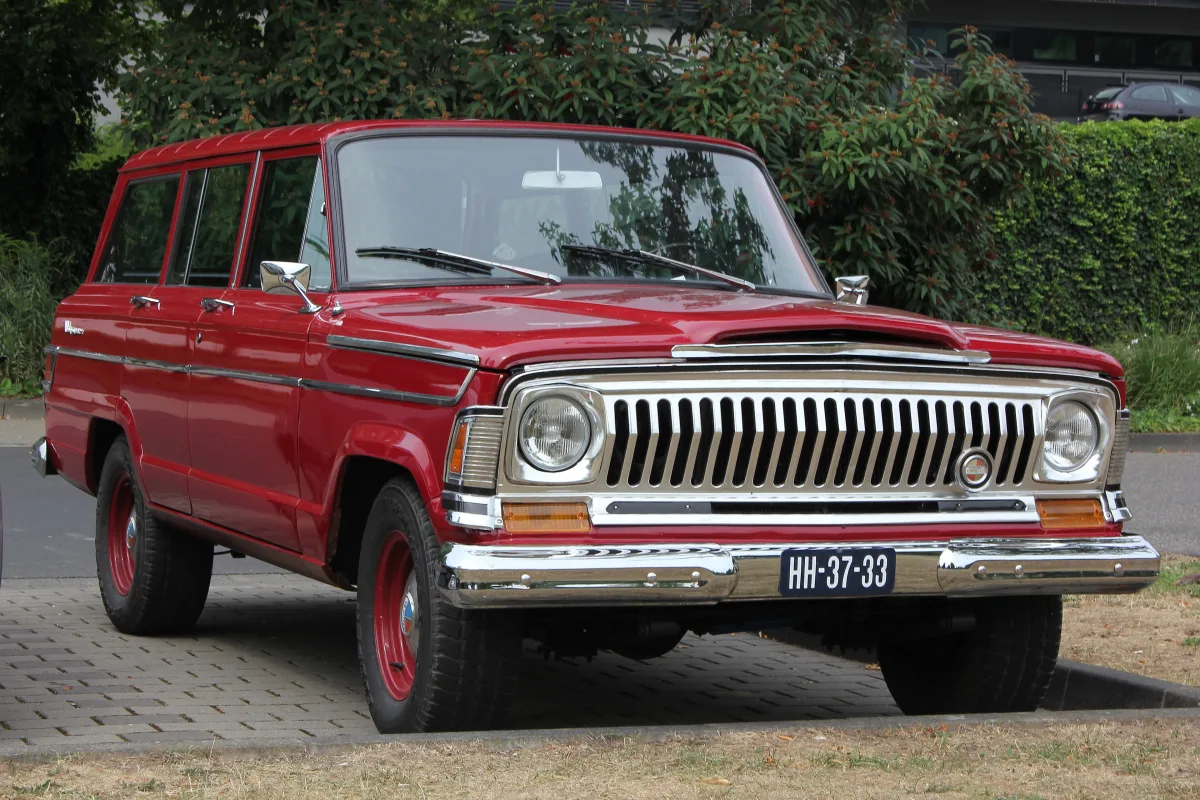
Jeep Wagoneer (SJ): generations, engines, and what to know when buying
Jeep Wagoneer (1963–1991) — a large SUV with a separate chassis, considered one of the first luxury SUVs. We look at the generations, engines, and what to check when buying this classic car in Lithuania.






Wagoneer in brief
The first Wagoneer was introduced in November 1962 as a 1963 model and replaced the 'Willys Jeep Station Wagon' produced since 1946. It's a large, body-on-frame SUV with architecture shared with the 'Gladiator' pickup. Initially, rear-wheel drive was available, but four-wheel drive soon became standard.
The SJ body changed very little over nearly 29 model years: it was produced from 1963 to 1991. Initially built by 'Kaiser Motors' (until 1971), then by 'American Motors' (1971–1987), and from 1987 by 'Chrysler'. This car is considered one of the pioneers of luxury SUVs.
Which generation to choose
1963–1971 'Kaiser' era cars — with simpler technology and earlier engines. During this period, the particularly luxurious 'Super Wagoneer' (1966–1969) also appeared. These are the earliest and most sought-after Wagoneers among collectors.
The 1971–1987 'AMC' era brought more powerful V8 engines and an improved four-wheel drive system, and from 1973, the permanent four-wheel drive system 'Quadra-Trac'. Due to high demand, 'AMC' and 'Chrysler' continued SJ production until 1991, even though the smaller 'XJ' Wagoneer had already been created.
From 1984, the SJ was offered as a more luxurious 'Grand Wagoneer' with woodgrain-style side panels and better trim.
Engines and transmissions
Early Wagoneers came with a 3.8-litre inline six-cylinder 'Tornado' engine with an overhead valve train. From 1965, the 'Buick' V6 (225 cubic inches) appeared, and later AMC six-cylinder and V8 engines were used (e.g., the 5.9-litre 360 and 6.6-litre 401 V8).
The Wagoneer was one of the first four-wheel-drive SUVs to offer an automatic transmission. Additionally, a three-speed manual gearbox was available. The 1973 'Quadra-Trac' constantly drove all wheels, so there was no need to manually switch the differential.
What to check when buying a used Wagoneer
First, inspect the body and frame: look for rust, the floor, undersides of the rear fenders, the boot lid, and the undersides of the doors. For the Grand Wagoneer, check the woodgrain panels—they might warp, peel, or come loose.
Check the engine cooling system and oil leaks, the automatic transmission, transfer case (if there's a 'Quadra-Trac', check its condition), and the differentials. The steering mechanism should have minimal play, and the brakes should operate smoothly.
The supply of mechanical parts is usually sufficient, as the technology was used in other 'AMC' or 'Jeep' models, but body, chrome, and interior parts may need to be sourced from abroad. Most of these cars are imported from the USA or Germany, so check the documents and history in advance.


Versions and eras
Names and equipment vary by year; we list the main Wagoneer versions.
Wagoneer
1963–1991The base SJ model.
- Body-on-frame construction
- Often — four-wheel drive
- Engine choices by year: from six-cylinder to V8
Super Wagoneer
1966–1969A particularly luxurious and powerful version.
- V8 engine
- More luxurious trim and greater comfort features
- A rare model, prized by collectors
Wagoneer Limited
1978–1983The upscale SJ version.
- Better interior trim
- V8 engine
- Often — woodgrain-style side panels
Grand Wagoneer
1984–1991The top-of-the-range SJ model.
- Wood-effect side panels
- 5.9-litre (360) V8 engine
- Luxurious interior trim
Model comparison
| Wagoneer | Super Wagoneer | Grand Wagoneer | |
|---|---|---|---|
| Who it's for | The classic off-roader | For collectors | The luxury retro car |
| Year | 1963–1991 | 1966–1969 | 1984–1991 |
| Engine | Six-cylinder or V8 | V8 | 5.9-litre V8 |
| Interior | Base | Luxury | Wood imitation and luxury interior |
| Price in the used market (relatively) | €€ | €€€ | €€€ |
Most buyers will find the well-preserved Wagoneer or Grand Wagoneer appealing. The 'Super Wagoneer' is strictly for collectors, as there are very few around and they command high prices.
Pros
- A long-lasting, uniquely styled classic SUV
- Spacious and robust four-wheel-drive vehicle
- Many mechanical parts are shared with other 'AMC' and 'Jeep' models
- Luxury Grand Wagoneer versions
Cons
- Rust and hard-to-find body and interior parts
- High fuel consumption
- Old safety systems, and the wood imitation panels may be worn
Frequently asked questions
Is the Wagoneer the same as the Grand Wagoneer?
The SJ Wagoneer from 1984 onwards was also offered as the more luxurious 'Grand Wagoneer' with woodgrain-style panels and better trim. The main body and mechanics remained the same.
How many years was the SJ Wagoneer produced?
Around 29 model years — from 1963 to 1991. During that time, the body changed very little.
Is the Wagoneer suitable for daily driving?
Technically, yes, but it's an old car with high fuel consumption. It's often used for seasonal driving and shows.
Updated 2026-10-21 · Trim levels and equipment vary by market and model year — check the equipment of the specific car. · Translated automatically


