 English
 Lietuvių
 Latviešu
 Eesti
 Polski
 Русский
 Українська
 Deutsch
 Nederlands
 Čeština
 Slovenčina
 Svenska
 Norsk
 Dansk
 Suomi


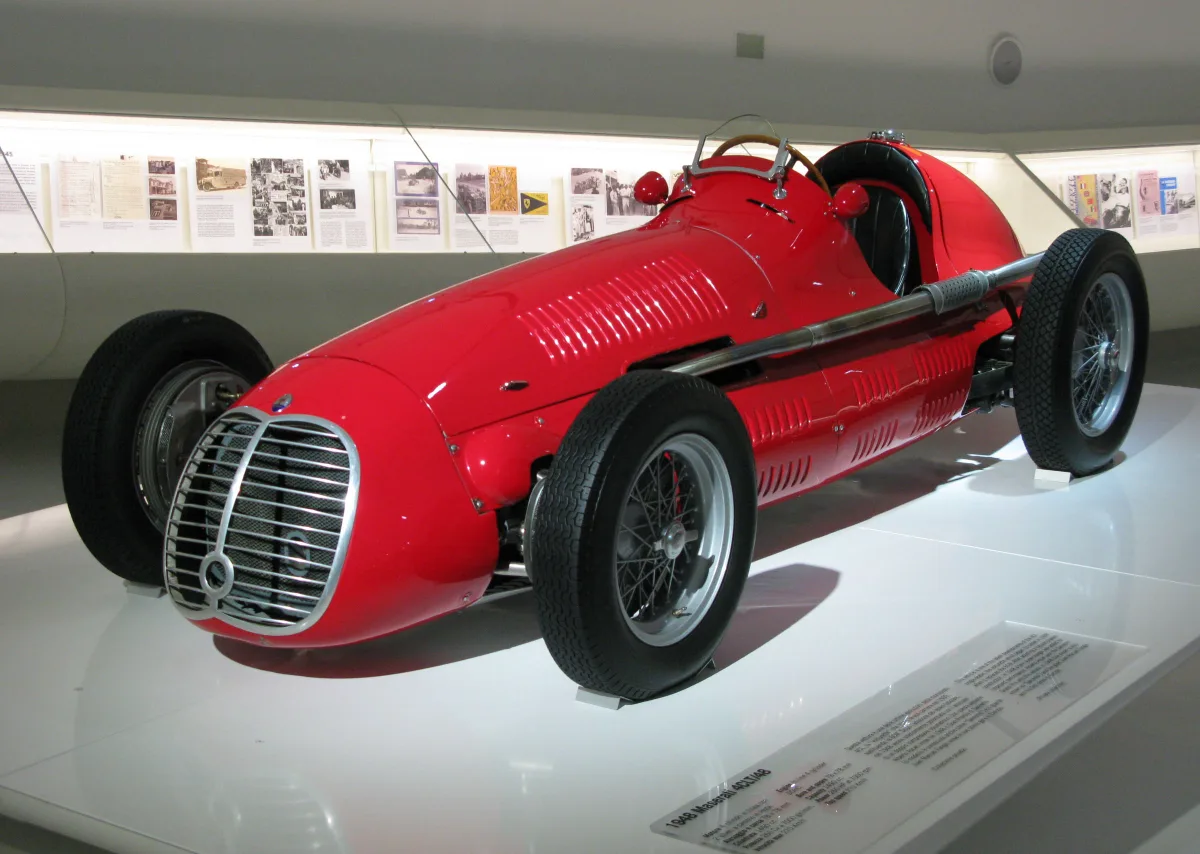
Maserati 4CLT: post-war Grand Prix race car
The Maserati 4CLT is a 1.5-litre Grand Prix race car with a supercharger that debuted in 1947 and became one of the most significant post-war Maserati models. We look at its origins, technology, significance, and where you can see such cars today.






4CLT in brief
The Maserati 4CLT is a single-seater race car designed to meet the Grand Prix regulations of its time, which allowed 1.5-litre engines with superchargers or 4.5-litre naturally aspirated engines. It was one of the most popular small-displacement Grand Prix cars among factory and privateer teams.
The letter T in the name usually stands for 'tubolare' — a tubular frame, which distinguished the new car from the earlier 4CL.
History and development
The 4CLT is an improved version of the earlier 4CL, which was introduced in 1939. The Second World War interrupted racing, and when it resumed in 1947, Maserati offered an enhanced car that complied with the new post-war regulations.
In 1948, the 4CLT/48 version, known as the 'San Remo,' was introduced — a name linked to the San Remo Grand Prix races of that year, in which this model performed exceptionally well.
Technology
The car was powered by a 1.5-litre four-cylinder engine with a supercharger (two-stage in later versions); its output exceeded 200 hp. Such power from a small-displacement engine was remarkable at the time.
The lightweight tubular frame made the car highly manoeuvrable, and the distinctive oval-shaped grille at the front is a hallmark of its design.
Significance and where to see it
The 4CLT was raced by notable drivers of the time, including Luigi Villoresi, Alberto Ascari, and Juan Manuel Fangio. The car helped Maserati stay in the Grand Prix racing scene in the post-war years.
Surviving 4CLTs often appear in museums and historic racing events, such as Goodwood. Individual examples occasionally surface in the collector's market, but these are very rare cars.


Versions
Key milestones in the evolution of the 4CL and 4CLT.
4CL
1939The earlier 1.5-litre Maserati Grand Prix car.
- Four-cylinder supercharged engine
- Often the earlier design
- Predecessor to the 4CLT
4CLT
1947Post-war version with a tubular frame.
- Tubular frame
- Supercharged 1.5-litre engine
- Also sold to private teams
4CLT/48 „San Remo“
1948An enhanced version, named after the Sanremo races.
- Often — a two-stage supercharger
- More power than previous versions
- Used in the early Formula 1 seasons
The 4CLT and its post-war rivals
| Maserati 4CLT/48 | Alfa Romeo 158 | Talbot-Lago T26C | Ferrari 125 F1 | |
|---|---|---|---|---|
| Engine | 1.5-litre, 4-cylinder, supercharged | 1.5-litre, 8-cylinder, supercharged | 4.5-litre, 6-cylinder, naturally aspirated | 1.5-litre, V12, supercharged |
| Time of introduction | 1948 | 1938 (also used post-war) | 1948 | 1948 |
| What sets it apart | Bought and run by private teams | Competed in early Formula 1 seasons | Economical — less frequent refuelling stops | The first Ferrari Grand Prix car |
The 4CLT wasn't the most powerful, but it was accessible to private teams — that's why you can see it in many post-war racing starting grids.
Pros
- A significant part of Maserati's post-war history
- Advanced construction for its time
- Used by famous drivers
- A beautiful, recognisable design
Cons
- A very rare car
- Requires specialist maintenance
- Unsafe and not suited to daily use
Frequently asked questions
Can you buy a Maserati 4CLT?
Individual cars occasionally appear in collectors' markets, but there are very few of them and they are expensive. They usually belong to museums or private collectors.
What do the letters 4CLT stand for?
The number 4 indicates four cylinders, C stands for Corsa (racing), and T is usually associated with a tubular frame (tubolare). Other letters have varying explanations in different sources.
Did the 4CLT compete in Formula 1?
Yes, this model was used by some privateer teams during the early seasons of the Formula 1 World Championship.
Updated 2026-10-21 · Trim levels and equipment vary by market and model year — check the equipment of the specific car. · Translated automatically


