 English
 Lietuvių
 Latviešu
 Eesti
 Polski
 Русский
 Українська
 Deutsch
 Nederlands
 Čeština
 Slovenčina
 Svenska
 Norsk
 Dansk
 Suomi


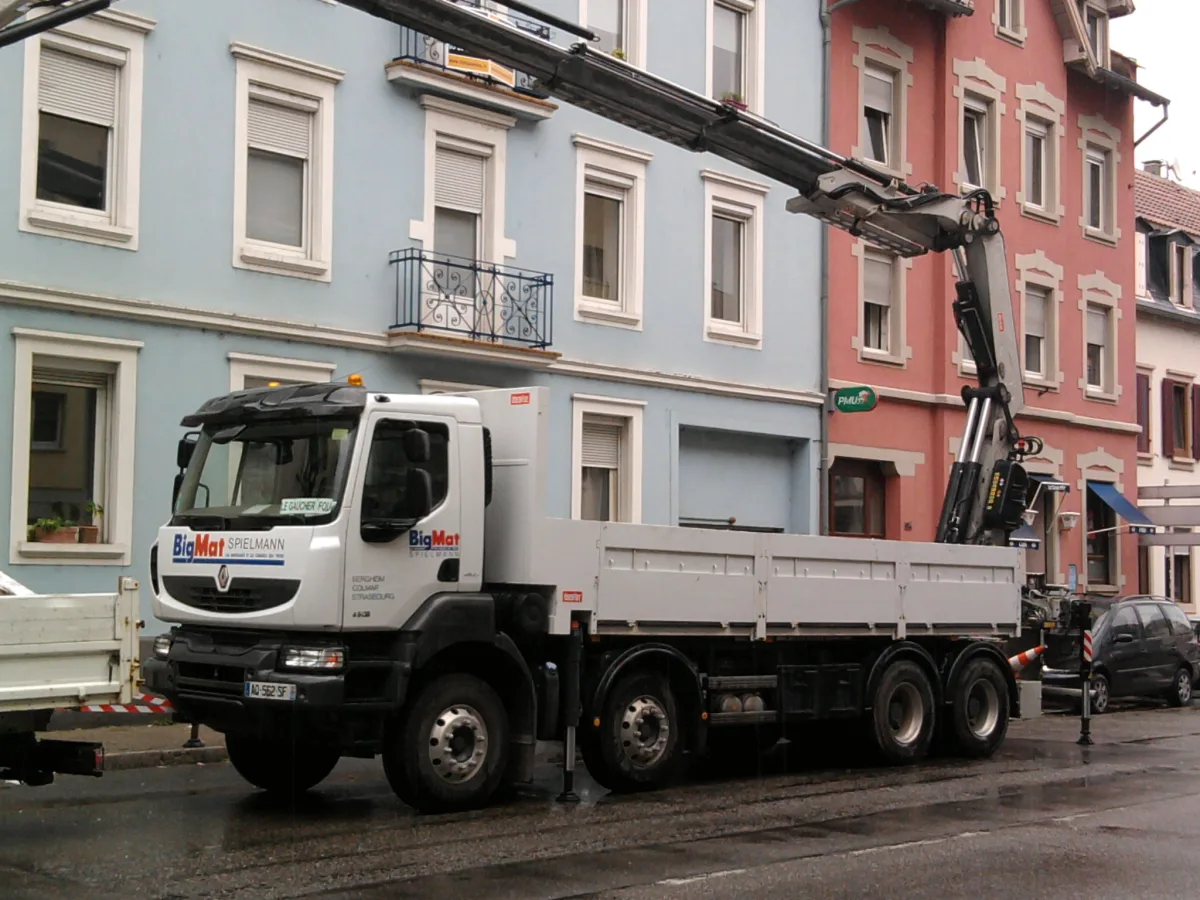
Renault Kerax: generations, engines and what to check
The Renault Kerax is a heavy-duty truck produced from 1997 to 2013, designed for tough work on construction sites, quarries, and building yards. We look at its versions, axle configurations, engines, and what to check when buying a used Kerax.






Kerax in brief
The Kerax is Renault Trucks' heavy-duty workhorse, built on a reinforced chassis. Common axle configurations include 4x2, 6x4, and 8x4, with all-wheel drive options like 4x4, 6x6, and 8x8. These trucks are fitted with concrete mixers, cranes, and specialist bodies.
The Kerax is built for hard work, so many have seen plenty of action. When buying, focus on the condition of the chassis, suspension, and hydraulics rather than just the price.
Generations — what's the difference?
Early Kerax models (around 1997–2005) are more basic, with older engine designs and Euro 2 or Euro 3 emissions standards. They're cheaper but often heavily worn.
Later Kerax models (around 2005–2013) feature 'dCi' and 'DXi' engines meeting Euro 3–Euro 5 standards, a more modern cabin, and newer equipment. These trucks are more economical but have more complex exhaust systems.
In 2013, the Kerax was replaced by the Renault Trucks K series, so you won't find any newer than 2013.
Engines and gearboxes
Kerax engines are six-cylinder turbodiesels. Common choices are the 'dCi 11' and 'DXi 11' (around 10.8 litres), with more powerful versions featuring the 'DXi 13' (around 12.8 litres); power ranges from roughly 300 to 520 hp. For instance, the Kerax 520 boasts around 520 hp.
Transmissions come in manual, automated 'Optidriver', or full automatic (especially in concrete mixers). Automated boxes should be tested while driving, particularly under load.
Before buying, ask for the specific engine code and Euro class of the car, as these determine the availability of parts and permitted zones of operation.
What to check when buying a used Kerax
First off — the frame, axles, and suspension. Structural vehicles often have frame cracks, welds, and deformations, especially after a rollover or crane use. Check all axle bearings and brakes.
Inspect the engine, transmission, and differential seals. In newer vehicles, assess the DPF and SCR systems, and hydraulic units for crane, rollover, or concrete mixer operation.
Check the hours and service history via the tachograph data. Pay attention to the gross vehicle weight and axle load limits specified in the documents.


Versions and bodies
Names and equipment vary by year; we list the most commonly encountered Kerax versions.
Savivartis 6x4
All seriesThe most common construction version.
- Often — a steel or aluminium body
- Reinforced frame
- High-mileage chassis
Savivartis 8x4
Common heavy-duty versionsGreater load capacity and stability.
- Additional axle
- Often comes with a goods loading platform
- Higher maintenance costs
Betono maišyklė
Frequent special editionWith a concrete mixer on a 6x4 or 8x4 chassis.
- Often comes with an automatic gearbox
- Condition of special equipment is crucial
- Often plenty of mileage
Su kranu
Frequent construction versionWith a hydraulic crane for loading cargo.
- Additional hydraulic units
- Condition of the crane determines value
- Often comes with a reinforced frame
Kerax 4x4 / 6x6 / 8x8
Less common versionsFour-wheel drive versions are rare.
- More headroom
- Often — diff locks
- Higher maintenance costs
Kerax version comparison
| Savivartis 6x4 | Savivartis 8x4 | Su kranu | Visų ratų pavara | |
|---|---|---|---|---|
| Who it's for | For construction and quarry work | For heavier loads | For loading cargo | Cab |
| Axle configuration | 6x4 | 8x4 | Often 6x4 or 8x4 | 4x4, 6x6 or 8x8 |
| Most important to check | Frame and hydraulics | Frame and axles | Crane and hydraulics | Transmission and locks |
| Price in the used market (relatively) | Mid-range | High-end | High-end | High-end |
For construction work, the later Kerax with a solid frame and proven hydraulics is usually the best choice. Opt for all-wheel drive only if you really need to go off-road, as maintenance is more expensive.
Pros
- Robust construction for building work
- Various axle configurations and cabs
- Powerful engines
- Wide Renault Trucks service network
Cons
- Many vehicles have been heavily used
- Repairing Euro 4/5 emission systems is costly
- Signs of heavy use — frame damage and corrosion
Frequently asked questions
What does the number in the Kerax name mean?
The number indicates the approximate engine power in horsepower, for example, Kerax 520 — around 520 HP. The axle formula and other specifications are also listed.
What category of license is required to drive a Kerax?
Rigid trucks and other heavy-duty vehicles require a C category license, and for operating in the freight transport business, a professional qualification is also needed. A tractor unit with a semi-trailer requires a CE category license.
Which Kerax series should you choose?
If you'll be working in cities with low-emission zones, it's worth choosing a later series with a newer engine. Earlier Kerax models are cheaper and simpler, so they might be suitable for local construction work, provided their chassis and engine are in good condition.
Updated 2026-10-21 · Trim levels and equipment vary by market and model year — check the equipment of the specific car. · Translated automatically


