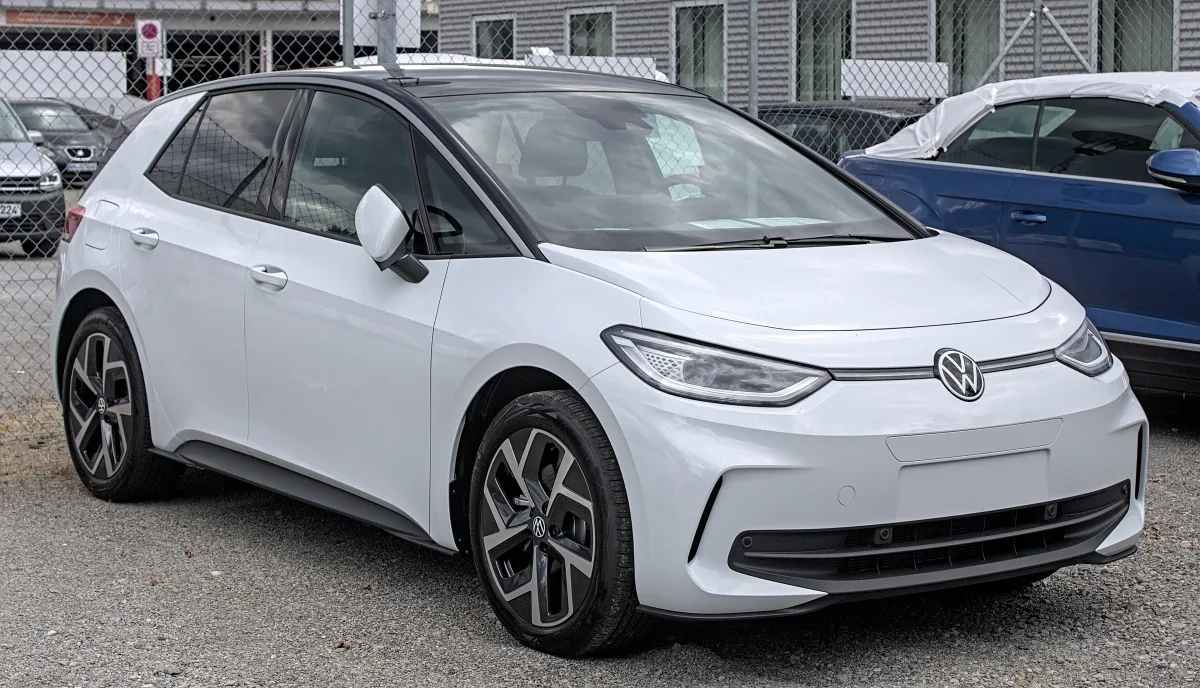
The Volkswagen ID.3 is an electric compact hatchback that has been on sale since 2020 and has become one of Volkswagen's most popular electric vehicles in Europe. We look at how the batteries and versions differ, what equipment is on offer and what to check when buying a used ID.3.
ADVERTISEMENT
ID.3 in brief
The ID.3 is built on the MEB electric vehicle platform, so it has a short front end and a long wheelbase – the interior is more spacious than you might expect from a compact hatchback. In terms of size, it's similar to the Golf, but the interior space is larger.
The car is powered by the rear wheels, and the instrument cluster and multimedia system are controlled by screens and touch-sensitive controls.
Versions – what's the difference?
The first version was launched in 2020, and it was updated in 2023: the design was changed, the interior and software were improved, and in some versions, the batteries and engines were updated.
In the used market, it's worth distinguishing between the early cars (when the software was criticised) and the updated ones, which got a better system. There's also a sporty GTX version on offer.
Engine, battery and charging
The ID.3 is offered with three battery sizes – roughly from 45–59 up to 77 kWh. The larger battery provides a greater range: according to WLTP, the largest versions achieve around 550 km.
Power ranges from roughly 150 to 230 hp, and the sporty GTX version reaches around 326 hp. There's no gearbox – the electric vehicle has a single gear.
The car supports DC fast charging, although the charging speed varies depending on the battery.
What to check when buying a used ID.3
Request a battery condition report and check if the manufacturer's warranty is still valid. Test AC and DC charging.
Check the multimedia system and touch controls to ensure the software is up to date. Early models were criticised for glitches.
Inspect the bodywork, wheels, and brakes, as well as whether all charging cables are included.
ADVERTISEMENT
Trim levels
Names and equipment vary by market and year; we list the most common trims found in Europe.
Life
from 2020
Base trim.
Often — light-alloy wheels
Digital driver's display
Often — basic driver assistance systems
Business
from 2020
More comfort for business customers.
Often — navigation
Often — heated seats
Often — additional driver assistance systems
Style
from 2020
A more elegant version.
Often — larger wheels
Often — LED headlights
Often — enhanced interior trim
Max
from 2020
Top-of-the-range trim.
Often — the largest wheels
Often — additional comfort features
Often — full suite of driver assistance systems
GTX
From 2024
Sporty version.
Around 326 hp
Sporty styling and wheels
Often — sport seats
Trim comparison
Life
Style
Max
GTX
Who it's for
For daily driving
For comfort
For maximum equipment
For dynamics
Most common wheels
18 inch
18–19 inch
19–20 inch
20 inch
Front headlights
LED
LED
Matrix LED
Matrix LED
Price in the used market (relatively)
Mid-range
Mid-range
High-end
High-end
Most buyers will be happy with the Style trim with a mid-sized or larger battery. The GTX is worth considering for its dynamics alone.
Pros
Spacious interior for its size
Quiet and smooth electric driving
Wide range of battery options
Tight turning circle in the city
Cons
Early software in these cars was criticized
Sensitive controls aren't to everyone's liking
Real-world range in winter is significantly lower
Frequently asked questions
Which battery to choose?
A smaller battery is fine for city driving, but for longer distances, it's worth choosing a larger one. This depends on your daily mileage and the ability to charge daily.
Is the ID.3 reliable?
Mechanically it's simple, but early cars had software issues that were often resolved with updates.
Is the ID.3 rear-wheel drive?
Yes, the ID.3 has rear-wheel drive, making the handling more engaging and the turning circle smaller.
Updated 2026-10-17 · Trim levels and equipment vary by market and model year — check the equipment of the specific car. · Translated automatically
Comments
No comments about the Volkswagen ID.3 yet. Share your experience.
We use necessary cookies to run the website. With your consent, we will also use analytics and advertising measurement cookies — to understand how the website is used and to measure our advertising results. Learn more
 English
 Lietuvių
 Latviešu
 Eesti
 Polski
 Русский
 Українська
 Deutsch
 Nederlands
 Čeština
 Slovenčina
 Svenska
 Norsk
 Dansk
 Suomi


 4