 English
 Lietuvių
 Latviešu
 Eesti
 Polski
 Русский
 Українська
 Deutsch
 Nederlands
 Čeština
 Slovenčina
 Svenska
 Norsk
 Dansk
 Suomi


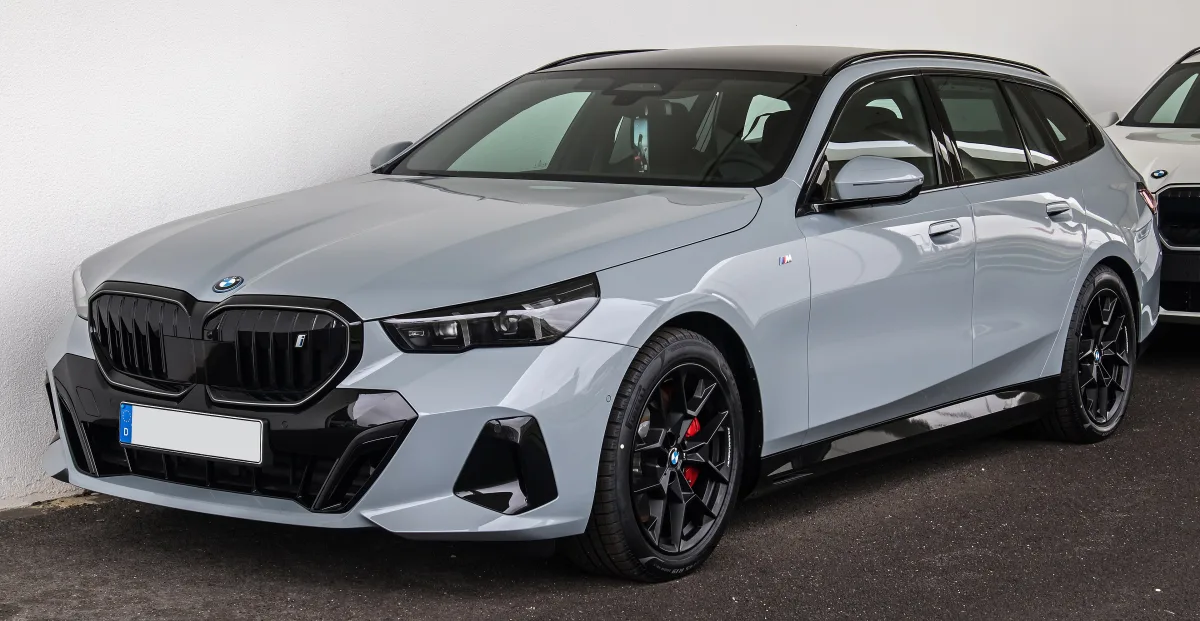
BMW i5 (G60/G61): generations, battery, charging and trims
BMW i5 — the all-electric eighth-generation 5 Series, available as a saloon (G60) and an estate — i5 Touring (G61). We look at how the eDrive40, xDrive40 and M60 xDrive differ, how much range you can realistically expect in winter, how to charge the battery and what to check when buying a used i5.






BMW i5 in brief
The i5 goes on sale from the end of 2023, with the estate i5 Touring following in 2024. The electric version doesn’t have a dedicated body: it’s built in Dingolfing alongside petrol, diesel and plug-in hybrid 5 Series cars and looks almost identical from the outside.
Buyers praise the i5 for its incredibly quiet cabin, comfortable ride and modern kit. Downsides include a slightly smaller boot (around 490 litres) in the saloon due to the battery under the floor, and the car’s considerable weight.
Generations and bodies — what’s the difference
Initially, two versions were offered: the eDrive40 with a single rear motor and the M60 xDrive with two motors and four-wheel drive. In 2024, the xDrive40 arrived — a two-motor version that sits between the other two in terms of power and price.
The i5 Touring (G61) is more practical: it has a larger boot, and with the rear seats folded flat, it becomes very spacious. Technically, the versions are the same as the saloon, but the Touring typically offers slightly less range due to its shape and weight.
Since the model is new, used examples in the market are mostly 2024–2025 cars, often coming from leasing agreements or company fleets. Electric vehicle values often drop faster in their first year than petrol or diesel models, so a used i5 could be significantly cheaper than a new one.
Battery, range and charging
All i5 variants come with around an 81 kWh usable battery. The eDrive40 (around 340 hp, rear-wheel drive) is rated by the manufacturer (WLTP) to cover around 500–580 km, while the xDrive40 (around 394 hp) and M60 xDrive (up to roughly 600 hp) cover less.
In reality, especially on the motorway, the range is often lower, and in winter you might see around 20–30% less than in summer, even more so on short journeys. The heat pump helps, but on cold mornings energy is used to heat the cabin and battery.
The i5 charges via a CCS2 connector: with alternating current up to 11 kW (with additional equipment up to 22 kW), and at rapid charging stations up to around 205 kW. Maximum power is only achieved when the battery is warm and not too full, so it’s worth using the navigation system’s battery pre-conditioning before a long journey.
What to check when buying a used BMW i5
The most important thing is the battery’s condition. Ask a BMW service centre or diagnostic specialist for a battery health (SoH) report and find out how often rapid charging has been used. During a test drive, observe how the charge percentage drops and test charging both with alternating current and at a rapid charging station.
Check which features come with the car for good: some BMW features can be activated as a subscription, so the equipment listed in the ad doesn't always mean it will work after purchase. Ensure that the software is updated and all assist systems are operational.
Inspect the tyres and brakes — a heavy car will wear out tyres faster, and rarely used brake discs can rust. If the car has air suspension, check that it doesn't sag when parked. Verify the history using the VIN, and have high-stress systems checked by a service after an incident.


Versions and Packages
The BMW i5 differs mainly in versions (engines and gearboxes), body style, and equipment packages; we list the versions most commonly found in Europe.
eDrive40
From 2023The most popular version with the longest range.
- One rear electric motor, around 340 hp
- The longest range for the i5
- Often — M Sport package
xDrive40
From 2024All-wheel drive without the M60 price tag.
- Two electric motors, around 394 hp
- Better grip in winter and on slippery surfaces
- Slightly shorter range than the eDrive40
M60 xDrive
From 2023The most powerful i5 version.
- Two electric powertrains, up to around 600 hp
- Often — adaptive suspension and larger wheels
- The shortest driving range
i5 Touring
From 2024Versatile with a larger boot.
- Available with eDrive40, xDrive40 and M60 xDrive versions
- Larger boot and more convenient loading
- Often — rear air suspension
M Sport / M Sport Pro
All year roundSporty styling packages.
- M Sport bumpers, wheels and sport seats
- M Sport Pro — dark exterior details and sport brakes
- Often — illuminated kidney grilles
Comparison of BMW i5 versions
| eDrive40 | xDrive40 | M60 xDrive | |
|---|---|---|---|
| Who it suits | For long journeys | Winters and slippery roads | For driving comfort |
| Powered wheels | Rear | All | All |
| Wheel sizes (most common) | 19–20 inch | 19–20 inch | 20–21 inch |
| Mileage (relatively) | Highest | High | Lower |
| Price in the used market (relatively) | Budget | Mid-range | €€€ |
Many buyers' top choice is the eDrive40: it offers the longest range and ample power. The xDrive40 is worth considering for its all-wheel drive, while the M60 xDrive is only if performance is paramount.
Pros
- The cabin is remarkably quiet and comfortable
- Modern driver-assistance systems
- You can also opt for an estate (Touring)
- Good range and reasonably quick charging
Cons
- Its hefty weight means tyres wear out faster
- The sedan's boot is smaller than that of the petrol 5 Series
- Some features may require a subscription
Frequently asked questions
How far does a BMW i5 really go in winter?
This depends on the version, speed, and air temperature. In cold weather, you often need to count on 20–30% less range than in summer, and even less when driving short distances with the heating on. The eDrive40 sedan typically covers the most miles in winter.
Which to choose: eDrive40 or xDrive40?
The eDrive40 offers the longest range and is cheaper, and with good winter tyres, it usually suffices in Lithuania. The xDrive40 is worth considering if you often drive on slippery or unpaved roads or tow a trailer.
How to check the condition of a used i5 battery?
The most reliable method is a battery health (SoH) report from a BMW service centre or diagnostic specialist. Additionally, charge the car to 100% and compare the displayed range with the new car's data, and inquire about the use of fast charging.
How does the i5 differ from the standard 5 Series?
The body, interior and a large portion of the equipment are shared, but the i5 is electric and has a battery under the floor. As a result, it's heavier and has a slightly smaller boot, but it drives more quietly and accelerates faster.
Updated 2026-10-09 · Trim levels and equipment vary by market and model year — check the equipment of the specific car. · Translated automatically


