 English
 Lietuvių
 Latviešu
 Eesti
 Polski
 Русский
 Українська
 Deutsch
 Nederlands
 Čeština
 Slovenčina
 Svenska
 Norsk
 Dansk
 Suomi


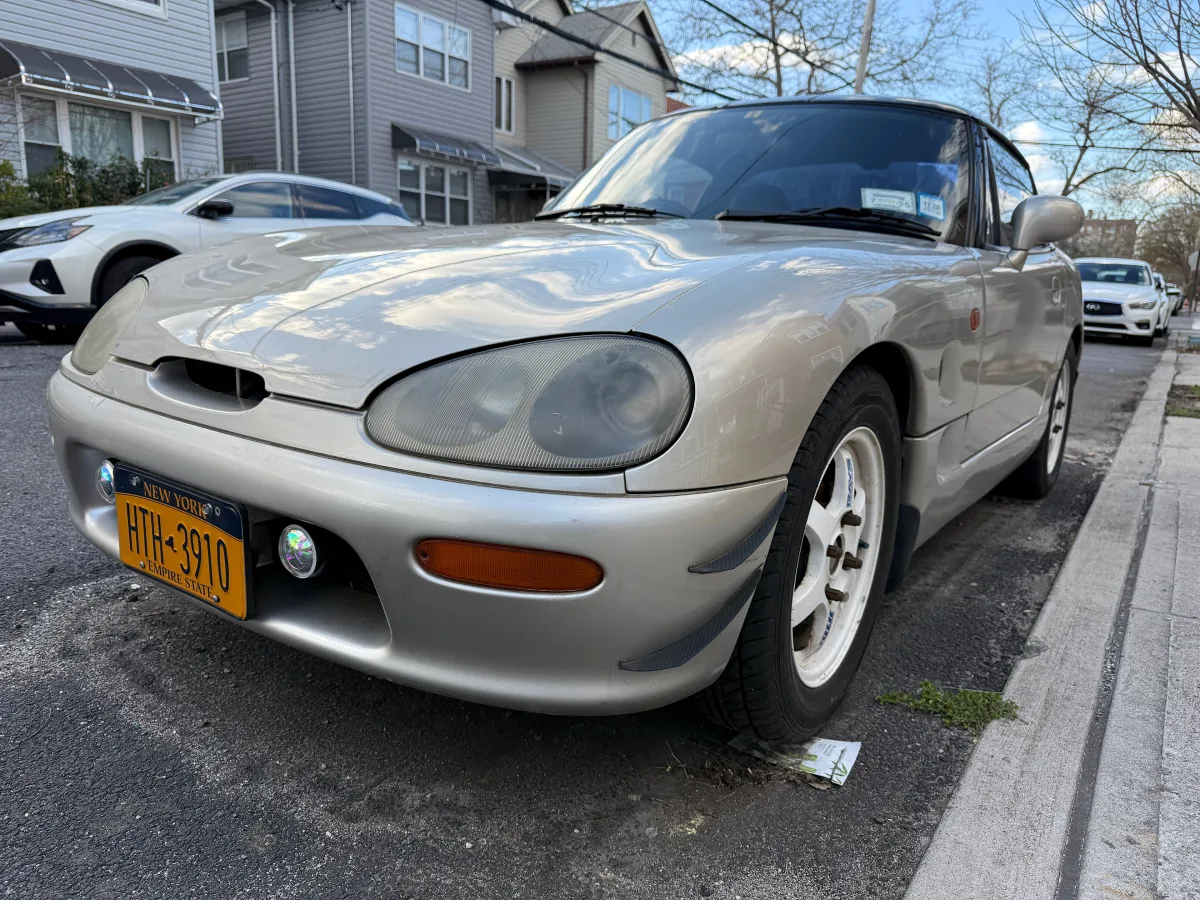
Suzuki Cappuccino (1991–1998): a small turbo roadster
The Suzuki Cappuccino is a Japanese 'kei' class roadster with a turbo engine, produced from 1991 to 1998. In this article, we look at its history, technology, and what you need to know if you're considering buying this rare small convertible.






The Cappuccino in brief
The Cappuccino is a two-seater roadster designed to meet Japanese 'kei' class requirements. It's very small and light, with the engine mounted at the front, making it rear-wheel drive.
The roof is made up of several removable parts: you can drive with a closed coupe, an open roof, or as a full convertible. This creates a lot of versatility in a small car.
Versions
During its production run, the Cappuccino was updated: the second series got an improved engine, and some versions offered an automatic transmission.
Since the Cappuccino was barely sold officially in Europe, most cars were imported from Japan. This means that documentation and provenance are very important.
Engine and transmission
The Cappuccino has a roughly 0.66-litre three-cylinder turbo petrol engine with an intercooler. The 'kei' class limit is around 64 hp, but due to its light weight (around 700 kg) it drives enthusiastically.
The transmission is usually a 5-speed manual, with an automatic option in some versions. It's rear-wheel drive, and the suspension is designed to be fun and precise.
What to check if you're considering buying one
First, inspect the body for rust — check the sills, undersides of the wings, floor, and engine bay. Open-top cars may also have moisture marks in the cabin.
Check the turbo, intercooler, and engine condition: turbo engines don't like neglect. Listen for noises, check the cooling system, and oil level.
For a car imported from Japan, check the mileage and history, and whether it's suitable for registration in Lithuania. Roof parts should fit securely.


Trim levels
Names and equipment vary by market and year; we list the versions most commonly found in Europe.
Cappuccino
1991–1998The sole main version with a turbo engine.
- Approximately 0.66-litre turbo engine
- Removable roof
- Rear-wheel drive
Comparison of Cappuccino roof variants
| Uždarytas stogas | Targa | Pilnas kabrioletas | |
|---|---|---|---|
| Who it's for | For cold weather and motorway driving | For semi-open-top driving | For warm weather and comfort |
| Comfort | Largest | Average | Least wind protection |
| Price in the used market (relatively) | €€ | €€ | €€ |
The Cappuccino is loved for its versatility and ease of use. Before buying, make sure the roof parts are in good condition and the turbo engine is well-maintained.
Pros
- Very light and fun
- Versatile removable roof
- Rear-wheel drive
- A rare and unique car
Cons
- Very few available in Lithuania
- Weak boot and cramped interior
- Finding parts might take time
Frequently asked questions
What engine does the Suzuki Cappuccino have?
Approximately a 0.66-litre three-cylinder turbo petrol engine.
Does the Cappuccino have a removable roof?
Yes, the roof is made up of several removable parts, so you can drive it as a coupé, with an open roof, or as a convertible.
Is the Cappuccino suitable for daily use?
It's fine for city driving and warm weather, but due to the small boot and two seats, it's often more of a fun car.
Updated 2026-10-19 · Trim levels and equipment vary by market and model year — check the equipment of the specific car. · Translated automatically


