 English
 Lietuvių
 Latviešu
 Eesti
 Polski
 Русский
 Українська
 Deutsch
 Nederlands
 Čeština
 Slovenčina
 Svenska
 Norsk
 Dansk
 Suomi


Toyota Cressida: four generations, engines, and what to know when buying a classic
The Toyota Cressida is a rear-wheel-drive mid-size car sold in export markets from 1976 to 1992 (known as the Mark II in Japan). This article covers the four generations, engines, and what to check if you come across one in the used market.






Cressida in brief
The Cressida is the export name for the Toyota Corona Mark II and later Mark II. The Cressida name was used in export markets from 1976 to 1992 across four generations. The car was always rear-wheel-drive and, in Japan, one of Toyota's more luxurious offerings.
There were several body styles: sedan, hardtop, and estate. The Cressida is quite rare in Lithuania, usually appearing as a collector's item or an import from other countries.
Generations — what's the difference
The first Cressida (X30, X40; 1976) had a more European look with a British-style front. The second (X60; 1980) was more angular, and the coupe body style was discontinued — replaced by the Soarer. These cars are often referred to as Cressida GL, XL, or Grande — check the specific trim for exact features.
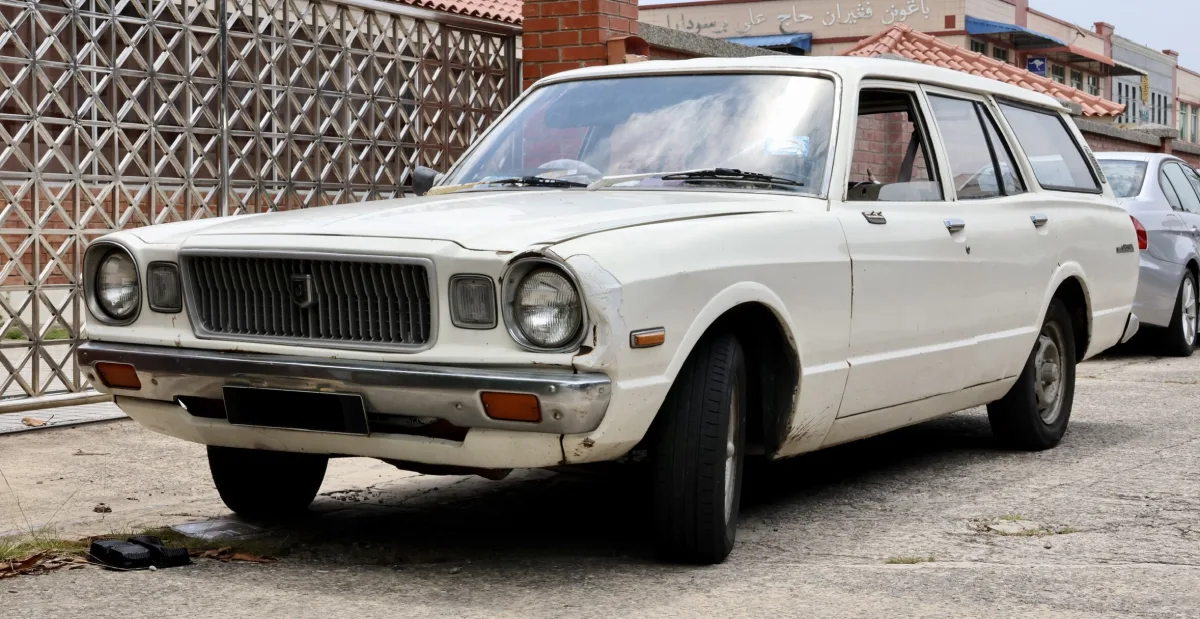
Later generations (X70 and X80) were even more luxurious, with more comfort features. The estate car shown in the photo is an example of the first generation (X30).
Engines and transmissions
The Cressida came with four-cylinder and inline six-cylinder petrol engines. The second-generation (X60) Mark II line-up included 1G and M series six-cylinder engines, the 2.8-litre 5M-EU with around 145hp, as well as the 18R-G twin-carb variant; export market offerings varied.
The gearbox was manual or automatic (later electronically controlled four-speed). Check specific details against the car's documentation.
What to check when buying a Cressida
These cars are old, so the body condition is key: check for rust, arches, the floor, and the boot floor. Pay special attention to door and window mechanisms and the interior trim, as parts can be hard to find.
Check the engine, cooling, gearbox, rear axle, and brakes. Parts, especially for the body and interior, are almost non-existent in Lithuania, so consider availability before buying.


Trim levels
Trim names and equipment vary by market and year; commonly mentioned are GL, XL, and Grande.
Grande
Top-of-the-range trimThe top-tier version with more comfort features.
- Often — leather or velour interior trim
- Often — electric windows and air conditioning
- More powerful six-cylinder engine
Generation comparison
| X30 (1976) | X60 (1980) | |
|---|---|---|
| Body styles | Saloon, hardtop, estate | Saloon, hardtop, estate |
| Style | A more European, British-style front end | A more angular, modern look |
| Who it's for | For classic car enthusiasts | For those who need more modern features |
| Price in the used market (relatively) | Mid-range | Mid-range |
Both generations suit classic car enthusiasts. The key is the condition of the body and the availability of parts.
Pros
- Rear-wheel drive and classic driving experience
- Solid Toyota build quality
- Spacious interior
- A rare classic car
Cons
- Finding parts in Lithuania is very challenging
- Risk of corrosion due to age
- High fuel consumption
Frequently asked questions
How does the Cressida differ from the Mark II?
It's the same car. Mark II is the Japanese name, while Cressida was the name used in most export markets from 1976 to 1992.
Was the Cressida always rear-wheel drive?
Yes, all generations of the Cressida were rear-wheel drive.
Is it worth buying a used Cressida?
It is, if the car is in good condition and you can find parts. It's less practical for daily use due to its age and fuel consumption.
Updated 2026-10-21 · Trim levels and equipment vary by market and model year — check the equipment of the specific car. · Translated automatically


