 English
 Lietuvių
 Latviešu
 Eesti
 Polski
 Русский
 Українська
 Deutsch
 Nederlands
 Čeština
 Slovenčina
 Svenska
 Norsk
 Dansk
 Suomi


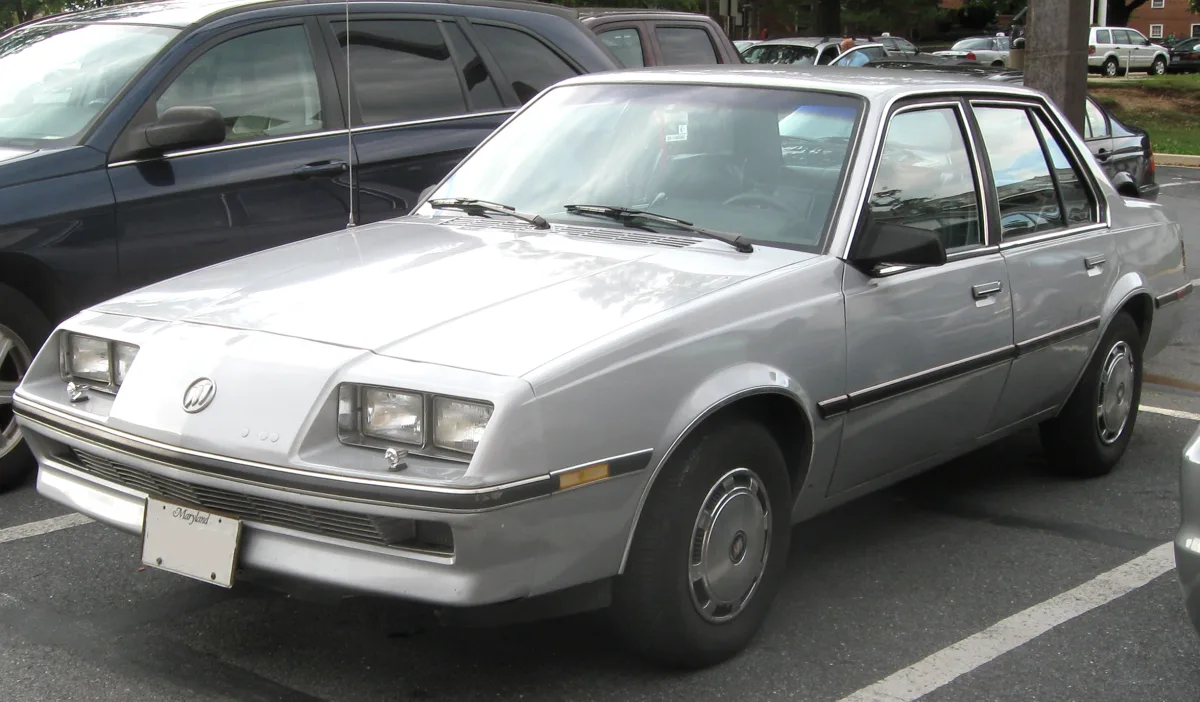
Buick Skyhawk: two generations, engines and body styles
The Buick Skyhawk is a compact car from Buick, produced in two generations: a rear-wheel-drive hatchback from 1975–1980 and a front-wheel-drive compact from 1982–1989. This article covers both generations, engines, trims, and what you need to know to buy a classic American small Buick.






Skyhawk in brief
The Skyhawk was the smallest car sold under the Buick badge for over 60 years. The first generation was a subcompact hatchback based on the Chevrolet Monza, while the second was a front-wheel-drive J-body compact, with the Chevrolet Cavalier as its sibling.
Such a car is very rare in Lithuania — it's American classic, mostly appealing to collectors and enthusiasts seeking an unusual but charming model.
Which generation to choose
First generation (1975–1980) — a rear-wheel-drive two-door hatchback that was technically based on the Chevrolet Vega. Its body resembled the Ferrari 365 GTC/4, and in 1979, it was refreshed with rectangular headlights. It always came with the Buick 3.8-litre (231 cu in) V6 engine, and a total of 125,311 units were produced.
Second generation (1982–1989) debuted at the 1982 Chicago Auto Show. It offered four body styles: a two-door sedan and hatchback, a four-door sedan, and a station wagon. Most of these cars had small four-cylinder engines, and in 1984, production peaked at 134,076 units; around 530,000 second-generation cars were made in total.
If comfort and easier maintenance are important to you, go for the second generation. If you're drawn to rarer, earlier classics, opt for the first.
Engines and transmissions
The first generation had just one engine – a 3.8-litre V6 with a dual-barrel carburettor and around 110hp; the standard box was a four-speed manual, with a three-speed automatic as an option. Later, in 1976, a five-speed manual box arrived, but it was discontinued in 1980.
The second generation offered four-cylinder engines: 1.8-litre and 2.0-litre, with power ranging from around 84 to 96hp. The turbo 'T-Type' version had a 1.8-litre turbo engine (around 150hp, 1984–1986), and in 1987, a 2.0-litre turbo engine with around 165hp. By 1989, only the 2.0-litre OHV engine with around 90hp remained.
The transmission was manual or automatic; the second-gen Skyhawk was the last 'Buick' with a manual box until the 2011 'Regal Turbo'.
What to check when buying a Buick Skyhawk
The most important thing is the body condition: check the sills, wings, floor and underside for rust. Make sure the car hasn't been heavily repaired, as older GM compacts aren't particularly resistant to corrosion.
The engine should run without fluid leaks. Turbo versions (T-Type) need to be thoroughly checked: the turbocharger, cooling and oil systems. Also, check the automatic transmission and electrical system.
Source parts through American classic car suppliers and clubs. Many mechanical parts are shared with the 'Chevrolet Cavalier', 'Pontiac Sunbird' and 'Oldsmobile Firenza', so finding parts is easier than for unique models.


Trims
Names and equipment vary by market and year; we list the versions most commonly found in Europe.
Skyhawk (I karta)
1975–1980Rear-wheel-drive hatchback with V6.
- 3.8-litre V6 engine, around 110 hp
- Four-speed manual or automatic transmission
- Separate, more affordable “Skyhawk S” version
Skyhawk Custom / Limited
From 1982Main second-generation trims.
- Four-cylinder engines
- Two- and four-door saloons
- Limited — more comfort
Skyhawk T-Type
1984–1987Sporty version with turbo engine option.
- Gran Touring suspension
- Turbo engine with around 150 HP (1984–1986) and around 165 HP (1987)
- Only two-door bodies
Skyhawk Sport / Sport S/E
1988The sole remaining trim for 1988
- Sport S/E — two-door coupe
- The hatchback is no longer available
- The turbo engine is no longer offered
Skyhawk universalas
1983–1989Four-door estate
- The first "Buick" estate with front-wheel drive
- 60/40 split-folding rear seat
- Practical for families
Comparing versions
| I karta | II karta (įprasta) | T-Type (turbo) | |
|---|---|---|---|
| Who it's for | For those who love a rare classic | For daily driving | For sportier driving |
| Gearbox | Rear-wheel drive | Front-wheel drive | Front-wheel drive |
| Engine | 3.8-litre V6, around 110 hp | 1.8–2.0-litre, around 84–96 hp | 1.8–2.0-litre turbo, around 150–165 hp |
| Price in the used market (relatively) | Mid-range | Budget | Mid-range |
Most buyers will find the straightforward second-gen version suitable. The turbo T-Type is for driving enthusiasts, while the first-gen is for those who value atypical classics.
Pros
- A rare model among American classic cars
- Shares many components with other GM compacts
- Choices of body styles and engines
- Turbo versions are lively by today's standards
Cons
- Very limited supply in Lithuania
- The age and rust of old GM compacts
- Basic materials and limited safety features
Frequently asked questions
How many times was the Skyhawk produced?
Two generations: 1975–1980 (rear-wheel drive) and 1982–1989 (front-wheel drive).
Which models share a platform with the Skyhawk?
The first generation was based on the 'Chevrolet Vega' and was related to the 'Chevrolet Monza'. The second generation shared its platform with the 'Chevrolet Cavalier', 'Pontiac Sunbird', 'Oldsmobile Firenza' and 'Cadillac Cimarron'.
Did the Skyhawk have a turbo version?
Yes, the T-Type had a turbo engine — 1.8 l (around 150 hp) from 1984–1986 and 2.0 l (around 165 hp) in 1987.
Updated 2026-10-21 · Trim levels and equipment vary by market and model year — check the equipment of the specific car. · Translated automatically


