 English
 Lietuvių
 Latviešu
 Eesti
 Polski
 Русский
 Українська
 Deutsch
 Nederlands
 Čeština
 Slovenčina
 Svenska
 Norsk
 Dansk
 Suomi


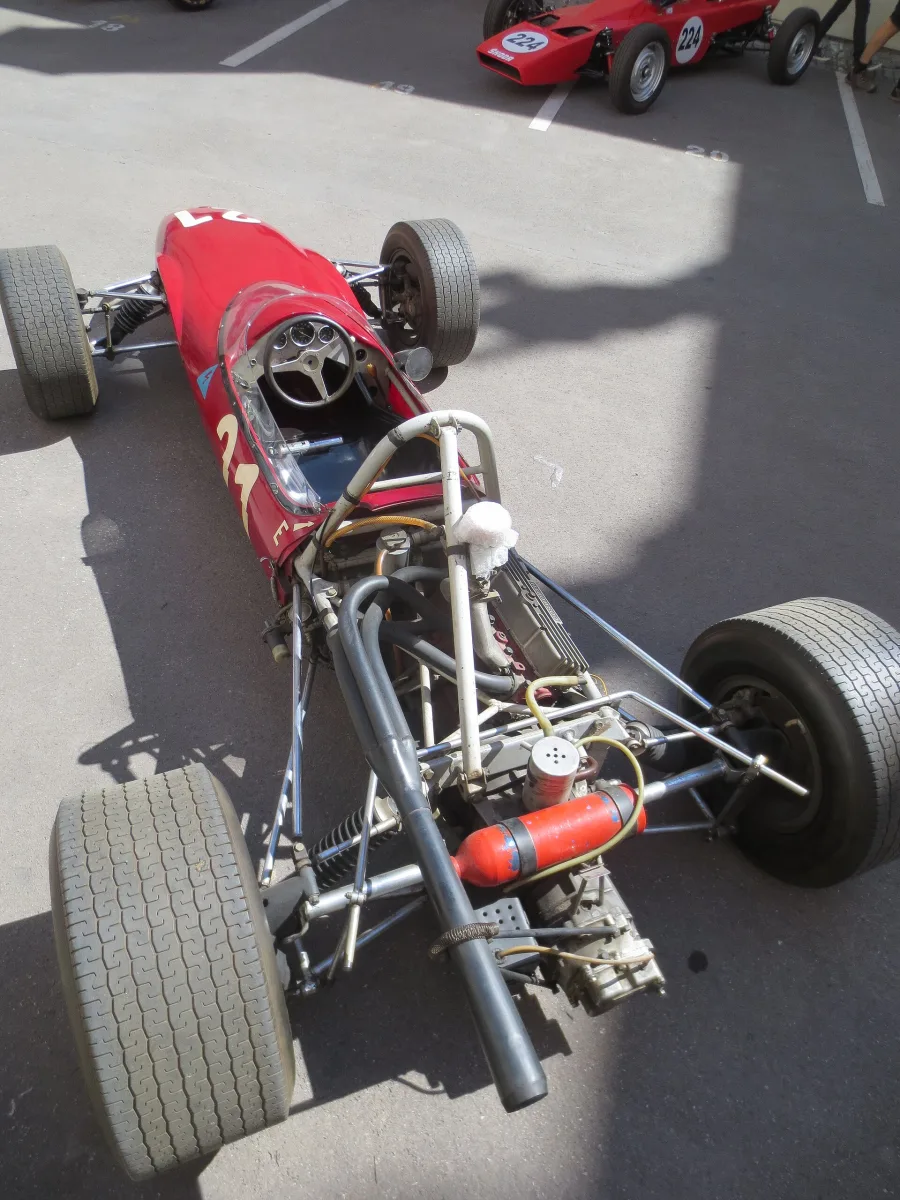
Lotus 41: 1966–1968 Formula 3 and 2 car
Lotus 41 — the Lotus Formula 3 and Formula 2 racing car used from 1966–1968. We look at its steel spaceframe, designers and commercial failure.






Lotus 41 in brief
The Lotus 41 was a Formula 3 and Formula 2 racing car used from 1966–1968. It was a single-seater race car, not a road-going model.
We examine its creation and place in Lotus history.
Construction
The car was designed by John Joyce, then Lotus chief engineer, assisted by Dave Baldwin. They started with a clean sheet of paper. The chassis is a welded steel tubular spaceframe.
At the time, minimum weights were set for racing classes, so steel could be used instead of aluminium without a weight penalty. The key feature is the extensive use of flat steel plates in bulkheads around the footwell and engine bay.
Interesting solutions
One clever solution was using the rear bulkhead as an oil overflow collector; even the overflow from the front oil tank was routed via a maze of tubes through the frame to the end.
The Formula 2 Lotus 41 chassis was considered as a potential basis for a sports racing car with a 500 AG V8 engine of type 868, but nothing came of it. Known variants include the 41C and 41X, whose suspension solutions were later used in the Lotus 59.
Commercial failure and can you see one?
The Lotus 41 was not a commercial success, so its successor, the Lotus 59, was decided to be built from scratch.
Surviving cars participate in historic races and collections; buying an original is a collector's pursuit.


Versions
This is a race car, so there are no trims; we list the main variants.
Lotus 41
1966–1968The main version for Formula 3 and Formula 2.
- A welded steel space frame
- Tensioned steel plates in bulkheads
- The rear bulkhead acts as an oil collector
Lotus 41C / 41X
1966–1968Later variants with improved suspension.
- 41C — improved rear suspension (anti-squat)
- 41X — more suspension mounting points
- Solutions borrowed from the Lotus 59
Lotus 41 and Lotus 59
| Lotus 41 | Lotus 59 | |
|---|---|---|
| Who it's for | F3 and F2 | F3, F2, Formula Ford, Formula B |
| Frame | Welded steel tube with steel plates | Space frame of square tubes |
| Commercial success | Weak | Better |
| Market price (relatively) | €€ | €€ |
The Lotus 41 was meticulously crafted but commercially unsuccessful; its lessons were applied in creating the simpler Lotus 59.
Pros
- Thoughtfully designed steel construction
- Many innovative solutions
- Suspension ideas used later
- Rare collectible model
Cons
- Commercially unsuccessful
- Tricky and expensive to fix
- Can't drive on certain roads
Frequently asked questions
Who created the Lotus 41?
Lotus chief engineer John Joyce with Dave Baldwin's help.
What made the Lotus 41 stand out?
Built with a reinforced steel spaceframe, steel plates in the bulkheads, and clever oil overflow routed through the chassis tubes.
What replaced the Lotus 41?
How the simpler and more successful Lotus 59 was developed.
Updated 2026-10-21 · Trim levels and equipment vary by market and model year — check the equipment of the specific car. · Translated automatically


