 English
 Lietuvių
 Latviešu
 Eesti
 Polski
 Русский
 Українська
 Deutsch
 Nederlands
 Čeština
 Slovenčina
 Svenska
 Norsk
 Dansk
 Suomi


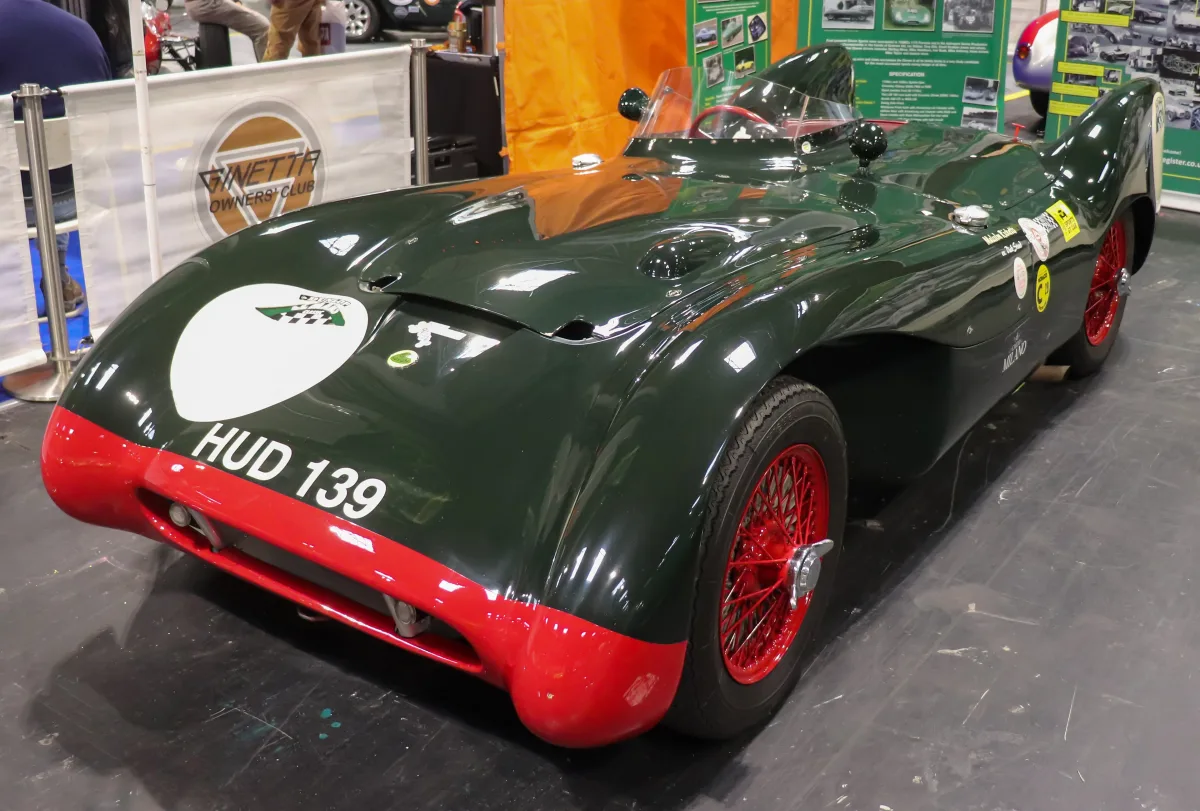
Lotus Mark IX: 1955 aerodynamic racing car
Lotus Mark IX — the 1955 lightweight sports racing car created by Colin Chapman's company, featuring an aerodynamic body and a small-displacement engine. In this article, we'll explore its origins, technology, significance in Lotus history, and where you can see such cars today.






Mark IX in brief
The Mark IX is one of the early Lotus sports models that earned the young, 1952-founded company a name in the racing world. It's an open two-seater sports car designed for the small-displacement (up to 1100 cm³) sports car class.
The car is renowned for its very light construction and sleek body: Chapman's philosophy was not to increase power, but to reduce weight and aerodynamic drag.
History and development
The Mark IX evolved from the Mark VIII (1954) — the first Lotus model with an aerodynamic body, designed by aerodynamics specialist Frank Costin. The Mark IX built on this idea and refined it.
The preceding Mark VI was sold as a kit that buyers assembled themselves; the Mark VIII and IX were more serious racing cars with which Lotus began competing on an international scale.
Technology
The car's foundation is a lightweight space frame, clad in a light, sleek body with enclosed wheel arches. This construction allowed for good speed with a very small-displacement engine.
The Coventry Climax 1.1-litre engine was commonly used and was popular among small-displacement sports racing cars of the time. Its overall power was modest compared to modern cars, but its light weight ensured good dynamics.
Value and where to find one
The Mark IX competed in the 1955 24 Hours of Le Mans — this was one of Lotus's first outings to these famous endurance races. This experience laid the foundation for future models: the Lotus Eleven debuted in 1956, followed by the legendary Seven.
Today, surviving Mark IX models belong to collectors and museums and can be seen at historic racing events and classic car shows. We cannot specify the exact number of surviving cars.


Evolution to the Mark IX
The story of Lotus sports racing models before and after the Mark IX.
Mark VI
1952–1955The first widely sold Lotus model aimed at customers.
- Lightweight space frame
- Often sold as a kit car
- Various contemporary engines
Mark VIII
1954The first Lotus with a Chapman-designed aerodynamic body.
- Compact body
- Lightweight frame
- Small-capacity engine
Mark IX
1955The enhanced Mark VIII — the hero of this article.
- Aerodynamic body
- Often the Coventry Climax 1.1-litre engine
- Competed in the Le Mans races
The Mark IX and contemporaries of the time
| Lotus Mark IX | Cooper T39 | Porsche 550 Spyder | Lotus Eleven | |
|---|---|---|---|---|
| Origin | United Kingdom | United Kingdom | Germany | United Kingdom |
| Engine location | At the front | Centre (behind the driver) | Centre (behind the driver) | At the front |
| Engine (usually) | Coventry Climax ~1.1-litre | Coventry Climax ~1.1-litre | ~1.5-litre flat-four | Coventry Climax ~1.1-litre and larger |
| Purpose | Small-capacity racing | Small-capacity racing | Racing and road use | Small-capacity racing |
Mark IX — a lightweight and aerodynamic example: it didn't show all of Lotus's future success, but it clearly pointed the way that the Eleven would soon expand upon.
Pros
- Very light and nimble construction
- A significant part of Lotus history
- Early Frank Costin aerodynamics work
- For collectors — rare and historically valuable
Cons
- Only a few cars survive
- Built for racing, not daily driving
- Finding parts and specialists is challenging
Frequently asked questions
Can you buy a Lotus Mark IX?
Occasionally, such cars turn up in collectors' circles or at auctions, but there are very few of them, and prices depend on history and condition. They often remain in private collections.
How does the Mark IX differ from the Lotus Eleven?
The Mark IX is the earlier model, dating back to 1955, while the Eleven was introduced in 1956 as a more refined and widely produced successor aimed at the same small-capacity class.
Who designed the Mark IX's aerodynamics?
The body shape of the Mark VIII and IX was designed by aerodynamics specialist Frank Costin, who worked alongside Colin Chapman.
Updated 2026-10-21 · Trim levels and equipment vary by market and model year — check the equipment of the specific car. · Translated automatically


