 English
 Lietuvių
 Latviešu
 Eesti
 Polski
 Русский
 Українська
 Deutsch
 Nederlands
 Čeština
 Slovenčina
 Svenska
 Norsk
 Dansk
 Suomi


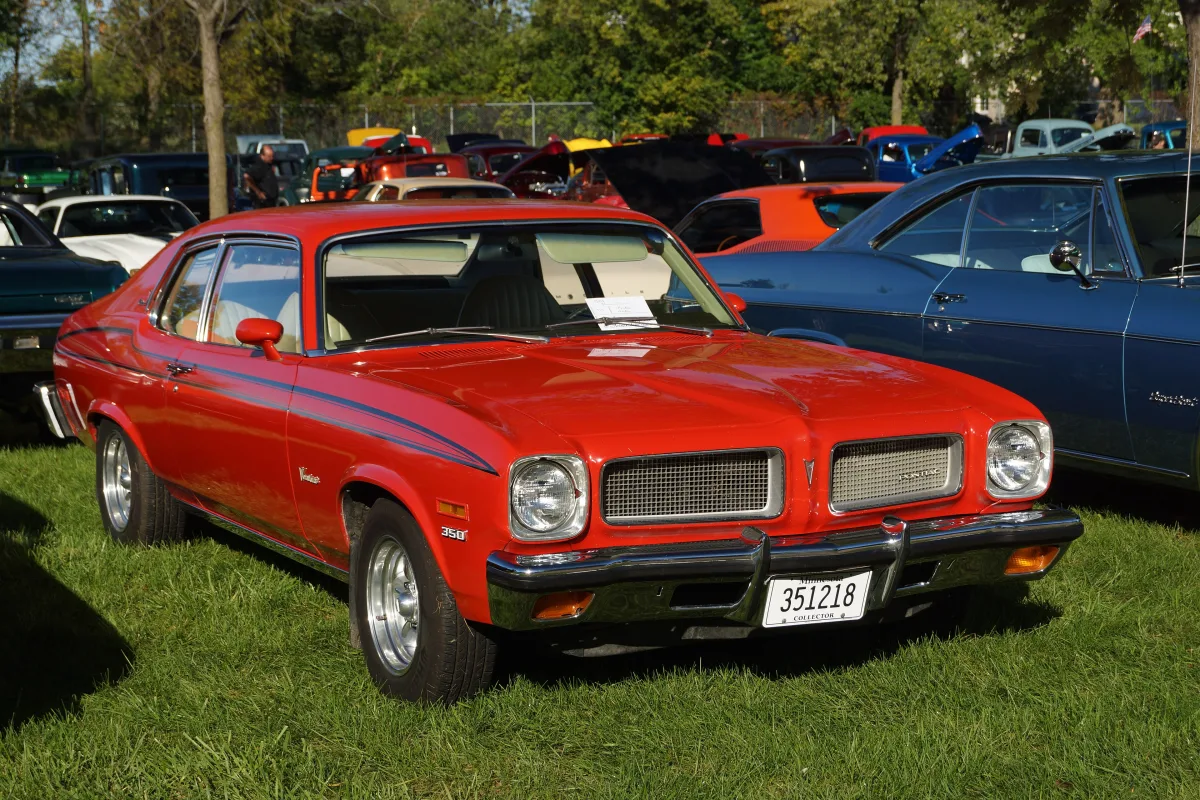
Pontiac Ventura: two distinct generations, engines, and what to know when buying
Pontiac Ventura — a name that was used for two different cars: from 1960–1970 as a more luxurious “Catalina” trim, and from 1971–1977 as a compact model based on the “Chevrolet Nova”. We look at both eras, engines, and what to check when buying.






Ventura in brief
In 1960, the Ventura debuted as an upgraded “Pontiac Catalina” trim — a four-door hardtop “Vista” or two-door “Sports Coupe”. It was pricier than the “Star Chief” but cheaper than the “Bonneville”. Its success inspired the 1962 “Grand Prix”. The name comes from Ventura, California.
In 1971, the Ventura name was given to a new entry-level “X-body” model, the “Ventura II”, based on the “Chevrolet Nova”. After 1972, the “II” suffix was dropped, and in 1978, the Ventura was replaced by the “Phoenix”. This article focuses mainly on the 1971–1977 era, which is most commonly found on the market.
Which era to choose
From 1960–1970, the Ventura was just a “Catalina” trim with badges, wheel covers, a sporty steering wheel, and distinctive three-tone paint. It could also be paired with the powerful “Pontiac” 421 H.O. V8. These cars are large, and finding parts and trim details can be challenging.
1971–1977 Ventura — a compact, straightforward rear-wheel-drive car that's easy to maintain. In 1973, higher-spec models received split grilles in the style of the Firebird and GTO, while the Ventura Custom became a separate series. From 1971 to 1975, two-door models could be had with the sporty Sprint package.
Mid-1972 saw the introduction of the limited-run Ventura SD — a sporty-luxury version aimed at the Southern California market. Around 250 were produced, all at the Van Nuys plant in California.
Engines and transmissions
The 1971 Ventura II came with a choice of a 250 cubic-inch (4.1-litre) six-cylinder engine or a 307 cubic-inch (5.0-litre) V8. In 1972, a 350 cubic-inch (5.7-litre) V8 from Pontiac, featuring a dual-barrel carburettor, was offered as an option, becoming the standard V8 from 1973 to 1974.
The standard gearbox was a three-speed manual with a column-mounted shifter. Optional were a four-speed manual, a two-speed automatic (with the six-cylinder engine), and a three-speed Turbo Hydra-Matic (with the V8). In 1973, the six-cylinder Ventura was the last Pontiac where a two-speed automatic could still be specified.
What to check when buying a used Ventura
As with other cars of the era, the body condition is key. Inspect the floors, wheel arches, sills, boot floor, and lower door sections. Pay particular attention to whether the car has been repainted after an accident or major repair.
If the car is being sold as a “Sprint” or “SD”, check that it genuinely has the corresponding equipment, as these packages are often duplicated on basic Venturas. Also, ask about the engine and gearbox fitted, and whether the numbers match the documents.
The compact Ventura’s mechanical components are often shared with the “Chevrolet Nova”, making parts easier to find. However, parts for the more luxurious “Catalina”-based Ventura from the 1960–1970 period are harder to come by.


Versions and trims
Names and equipment vary by year; we list the main Ventura versions.
Ventura (Catalina komplektacija)
1960–1970The more luxurious “Catalina” version.
- The “Vista” four-door or “Sports Coupe” two-door hardtop
- Distinctive exterior styling and wheel arches
- Often – a sporty steering wheel
Ventura II
1971–1972The first compact Venturas.
- The compact “X-body” bodyshell
- 250 cubic inch six-cylinder or 307 V8 (1971)
- From 1972 – 350 V8 with a dual-barrel carburettor
Ventura Sprint
1971–1975Sporty package for two-door models.
- Three-speed manual gearbox with a floor-mounted shifter.
- Blacked-out grille and special stripes.
- Special steering wheel and 14-inch wheels.
Ventura SD
1972Rare limited-edition model for Southern California.
- High-back 'Strato' seats from the 'Firebird'.
- Special sport steering wheel and 'Rally II' wheels.
- Stiffer suspension.
Ventura Custom
from 1973Separate, higher-tier series.
- Separate series from 1973.
- Often — better interior trim.
- Engines are the same as other Venturas.
Comparison of compact Venturas.
| Ventura | Ventura Sprint | Ventura SD | |
|---|---|---|---|
| Who's it for? | The classic everyday car | For a sportier look | The rare, collectible car |
| Interior | Standard, bucket seats | Bucket seats or optional „Strato“ seats | High-back „Strato“ seats |
| Wheels | Standard | 14 inch | „Rally II“ |
| Rarity | Most commonly found | Fairly common | Very rare |
| Price in the used market (relatively) | € | €€ | €€€ |
For most buyers, the best bet is a well-maintained Ventura with the 350 V8. The Sprint is worth considering for its looks, while the SD is strictly for collectors, as there aren't many of these cars around.
Pros
- Simple rear-wheel drive and familiar mechanics
- Most mechanical parts are shared with the Chevrolet Nova
- A wide range of engines, from six-cylinder to V8
- Rarer than the Nova or Firebird
Cons
- Body prone to rust
- Copies of sporty versions
- Old safety systems, no modern equipment
Frequently asked questions
How does the Ventura differ from the Chevrolet Nova?
The mechanics and body structure are shared, but the Ventura features Pontiac grilles, badges, steering wheel, and different interior trim. From 1972, it also offered the Pontiac-built 350 V8 engine.
Did the Ventura have a sporty version?
Yes: the two-door models from 1971–1975 came with the 'Sprint' package, and in 1972, there was a limited 'Ventura SD' series.
Are all Venturas the same car?
No. From 1960–1970, the Ventura was the 'Catalina' trim, but from 1971–1977, it was a separate compact car based on the 'Chevrolet Nova'.
Updated 2026-10-21 · Trim levels and equipment vary by market and model year — check the equipment of the specific car. · Translated automatically


