 English
 Lietuvių
 Latviešu
 Eesti
 Polski
 Русский
 Українська
 Deutsch
 Nederlands
 Čeština
 Slovenčina
 Svenska
 Norsk
 Dansk
 Suomi


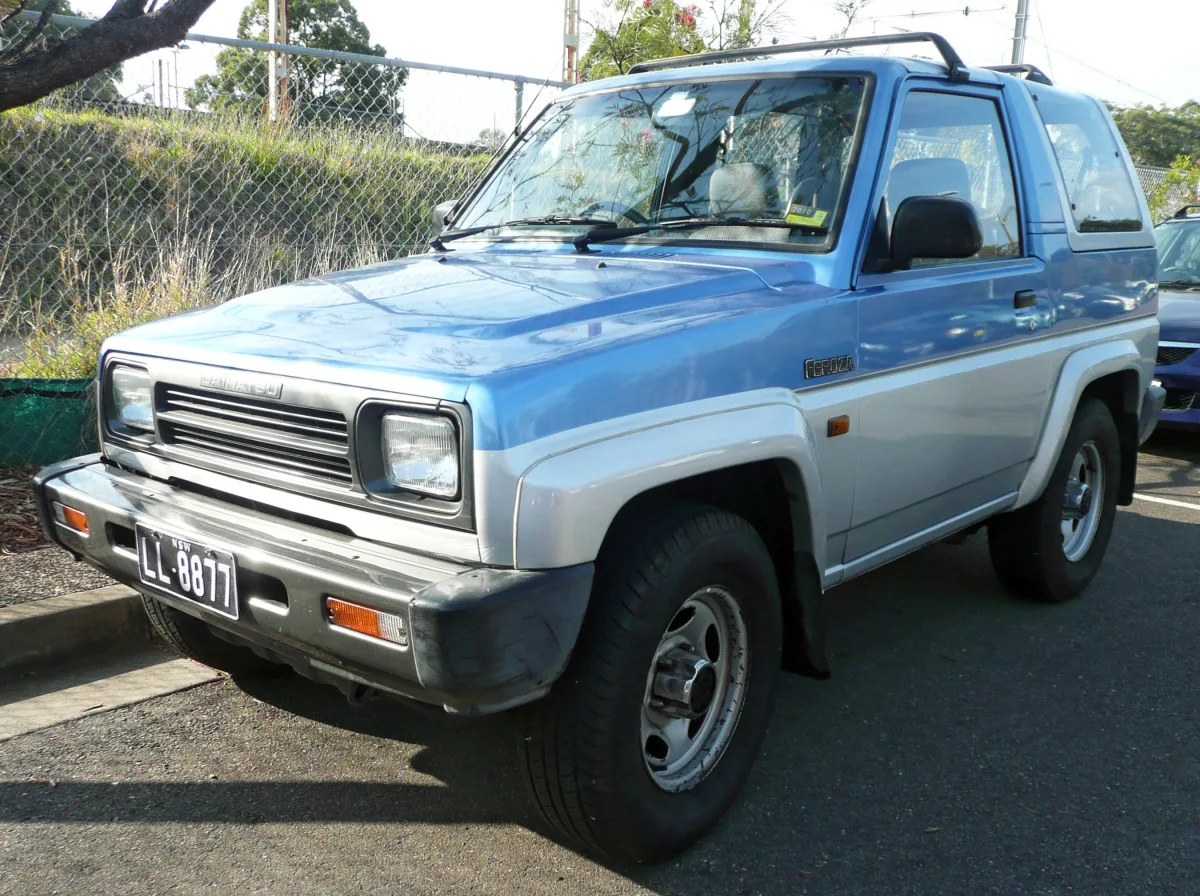
Daihatsu Feroza: compact off-roader with a ladder frame and what to know before buying
Daihatsu Feroza — a compact off-roader with a ladder-frame chassis, produced from 1989 to 2002. This is the export version of the F300 series Rocky, popular among those seeking a light and affordable off-roader. We look at the body styles, engine, and what to check when buying.






Feroza in brief
The Feroza is a short, light off-roader with a ladder frame, separate body construction, and a transfer case with a reduction gear. It was offered with a soft top or a hardtop roof. In Japan, this same vehicle was called the Rocky.
Thanks to its small size and light weight, the Feroza is favoured by those needing a light and manoeuvrable vehicle for forest trails or rough tracks. However, it's not as comfortable on the road as modern crossovers.
Generations and variants
The name Feroza was used for the export F300 series Rocky (1989–2002). The same name was also used in Indonesia (1993–1999) for another model — the rear-wheel-drive Rugger variant (F70), which is unrelated to the F300.
Most commonly found in Europe is the compact F300 with a short wheelbase. The cars differ in trim, body type, and equipment.
Engines and gearboxes
The most common Feroza engine is around 1.6-litre four-cylinder petrol, producing roughly 95hp. It is paired with a 5-speed manual gearbox and a transfer case with a reduction gear.
The car is light, so the power is sufficient for daily driving, but it's noisier on the motorway than modern cars.
What to check when buying a Feroza
The main thing to look out for is rust. Check the frame, sills, wheel arches, and floor. Frame or body rust is expensive to repair and not always worth the effort.
Test the engagement of all-wheel drive and the transfer case, check for oil leaks from the differentials and gearbox, and also inspect the clutch and suspension condition.
The choice of parts is limited, but some of them fit other Daihatsu models. When buying an older car, it's important to check the documents and history.


Trim levels
Trim names vary by market, so we describe the versions by transmission and body style.
Minkštas stogas
from 1989A more open and lighter option.
- Removable or folding roof
- Lower weight
- Often — basic equipment
Uždaras (hardtop)
from 1989Hardtop, more comfortable for daily use.
- Closed body
- Better sound and heat insulation
- Often — more equipment
SX
F300 seriesImproved interior and equipment.
- Often — better interior trim
- Additional exterior details
- Spare wheel on the rear doors
Eksportinės versijos
from 1989Adapted for other markets.
- Equipment varies by country
- Sometimes the name differs
- Check the paperwork before buying
Comparing versions
| Minkštas stogas | Uždaras | SX | |
|---|---|---|---|
| Who it suits | For open-top driving | For daily use | Enhanced equipment |
| Body | Open | Uždaras | Uždaras |
| Transmission | Manual, part-time 4×4 | Manual, part-time 4×4 | Manual, part-time 4×4 |
| Price in the used market (relatively) | € | €€ | €€ |
For most buyers, a closed body is more convenient for daily use. The key is to find an example without frame rust.
Pros
- A light and compact SUV with a frame
- Effective part-time 4×4 transmission with a reduction gear
- Simple technology
- Low purchase and maintenance costs
Cons
- Frame and body rust
- Little comfort on the road, noisy
- Limited choice of parts
Frequently asked questions
Is the Feroza a good SUV?
It's light and has a reduction gear in the transmission, so it handles pretty well off-road. However, it's less comfortable on the road than modern crossovers.
What engine does the Feroza have?
Most commonly — around a 1.6-litre four-cylinder petrol engine.
What should you look out for first?
Check for rust on the frame, sills, and arches, as well as the operation of the 4x4 system.
Updated 2026-10-21 · Trim levels and equipment vary by market and model year — check the equipment of the specific car. · Translated automatically


