 English
 Lietuvių
 Latviešu
 Eesti
 Polski
 Русский
 Українська
 Deutsch
 Nederlands
 Čeština
 Slovenčina
 Svenska
 Norsk
 Dansk
 Suomi


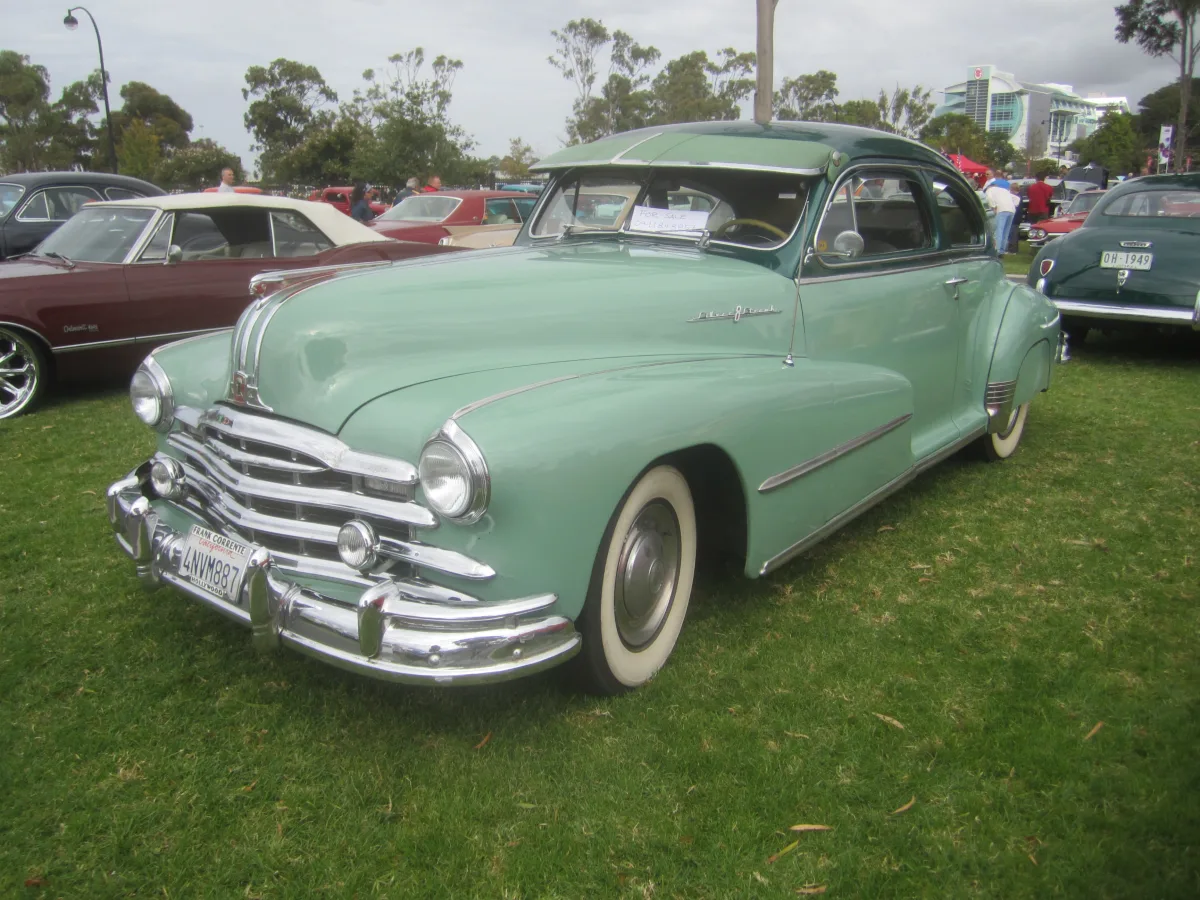
Pontiac Streamliner: variants, engines and what to know when buying
The Pontiac Streamliner was a large pre- and post-war Pontiac with its distinctive sloping rear (fastback), produced between 1942 and 1951. We look at the eras, engines, and what to check when buying this classic car.






Streamliner in brief
The Pontiac Streamliner was a large car built on the B-body platform. All its coupes and sedans featured a sloping rear (fastback), except for the station wagons. The first post-war Pontiac available for purchase in September 1945 was the Streamliner coupe.
This model was incredibly popular: in 1947, 128,660 Streamliners were sold, accounting for roughly 56% of all Pontiacs sold that year. The Streamliner station wagon was the most expensive Pontiac model each year. The body style was accompanied by Silver Streak chrome stripes on the hood, a Pontiac signature until 1960.
Eras — what sets them apart
The Streamliner's style evolved gradually between 1942 and 1948: in 1947, the hood had five chrome stripes, and in 1948, it featured three Silver Streak stripes, horizontal grilles with a vertical centre, and round tail lights. In 1946, the Chieftain trim was renamed Deluxe.
The 1949–1951 body was low and sleek (an 'envelope' shape). By the start of the decade, the sloping rear end already looked dated, so buyers increasingly opted for the new 'Chieftain' sedan with a conventional boot. 1951 was the final year for the Streamliner; Pontiac did not offer a 'B-body' car again until 1959.
Engines and transmissions
The Streamliner was available with an inline six-cylinder (around 3.9 litres) or an inline eight-cylinder (4.1–4.4 litres) engine. Eight-cylinder versions were denoted with an '8' between the words 'Silver Streak' or the inscription 'Pontiac Eight'.
From 1948, the 'Hydra-Matic' automatic transmission became incredibly popular: around 71% of all Pontiacs and 76% of all Streamliners (122,327 cars) were equipped with it. In 1948, fully automatic transmissions were only offered by General Motors brands: Chevrolet's 'Powerglide' appeared in 1950, and Ford's automatic transmission in 1951.
What to check when buying a used Streamliner
First, assess the body condition — dents, floor, wings, and boot. For estates, the condition of wooden parts is also crucial: earlier estates had wooden body elements, so check if the wood hasn't rotted and if the joints are sound.
Inline six- and eight-cylinder engines are simple and robust, but check the cooling system and oil leaks. If the car has a 'Hydra-Matic', ask when the transmission was last serviced and if it shifts smoothly.
Chrome trim, glass, and interior details — the most expensive and hardest-to-find parts, so it's best to choose a car that's as complete and minimally repaired as possible. Check the documents in advance — most of these cars are imported from the USA.


Trim levels and bodies
Names and equipment vary by year; we list the main Streamliner trim levels.
Standard Six
1942–1951The base version with a six-cylinder engine.
- Inline six-cylinder engine
- Often — simpler trim without belt mouldings
- Smaller wheel covers
Deluxe Six
1946–1951Better-equipped version with a six-cylinder engine.
- Often — chromed bumpers and stone guards
- More luxurious interior trim
- Six-cylinder engine
Standard / Deluxe Eight
1942–1951Version with an eight-cylinder engine.
- Inline eight-cylinder engine
- The number „8‟ on the emblems
- More power, but also higher running costs
Streamliner kupė
1942–1951The notchback coupe — the most recognizable variant.
- The notchback (fastback) body style
- The first post-war „Pontiac‟, 1945
- Often featuring „Silver Streak‟ chrome stripes
Streamliner universalas
1942–1951The estate — the priciest „Pontiac‟ model.
- Earlier years — with wooden body elements
- More space and cargo room
- 1950 estates became fully metal-bodied
Comparing trims
| Standard | Deluxe | Universalas | |
|---|---|---|---|
| Who it‟s for | For the everyday, budget-conscious classic | For those who want more luxury | The rarer, more practical option |
| Trim | Basic, painted wheel arches | Chrome arches and stone guards | Estate body, often with Deluxe trim |
| Body | Coupe or sedan | Coupe or sedan | Universalas |
| Engine | Six or eight cylinders | Six or eight cylinders | Six or eight cylinders |
| Price in the used market (relatively) | €€ | €€€ | €€€ |
For most buyers, the most interesting option is the Deluxe coupe or sedan in good body condition. The estate is rare and more expensive, and its upkeep demands more attention due to the wooden parts.
Pros
- Typical pre- and post-war Pontiac styling
- Reliable, straightforward engine
- Post-war automatic Hydra-Matic transmission
- Several body styles — coupe, sedan, station wagon
Cons
- Rust, hard-to-find interior and body parts
- High fuel consumption by today's standards
- Outdated safety systems and weak braking
Frequently asked questions
How does the Streamliner differ from the Chieftain?
The Streamliner is a fastback car. From 1949, the Chieftain with a conventional trunk became more popular, and Streamliner production ceased in 1951.
Did the Streamliner have an automatic transmission?
Yes. From 1948, the Hydra-Matic became very popular — around 76 percent of Streamliner buyers chose it.
Is the Streamliner suitable for daily use?
This car is over seventy years old, so it's usually driven seasonally and in shows.
Updated 2026-10-21 · Trim levels and equipment vary by market and model year — check the equipment of the specific car. · Translated automatically


