 English
 Lietuvių
 Latviešu
 Eesti
 Polski
 Русский
 Українська
 Deutsch
 Nederlands
 Čeština
 Slovenčina
 Svenska
 Norsk
 Dansk
 Suomi


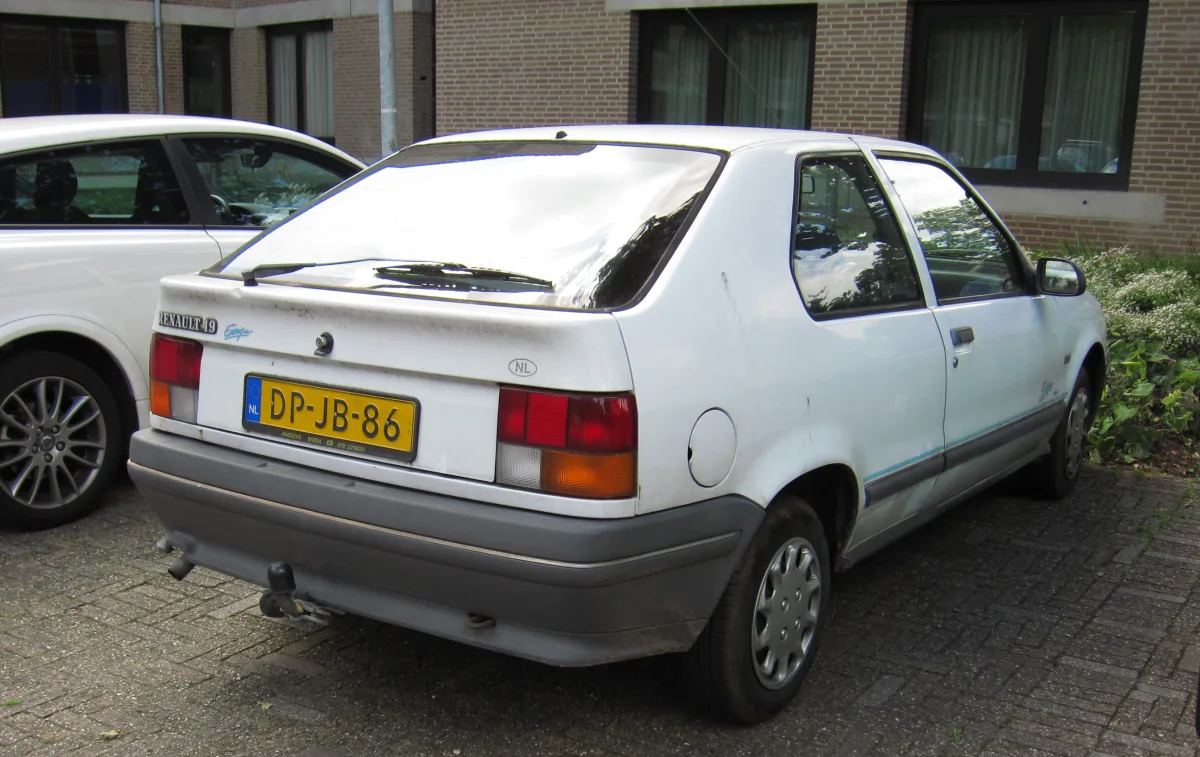
Renault 19: Phase I and II, engines and trims
Renault 19 (1988–2000) — a compact car that was highly popular and produced in Europe as a hatchback, sedan (Chamade) and convertible. We look at the phases, engines and what to check before buying such an old car.






Renault 19 in brief
The 19 replaced the Renault 9 and 11 models and became one of Renault's most important cars in the 1990s. Offered as a 3 and 5-door hatchback, 4-door sedan version Chamade and convertible.
This is a simple, easy-to-maintain front-wheel-drive car. Most examples are now quite old, so the condition of each specific car is crucial.
Which phase to choose
Phase I (1988–1992) has the early design and simpler interior trim. It's often cheaper, but also the oldest.
Phase II (from 1992) got a revised front and rear, updated interior and more safety features. If you're after a more comfortable and modern variant, it's worth considering.
Engines and gearboxes
Petrol engines — most commonly 1.4, 1.7 and 1.8 litres, with the sporty 16V version featuring a 1.8-litre 16-valve engine. There were also diesel versions, usually 1.9 litres.
Gearboxes — mostly manual, occasionally automatic. Early engines are quite simple, but due to their age, the technical condition of many units varies greatly.
What to check when buying a used Renault 19
Corrosion — the main risk: check the sills, wheel arches, boot floor and bottom of the windscreen. Deep corrosion often isn't worth repairing.
Check when the timing belt was last changed, inspect the clutch, cooling system, and electrical components — window motors, lighting, heating. For convertibles, examine the soft top and seals for leaks.


Trims
Names and equipment vary by market and year; we list the trims most commonly found in Europe.
TR
Phase I–IIThe more basic version with a smaller engine.
- Often a 1.4-litre engine
- More basic interior trim
- Often basic alloy wheels
RN
Phase IIA common daily driver with better equipment.
- Often — 1.4 or 1.8-litre engine
- Often — more comfortable seats
- Often — central locking
RT
Phase IIHigher trim level with more comfort.
- Often — electric windows
- Often — climate control or air conditioning
- Often — alloy wheels
16V
Phase I–IIThe sportiest version with a 1.8 l 16-valve engine.
- 1.8 l 16V engine
- Often — sport seats
- Often — alloy wheels and sporty trim
Comparing versions
| TR | RN | RT | 16V | |
|---|---|---|---|---|
| Who it's for | Budget-friendly everyday car | For daily driving | For comfort | For sportier driving |
| Engine | Mostly 1.4 l | 1.4–1.8 l | 1.8-litre petrol or diesel | 1.8-litre 16V |
| Interior | Basic | More comfortable | Luxurious | Sport seats |
| Price in the used market (relatively) | Budget | Budget | Mid-range | Mid-range |
For most buyers, the condition of the body and engine is key. If you can choose, it's better to look for a Phase II car with a 1.4 or 1.8-litre engine.
Pros
- Simple, easy-to-fix technology
- Spare parts are readily available
- Plenty of body styles — hatchback, sedan, convertible
- Easy driving experience
Cons
- Old cars can have a lot of rust
- Most examples are old with high mileage
- The safety features of an old model are simpler than those of modern ones
Frequently asked questions
Is the Renault 19 still worth buying?
It can be a cheap and simple car, but choose only a well-maintained example. Repairing a cheap car due to rust often isn't worth it.
What's the difference between Phase I and Phase II?
Phase II (from 1992) has a refreshed exterior, interior, and more safety features. The core technology is essentially the same.
Does the 19 come as a convertible and a sedan?
Yes, a convertible and a four-door sedan version called the Chamade were produced.
Updated 2026-10-09 · Trim levels and equipment vary by market and model year — check the equipment of the specific car. · Translated automatically


