 English
 Lietuvių
 Latviešu
 Eesti
 Polski
 Русский
 Українська
 Deutsch
 Nederlands
 Čeština
 Slovenčina
 Svenska
 Norsk
 Dansk
 Suomi


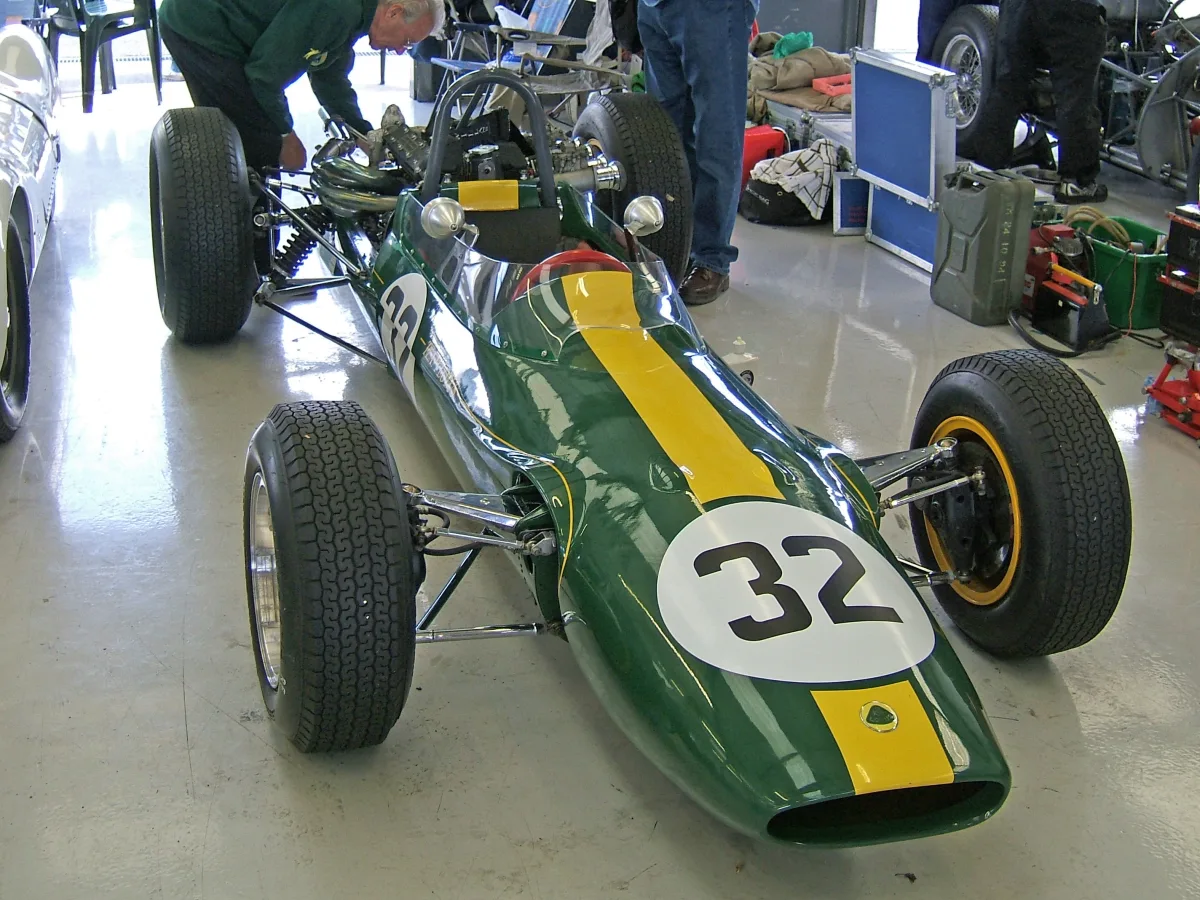
Lotus 32: The 1964 Formula 2 car based on the Formula Junior Lotus 27
The Lotus 32 is the 1964 Team Lotus Formula 2 car, developed from the Formula Junior Lotus 27. This article explores its technology, victories, and the 32B version, with which Jim Clark won the Tasman Series.






The Lotus 32 in brief
The Lotus 32 was the 1964 Team Lotus-built Formula 2 racing car, developed from the Formula Junior Lotus 27. A total of 12 cars were produced, four of which were used by the Ron Harris Team Lotus squad.
Jim Clark and Mike Spence raced with them. This is a racing car, not a road-going model.
The technology
The chassis is an aluminium monocoque with steel front and rear bulkheads and a central section to achieve the required weight. The suspension is typical Lotus: coil springs and dampers mounted inboard at the front, outboard at the rear.
The engine is a new 998 cm³ Cosworth SCA with two 40DCM2 Weber carburettors, producing around 115 bhp at 8700 rpm. The engine was tilted at a 25° angle, and the gearbox is a Hewland Mk IV (five-speed).
On the track
The Lotus 32 made its debut at the 1964 Pau Grand Prix: Jim Clark secured pole position, the fastest lap, and victory. Despite a strong start, the Brabham BT10 emerged as the main rival in the 1964 season.
Clark won three more races, while Brian Hart and Jackie Stewart each took one win. Mike Spence won the Autocar British Formula 2 Championship, and Clark finished fourth in the Trophées de France championship.
The Lotus 32B and can it be seen today?
Towards the end of the 1964 season, one chassis was fitted with a 2497 cm³ Climax FPF engine, a 4-speed Hewland HD gearbox, different suspension and wheels. This Lotus 32B with Jim Clark won the Tasman Series in 1965.
The car remained in New Zealand, where it was bought by Jim Palmer and finished fourth in the Tasman Championship the following season. Surviving cars can be seen at historic racing events, such as the Silverstone Classic.


Versions
This is a racing car, so there are no trims; we list the main variants.
Lotus 32
1964A Formula 2 car with a Cosworth SCA engine.
- 998 cm³ Cosworth SCA, around 115 bhp
- Aluminium monocoque
- Hewland Mk IV five-speed gearbox
Lotus 32B
1964–1965The Tasman Series version with a 2.5-litre Climax engine.
- 2497 cm³ Climax FPF
- 4-speed Hewland HD
- Jim Clark, Tasman Champion 1965
Lotus 32 and Lotus 27
| Lotus 27 | Lotus 32 | |
|---|---|---|
| Who's it for | Formula Junior | Formula 2 |
| Engine | Formula Junior engine | Cosworth SCA 998 cm³ |
| Year | 1963 | 1964 |
| Market price (relatively) | €€€ | €€€ |
The Lotus 32 was a successful Formula 2 car that built on the monocoque ideas of the Lotus 27 and secured victories with Jim Clark.
Pros
- Jim Clark's wins at Pau and Eifelrennen
- Mike Spence's championship
- Monocoque body
- The 32B version won the Tasman Series
Cons
- The Brabham BT10 was more powerful in 1964.
- Unable to drive on several roads
- Limited availability
Frequently asked questions
How many Lotus 32s were produced?
A total of 12 cars.
What is the Lotus 32B?
The version with the 2.5-litre Climax FPF engine, with which Jim Clark won the Tasman Series in 1965.
Who won with the Lotus 32?
Jim Clark, Brian Hart, and Jackie Stewart won races; Mike Spence won the British F2 Championship.
Updated 2026-10-21 · Trim levels and equipment vary by market and model year — check the equipment of the specific car. · Translated automatically


