 English
 Lietuvių
 Latviešu
 Eesti
 Polski
 Русский
 Українська
 Deutsch
 Nederlands
 Čeština
 Slovenčina
 Svenska
 Norsk
 Dansk
 Suomi


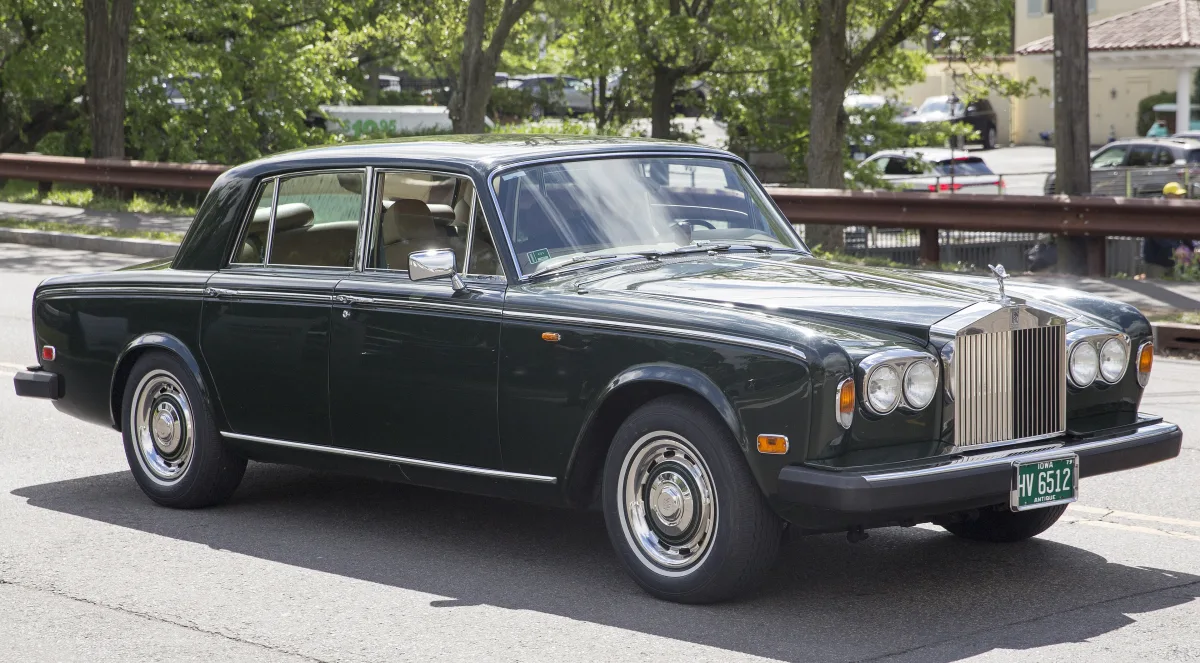
Rolls-Royce Silver Shadow: I and II generations, engine and what to check when buying
Rolls-Royce Silver Shadow — a luxurious limousine produced from 1965 to 1980, the first Rolls-Royce with a unibody (self-supporting) chassis. In this article, we review the Silver Shadow I and II, body variants, technology, and what's important to check before buying such a classic car.






Silver Shadow in brief
The Silver Shadow replaced the Silver Cloud and became a highly successful model — it was produced for fifteen years. Its sibling is the Bentley T series cars, which differ from the Rolls-Royce mainly in grilles and badges.
This was the first Rolls-Royce with a unibody, independent suspension on all wheels, and a self-leveling hydraulic suspension. As a result, it was far more modern and easier to handle than previous models.
Silver Shadow I and II — what's the difference
Silver Shadow I (1965–1977) is the earlier generation with chromed bumpers and classic proportions. From 1969, a longer-wheelbase version was offered, providing more space for rear passengers.
Silver Shadow II (1977–1980) received updates: a revised steering mechanism, improved air conditioning system, and refreshed exterior elements, including a larger front spoiler and rubber bumpers. The ride became more precise and smoother thanks to these changes.
Rarer are the two-door bodies — coupe and convertible, built by Mulliner Park Ward. They often appear as a separate Corniche model, so when buying, make sure to check the exact version.
Engine and transmission
Silver Shadow has an aluminium V8 engine. The first cars had a 6.2-litre engine, but from 1970, its capacity was increased to 6.75 litres. As is typical for Rolls-Royce, the manufacturer did not officially declare the power output.
Transmission is automatic. The key decision is the high-pressure hydraulic system that controls the suspension (self-levelling) and brakes. It provides excellent comfort but is complex and expensive to maintain.
What to check when buying a used Silver Shadow
The most important thing is the hydraulic system. Check if the car doesn't sag when parked, if there are no fluid leaks, and if the brakes work. Repairs according to the manufacturer's scheme can be expensive, especially if the system has not been well-maintained for a long time.
Inspect the body for corrosion: especially the sills, wings, boot area, and suspension mounting points. One of the biggest sources of expense for classic Rolls-Royces is a poorly repaired, corroded body.
Check the service history with specialists who know this technology, and get an independent appraisal. In the collector car market, condition and documentation are key.


Trim levels
Names and equipment vary by market and year; we list the versions most commonly found in Europe.
Silver Shadow I
1965–1977The first generation is the classic look.
- Aluminium V8 engine (6.2 litres, later 6.75 litres)
- Hydraulic suspension and brakes
- Chrome bumpers
Silver Shadow I, ilgoji bazė
From 1969Longer version with more space at the rear.
- More space for passengers in the rear
- The same tech as the standard version
- Often — a partition between the front and back
Silver Shadow II
1977–1980Updated generation with a smoother ride.
- Improved steering mechanism
- Updated air conditioning system
- Often — rubber bumpers and a different front end
Dviejų durų Mulliner Park Ward
Varies by yearRare coupé or convertible body style.
- Two-door body
- Often — named Corniche
- More of a collector's item
Comparison of versions
| Shadow I | Shadow II | Dviejų durų | |
|---|---|---|---|
| Who it's for | For classic style enthusiasts | For smoother, more refined driving | For collectors |
| Body | Four-door sedan | Four-door sedan | Coupe / convertible |
| Price in the used market (relatively) | Mid-range | Mid-range | High-end |
For most buyers, the best choice is a well-maintained Silver Shadow II, as it's more modern. The Silver Shadow I suits classic style enthusiasts, while the two-door versions are for collectors.
Pros
- Luxurious and comfortable interior
- Hydraulic suspension and quiet ride
- Classic Rolls-Royce styling
- A well-known and beloved model in the classic car scene
Cons
- Complex and expensive hydraulic system
- Risk of corrosion
- Expensive maintenance and parts
Frequently asked questions
Is the Silver Shadow reliable?
It depends on the maintenance. If the hydraulic system and body are well-maintained, the car can be reliable, but repairs are always costly.
What's the difference between the Silver Shadow I and II?
The second generation features a revised steering mechanism, improved air conditioning, and a different front end with rubber bumpers. The ride is smoother and more precise.
Is the Silver Shadow suitable for daily use?
It can be suitable for occasional use, but due to its age, maintenance costs, and fuel consumption, it is often considered a collector's or weekend car.
Updated 2026-10-21 · Trim levels and equipment vary by market and model year — check the equipment of the specific car. · Translated automatically


