 English
 Lietuvių
 Latviešu
 Eesti
 Polski
 Русский
 Українська
 Deutsch
 Nederlands
 Čeština
 Slovenčina
 Svenska
 Norsk
 Dansk
 Suomi


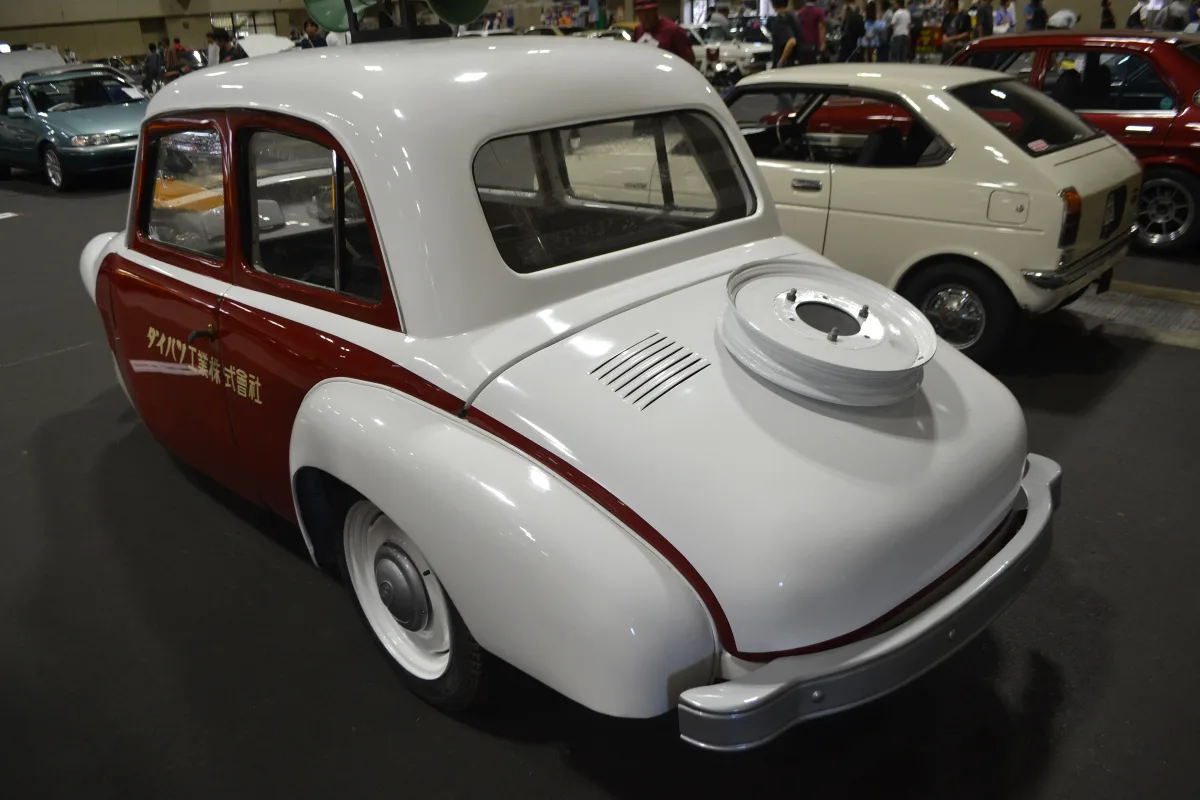
Daihatsu Bee: 1951 three-wheeled microcar and what you need to know
The Daihatsu Bee was a three-wheeled microcar produced from 1951 to 1952, the first 'Daihatsu' light car sold to the general public. In this article, we look at its history, technology, and why it's such a rare museum piece today.






The Bee in brief
The Bee was the first 'Daihatsu' car designed for the mass market. Sales began in September 1951, just before the company changed its name from 'Hatsudoki Seizo' to 'Daihatsu'. Its model code is PCA.
Up until then, 'Daihatsu' had been producing three-wheeled cargo motorcycles since 1930, and in 1937, it built a small military car. The Bee was created by adapting one of these three-wheeled cargo models.
What sets the Bee apart
The Bee featured a two-door enclosed body and was popular as a taxi in Japan, as regulations at the time allowed a lower fare per kilometre for three-wheeled vehicles than for four-wheeled ones.
Despite this, it sold poorly: production was very labour-intensive, so only around 300 cars were made, and production ceased in 1952. As a result, the Bee is practically never sold today—it's usually seen in museums and at collector shows.
Engine and tech
The Bee has a rear-mounted 540 cm³ two-cylinder, air-cooled four-stroke engine with overhead valves. As sources indicate, this was the first car in Japan with a horizontally opposed cylinder layout.
It has only three wheels, so the handling differs from a conventional four-wheeler. For more detailed technical specs (power, gearbox), it's worth checking museum or club archives.
What to know when buying a Daihatsu Bee
The Bee rarely comes up for sale, so first and foremost, check the documents and provenance: few were made, and replicas or modified cars can be misleading.
If you're seriously considering such a purchase, consult a specialist in classic Japanese cars or a Daihatsu museum or club. Parts are almost non-existent, so restoration can be particularly expensive and time-consuming.
Also, consider whether you're allowed to register and use such a vehicle in your country, as rules for three-wheeled cars can vary.


Trim levels
Names and equipment vary by market and year; we list the versions most commonly found in Europe.
Bee (PCA)
1951–1952The sole production version was a closed two-door body.
- Three-wheeled design
- 540 cm³ air-cooled two-cylinder engine at the rear
- Also used as a taxi in Japan
Comparison of example types
| Neatnaujintas originalas | Restauruotas egzempliorius | Muziejinis eksponatas | |
|---|---|---|---|
| Who it's for | Enthusiasts looking for a restoration project | For collectors looking to show off a car | Not for sale — for viewing only |
| What to expect | Lots of work and hard-to-find parts | Costs already incurred, but documentation is key | Retains original condition |
| Price in the used market (relatively) | €€€ | €€€ | — |
Due to its very limited production run, choosing a Bee requires caution and expert help. This is a collector's item, not a daily driver.
Pros
- Very rare and historically significant
- The first 'Daihatsu' light car for the public
- Unusual three-wheeled design
- Interesting tech — horizontally opposed engine
Cons
- Almost impossible to find one for sale
- Finding parts and specialists is very challenging
- Not suitable for daily use
Frequently asked questions
How many Daihatsu Bees were produced?
Approximately 300 cars were produced between 1951 and 1952.
Why does the Bee have three wheels?
It was adapted from Daihatsu’s three-wheeled commercial model. Plus, in Japan at the time, three-wheeled vehicles were taxed at a lower rate than four-wheelers, making it an attractive option for taxi services.
Can you buy a Bee?
Practically no — it’s a museum and collector’s car that rarely comes to market.
Updated 2026-10-21 · Trim levels and equipment vary by market and model year — check the equipment of the specific car. · Translated automatically


