 English
 Lietuvių
 Latviešu
 Eesti
 Polski
 Русский
 Українська
 Deutsch
 Nederlands
 Čeština
 Slovenčina
 Svenska
 Norsk
 Dansk
 Suomi


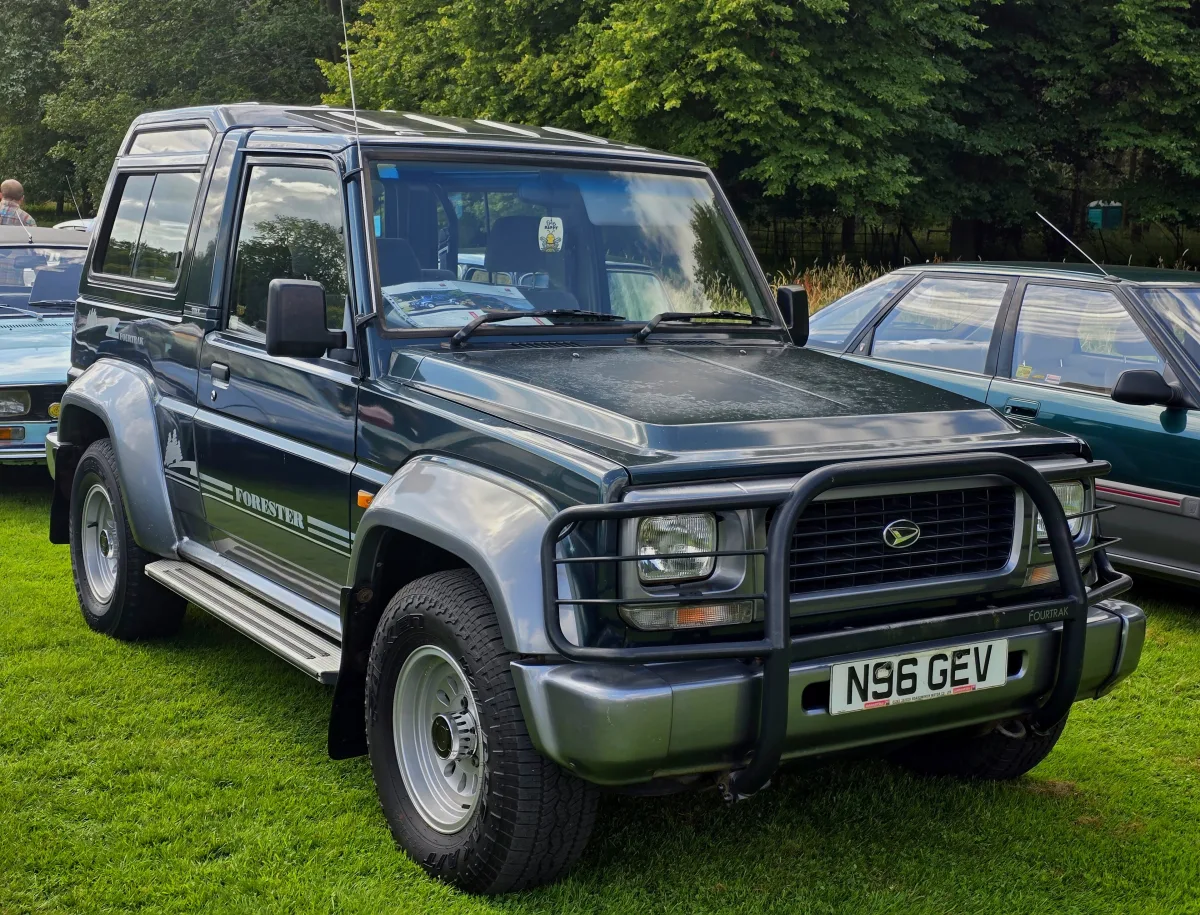
Daihatsu Rugger (Rocky, Fourtrak): generations, engines, and what to check
The Daihatsu Rugger is a body-on-frame SUV produced from 1984 to 2002. In many export markets, it was known as the Rocky, and in the UK, it went by the name Fourtrak. We'll look at two generations, engines, and what to check when buying a used one.






Rugger in brief
The Rugger is a typical Japanese SUV of its time: body-on-frame construction, solid axles, and a part-time four-wheel-drive system with a reduction gear. It can be compared to short-wheelbase versions of the Toyota Land Cruiser, Mitsubishi Pajero, or Nissan Patrol, but unlike most competitors, it seats five.
You might find this vehicle under different names in the market: Rugger (Japan), Rocky (most export markets), and Fourtrak (UK). Note that in Japan and the US, the Rocky name was also used for a smaller SUV from the F300 series.
Two generations — what sets them apart
The first generation (1984–1991) featured leaf springs at both ends, and the driver had to manually lock the front hubs by getting out of the vehicle. In 1991, automatic locking hubs were introduced.
The second generation (1992–2002) received a new dashboard (designed by Bertone), an independent front suspension, and a rear axle with coil springs, making the ride more comfortable. In the UK, three variants were offered: the short TDS, the longer TDL, and the better-equipped TDX.
Engines and transmissions
For the first time, you could choose between a 2.0-litre Toyota-derived petrol engine (around 88 hp), a 2.8-litre diesel (around 73 hp), or a 2.8-litre turbodiesel (around 88 hp). Later, the turbodiesel received an intercooler, and its power increased to roughly 102 hp.
The second generation retained the 2.8-litre turbodiesel with an intercooler (around 102 hp), while in the UK, you could also opt for a 2.2-litre petrol engine (around 91 hp). The gearbox is manual, and the four-wheel drive system includes a reduction gear to help conquer tough terrain.
What to check when buying a used Rugger
The most crucial aspect is corrosion. Inspect the frame, sills, wheel arches, and body mounting points. In the TDX version, additional plastic arches keep out mud and moisture, so rust often hides underneath.
Check if the four-wheel drive system and reduction gear engage properly, if there are no oil leaks from the differentials, and if there is no play in the steering and suspension bushes. In the turbodiesel, ensure the timing belt has been replaced, and inspect the condition of the turbocharger and injectors.


Trim levels
We present the versions known in the UK as the Fourtrak, which are commonly found in the second generation in the European market.
TDS
1992–2002Shorter wheelbase version.
- Shorter wheelbase (F73)
- 2.8-litre turbodiesel
- Available with or without rear seats
TDL
1992–2002Longer wheelbase version.
- Longer wheelbase (F78)
- 2.8-litre turbodiesel
- Roomier interior and larger boot
TDX
1992–2002Top-of-the-range trim.
- Often — lightweight alloy wheels
- Wider tyres and additional plastic arches
- Passenger version (five-seater) only
Comparison of Fourtrak trims
| TDS | TDL | TDX | |
|---|---|---|---|
| Who it's for | For those seeking a more rugged look and a shorter body | For families and more cargo space | For better equipment and styling |
| Wheelbase | Shorter | Longer | Longer |
| Engine | 2.8-litre turbodiesel | 2.8-litre turbodiesel | 2.8-litre turbodiesel |
| Price in the used market (relatively) | € | € | €€ |
Many buyers opt for the TDL or TDX with the 2.8-litre turbodiesel, but make sure to check the chassis and body condition, as the most common issue is corrosion.
Pros
- Robust ladder-frame construction
- Genuine four-wheel drive with a reduction gear
- Simple diesel engine, easy to service
- Five seats in a short wheelbase
Cons
- An older car, susceptible to rust
- Limited comfort and high noise levels
- The turbodiesel requires meticulous maintenance
Frequently asked questions
Are Rugger, Rocky, and Fourtrak the same?
Yes. It's the same model (F70/F80 series), which went by different names in various markets: Rugger, Rocky, or Fourtrak.
Which engine is the best?
Most often, the 2.8-litre turbodiesel with an intercooler is chosen, as it's the most powerful and reasonably economical. Petrol variants are rarer.
Is the Rugger suitable for off-roading?
Yes. It has fixed axles, a reduction gear and a simple design, so many use it for forestry, agricultural or hunting purposes.
Updated 2026-10-21 · Trim levels and equipment vary by market and model year — check the equipment of the specific car. · Translated automatically


