 English
 Lietuvių
 Latviešu
 Eesti
 Polski
 Русский
 Українська
 Deutsch
 Nederlands
 Čeština
 Slovenčina
 Svenska
 Norsk
 Dansk
 Suomi


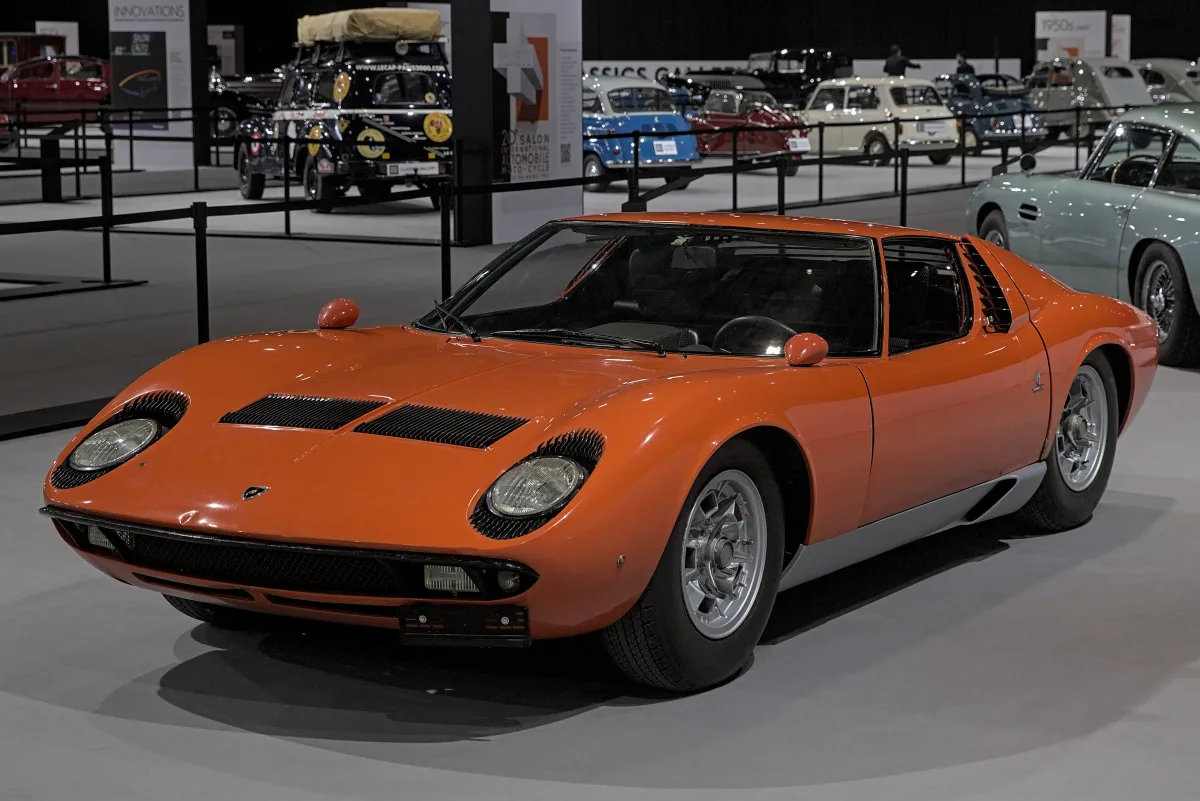
Lamborghini Miura: generations, V12 engine and what to know about this classic model
The Lamborghini Miura was a supersports car produced from 1966 to 1973 with a mid-mounted V12, often considered the first true supersports car. This article explores the generations, technology, and what you need to know about this collectible classic.






Miura in brief
The Miura was unveiled at the 1966 Geneva Motor Show and became one of the first production road cars with a mid-engine layout. The body design was crafted by Marcello Gandini at Bertone, while the engineering solutions were developed by Lamborghini's young team of engineers.
Approximately seven hundred and sixty units were produced. Today, the Miura is one of the most valuable classic Lamborghinis and is rarely seen on the market, with virtually none in Lithuania.
Generations and variants
The first version, the P400 (1966–1969), had around 350 hp. In 1969, the P400 S arrived with increased power (around 370 hp) and more luxurious trim, and in 1971, the P400 SV with around 385 hp and a wider rear section.
Beyond these, there are also very rare special variants, such as the Jota. The main differences between versions are power, trim, body details, and suspension, with collectors' choices largely depending on history and originality.
Engine and transmission
The Miura features a 3.9-litre V12 petrol engine mounted transversely behind the driver. This was a bold decision that allowed for a compact body. Power, depending on the version, ranged from approximately 350 to 385 hp.
Gearbox — 5-speed manual, with a shared engine and gearbox oil system. The car is rear-wheel drive. Due to its old design, it requires physical effort to drive, and at high speeds, it demands an experienced driver.
What to know when buying a Miura
The Miura is rarely sold, usually through specialist dealers or auctions. The most important thing is documentation: confirmation that the engine and body are original, a full service history, and restoration records if the car has been restored.
Before purchasing, an independent Lamborghini classic specialist inspection is essential. You need to check the engine, gearbox, body structure for corrosion and previous repairs, as well as the condition of all systems — fuel, electrical, cooling.


Trim levels
Names and equipment vary by market and year; we list the most commonly found trim levels in Europe.
Miura P400
1966–1969The first series, the true icon.
- Around 350 bhp
- 3.9-litre V12 transversely mounted
- Simpler interior trim
Miura P400 S
1969–1971With more power and better trim.
- Around 370 bhp
- Better interior trim
- Often — electrically adjustable windows
Miura P400 SV
1971–1973The most powerful and final series version.
- Around 385 bhp
- Wider rear end
- Improved technology
Comparison of Miura versions
| P400 | P400 S | P400 SV | |
|---|---|---|---|
| Who it's for | For purists of clean design | For a balanced choice | For collectors seeking the best version |
| Power (approx.) | 350 bhp | 370 bhp | 385 bhp |
| Engine | 3.9-litre V12 | 3.9-litre V12 | 3.9-litre V12 |
| Production years | 1966–1969 | 1969–1971 | 1971–1973 |
| Price in the used market (relatively) | Very expensive | Very expensive | Very expensive |
The P400 is valued for its purity and status as the first series model, the SV for its power and superior technology. All versions are collectible.
Pros
- Iconic design that influenced the world of supercars
- V12 engine mounted transversely behind the driver
- Significant historical and collectible value
- Extremely limited production run
Cons
- Practically unavailable in the market
- Very expensive maintenance and restoration
- Old construction, difficult to handle
Frequently asked questions
How many Miuras were made?
Around 760 cars over seven production years. Exact numbers vary slightly across sources.
How important is the Miura?
It was one of the first series-production road cars with a mid-engine layout and is often considered the first true supercar. Its design later became the standard.
Which Miura version is the best?
Many collectors value the P400 SV for its power and improvements, but the early P400 is prized for its purity. The key is the car's originality and history.
Updated 2026-10-19 · Trim levels and equipment vary by market and model year — check the equipment of the specific car. · Translated automatically


