 English
 Lietuvių
 Latviešu
 Eesti
 Polski
 Русский
 Українська
 Deutsch
 Nederlands
 Čeština
 Slovenčina
 Svenska
 Norsk
 Dansk
 Suomi


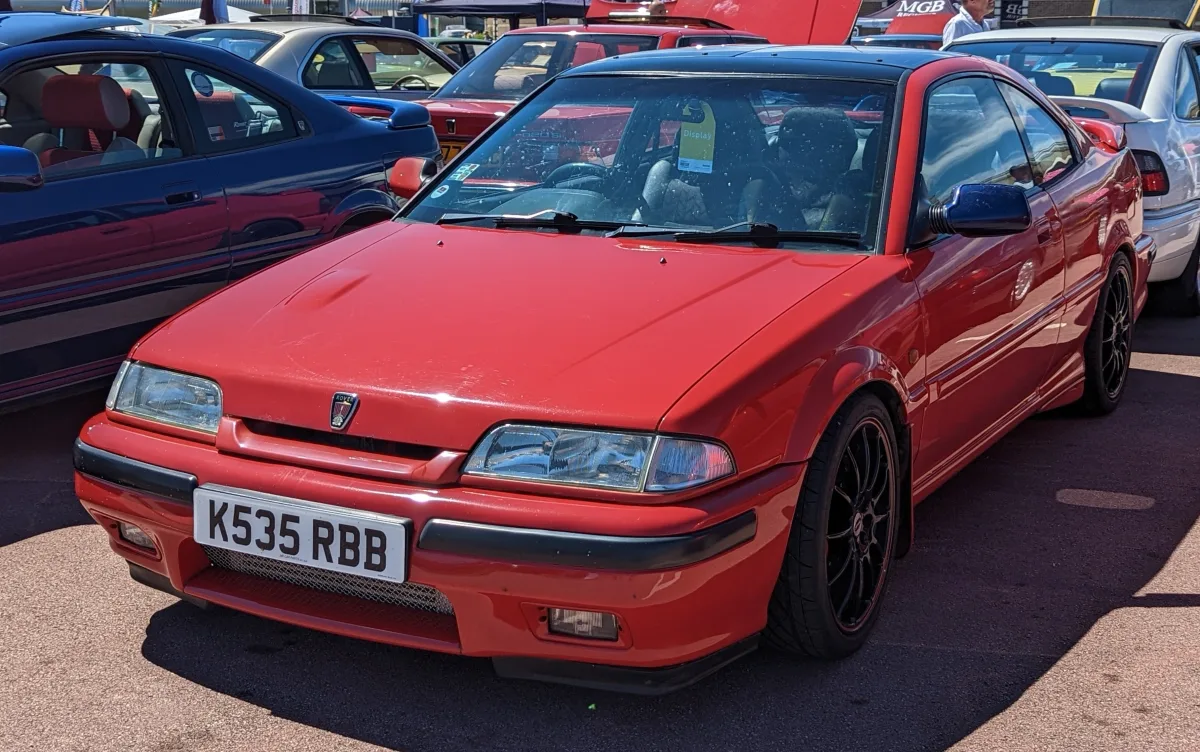
Rover 200 Coupé: convertible with a glass roof, engines and what to check
Rover 200 Coupé (project code “Tomcat”) — the 1992 British coupé built on the Rover 200 platform. We look at how the 216, 220, and 220 Turbo versions differ, what changed in 1996, and what to check before buying.






Rover 200 Coupé in brief
The Coupé was unveiled on October 6, 1992, at the Paris Motor Show and was based on the second-generation Rover 200, but features unique body panels and bumpers. It's a four-seater convertible with a glass roof made of two panels and a central T-shaped strip.
The top-spec 220 Turbo was, at the time, the most powerful and fastest Rover in production. The range was refreshed in 1996 and renamed Rover Coupé, with production ending in 1998.
Versions — how they differ
The base version is the 216 with a Honda D series 1.6-litre engine (111 PS). The mid-range is the 220 with a 2.0-litre T series engine (136 PS), while the 220 Turbo has the same engine with a turbocharger and 200 PS.
The Turbo version came standard with a Torsen limited-slip differential, helping to send power to the front wheels. The 1994 model year received chrome radiator grilles, and some interior and safety features were simplified.
Engines and gearboxes
All 1992–1995 versions came with a manual gearbox, with an automatic offered only with the 1.6-litre engine. The Turbo version could hit over 240 km/h (150 mph).
During the 1996 refresh, newer engines were introduced, including the 1.8-litre VVC (218 VVC). Gearbox choices varied depending on the engine.
What to check when buying a Rover 200 Coupé
Test the engine: Rover K-series engines from 1996 onwards are known for head gasket issues, so check for coolant leaks and signs of engine overheating. In the turbo version, pay attention to the condition of the turbocharger.
Check the condition of the sunroof, body for rust, and interior trim. Parts availability is limited, so look for a car that's already in good condition.


Trim levels
Trim names became engine designations: 216, 220, and 220 Turbo.
216 Coupé
1992–1995Base model with a 1.6-litre engine.
- Honda D-series 1.6-litre engine (111 hp)
- Automatic transmission available
- Sunroof and four-seat interior
220 Coupé
1992–1995Mid-range model with a 2.0-litre engine.
- 2.0-litre T-series engine (136 hp)
- Manual transmission
- Torsen differential was an option in the early years
220 Turbo Coupé
1992–1995Most powerful first-generation model.
- 2.0-litre turbo engine (200 PS)
- Torsen differential as standard
- Manual transmission
Rover Coupé
1996–1998 model yearsRefreshed range with newer engines, including the 218 VVC.
- Newer engines (e.g., 1.8-litre VVC)
- Updated interior and trim details
- Turbo version remains the top choice
Comparing the versions
| 216 | 220 | 220 Turbo | |
|---|---|---|---|
| Who it's for | For more relaxed driving | For dynamic daily driving | For performance enthusiasts |
| Engine | 1.6-litre (111 PS) | 2.0-litre (136 PS) | 2.0-litre turbo (200 PS) |
| Torsen differential | No | Optional (in the first few years) | Standard |
| Price in the used market (relatively) | Budget | Mid-range | High-end |
Most buyers will be happy with the 220; the 220 Turbo is worth considering only if power is a priority, and you're prepared to deal with more complex technology.
Pros
- Distinctive British coupé styling
- Glass roof with central stripe
- Powerful 220 Turbo variant
- Rare, appeals to collectors
Cons
- Parts availability is limited
- Intermediate issues with K-series engine heads
- Condition of rust and interior trim in older cars
Frequently asked questions
Is the Rover 200 Coupé the same as the Rover Coupé?
Yes. The 1996 range was refreshed and renamed Rover Coupé, but it's the same model.
Which version is the fastest?
The 220 Turbo with the 200 PS turbo engine — it was the most powerful Rover of its time.
Does the Rover Coupé have front-wheel drive?
Yes. All versions are front-wheel drive, and the Turbo got a Torsen differential for better power distribution.
Updated 2026-10-21 · Trim levels and equipment vary by market and model year — check the equipment of the specific car. · Translated automatically


