 English
 Lietuvių
 Latviešu
 Eesti
 Polski
 Русский
 Українська
 Deutsch
 Nederlands
 Čeština
 Slovenčina
 Svenska
 Norsk
 Dansk
 Suomi


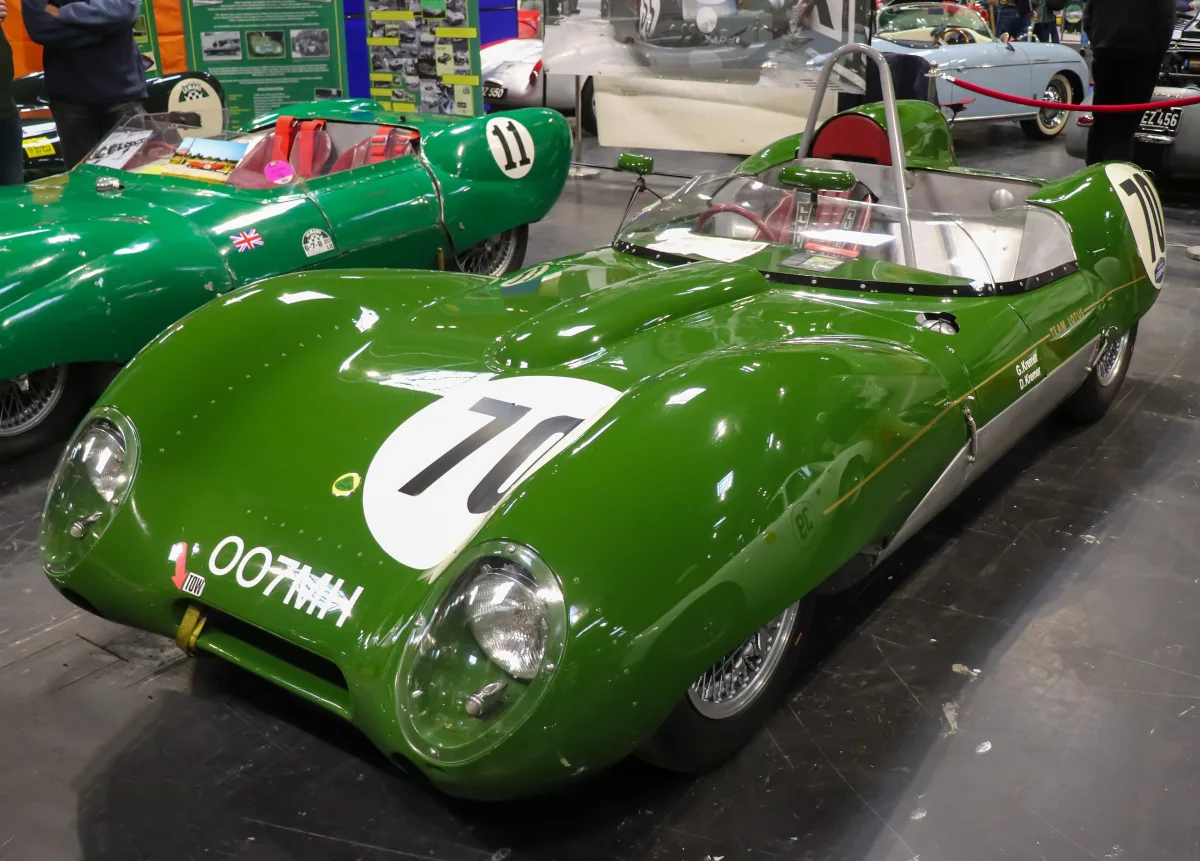
Lotus 15: 1958–1960 sports racing car
The Lotus 15 is a front-engined sports racing car designed by Colin Chapman and produced from 1958 to 1960. This article reviews its versions, technology, and gearbox issues.






Lotus 15 in brief
The Lotus 15 was a two-seater front-engined, rear-wheel-drive sports racing car designed by Colin Chapman. It was produced from 1958 to 1960 and was designed in 1957, with production starting at the end of that same year.
The body was aluminium over a spaceframe. The frame was similar to the Lotus Eleven but featured Chapman's own rear suspension and inboard brakes.
Technical details
Unlike its predecessor, the Lotus Mark X with a six-cylinder Bristol engine, the Lotus 15 was designed for a dry-sump aluminium four-cylinder DOHC Coventry Climax FPF engine — 1.5–2.5 l, developed for Formula 2 and Grand Prix. The engine was mated to a Lotus-designed five-speed sequential transaxle gearbox, known as the “Queerbox”.
The body was aluminium, similar to the smaller Lotus Eleven, but with a full-width front windscreen and a lower front end. Unlike the Eleven, whose body was designed by Frank Costin, the 15's body emerged from a collaboration between Chapman and the body builders Williams & Pritchard.
Versions
The Series 1 engine was tilted around 28° from the vertical, but this caused oil problems. The Series 2 (July 1958) received a BMC B-series four-speed gearbox directly behind the engine and a standard differential, with the engine tilted around 17°; this resulted in a larger bulge in the engine cover with air intake.
The Series 3 (1959) appeared when the Lotus gearbox, after being redesigned by Keith Duckworth, became more reliable, although the engineer himself noted that the gearbox couldn't safely transmit an excessively high torque.
Available to see and buy
The Lotus 15 made its debut on April 7, 1958, at the Sussex Trophy races on the Goodwood circuit: Graham Hill immediately set a lap record, but due to a gearbox failure, he didn't finish the race.
Surviving cars are often seen at historic racing events and in museums; buying an original is a collector's item.


Versions
This is a racing car, so there are no trims; we list the main variants.
Lotus 15 Series 1
1958The first version with the Lotus five-speed 'Queerbox'.
- Coventry Climax FPF engine, 1.5–2.5 l
- 'Queerbox' gearbox with reliability issues
- Engine tilted around 28°
Lotus 15 Series 2
1958Version with BMC gearbox.
- BMC B-series four-speed gearbox
- Engine tilted around 17°
- Larger bulge in the engine cover
Lotus 15 Series 3
1959Version with a more reliable Lotus gearbox.
- Improved Duckworth transaxle
- More reliable than Series 1
- Torque limit remained
Lotus 15 and Lotus Eleven
| Lotus Eleven | Lotus 15 | |
|---|---|---|
| Who it's for | For small-capacity racing | For large-capacity racing |
| Engine | Coventry Climax FWA/FWB | Coventry Climax FPF, 1.5–2.5 l |
| Body | Frank Costin design | Chapman and Williams & Pritchard design |
| Price on the market (relatively) | €€€ | €€€ |
The Lotus 15 was a more powerful and larger successor to the Lotus Eleven, but reliability issues with its 'Queerbox' gearbox long hindered its potential.
Pros
- Powerful Coventry Climax FPF engine
- Light aluminium body
- Chapman rear suspension with wishbones
- A favourite in historic racing
Cons
- Initial gearbox problems
- Cannot be driven on public roads
- An expensive purchase for collectors
Frequently asked questions
Who created the Lotus 15?
Colin Chapman, with the body designed in collaboration with Williams & Pritchard.
What was the 'Queerbox'?
It was the Lotus five-speed sequential transaxle gearbox, which was light and quick but had reliability issues.
What was the Lotus 15's debut?
On April 7, 1958, at the Goodwood Sussex Trophy, Graham Hill set a lap record but did not finish the race due to a gearbox issue.
Updated 2026-10-21 · Trim levels and equipment vary by market and model year — check the equipment of the specific car. · Translated automatically


