 English
 Lietuvių
 Latviešu
 Eesti
 Polski
 Русский
 Українська
 Deutsch
 Nederlands
 Čeština
 Slovenčina
 Svenska
 Norsk
 Dansk
 Suomi


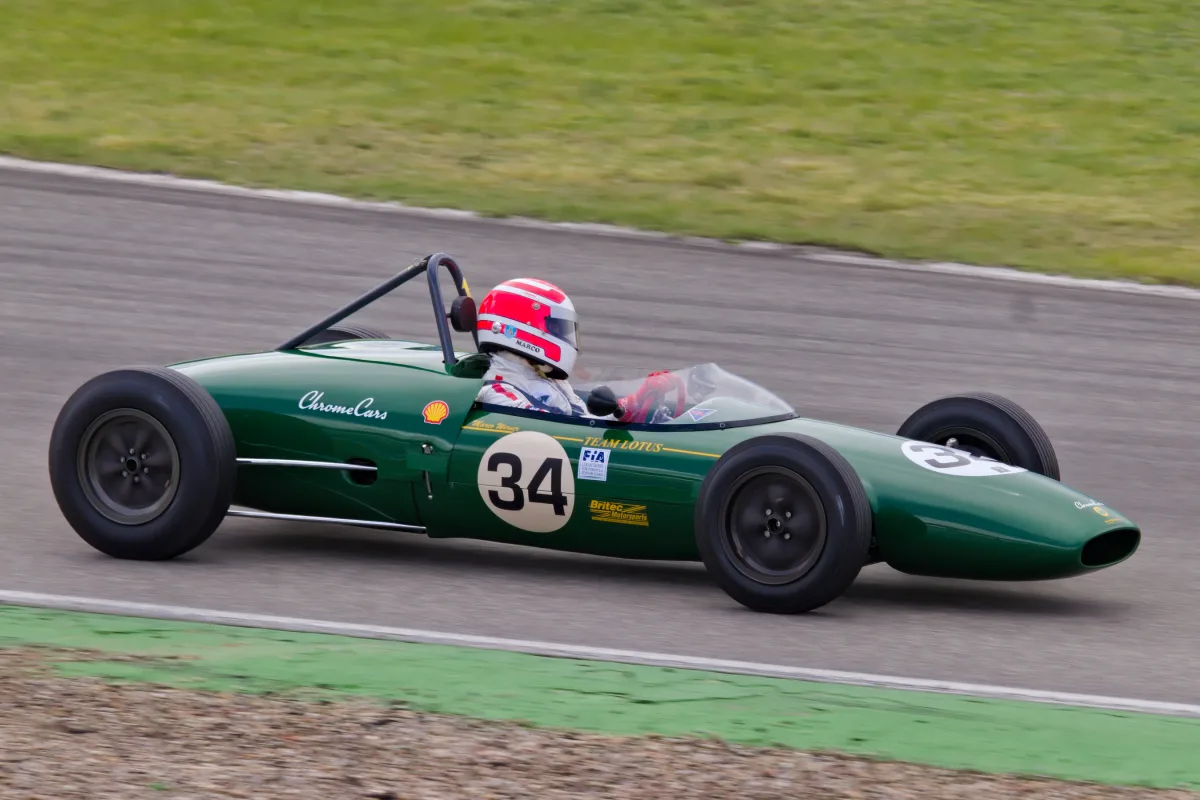
Lotus 22: The 1962 Formula Junior car and the basis for the Lotus 23
Lotus 22 — The 1962 Lotus-built Formula Junior single-seater, produced in 77 units. We review its technology, racing success, and how it became the foundation for other Lotus models.






Lotus 22 in brief
The Lotus 22 was a 1962 Lotus-built race car; a total of 77 units were produced. It was based on the 1961 Lotus 20 but with significant changes.
This is a single-seater Formula Junior class car, not a road-going model, so we focus mainly on its technology and significance.
Technology
Key differences from the Lotus 20: disc brakes on all wheels, an upper wishbone, and a rubber 'spring' in the rear suspension, while the engine had a dry sump and was tilted to lower the centre of gravity. The engine-covering body was smoother than the angular Lotus 20.
Most cars had a 1098 cm³ Cosworth Mk.IV or Mk.XI engine with around 100 hp. Seven Lotus 22s were built with the newly introduced 1498 cm³ Lotus Twin Cam engine for Formula Libre races. The gearbox was a four-speed unit from Renault or Volkswagen.
Racing success
The Lotus 22 was highly successful: Peter Arundell won nearly 75% of the 1962 FIA Formula Junior European Championship races with a factory car. In 1963, the final year of Formula Junior, the 22 still won several early races against the new Lotus 27 until the latter's reliability issues were sorted out.
The Lotus 22 was registered for the South African Grand Prix in both 1963 and 1965 — Brausch Niemann finished 14th in 1963, but failed to qualify in 1965.
Availability and whether it can be viewed
The Lotus 22 served as the basis for the Lotus 23 — essentially a more widespread two-seater 22 with the same suspension and gearbox. The 22 chassis was later revived several times: as the 1964 Lotus 31 Formula 3 car and, most notably, as the 1967 Lotus 51 — the first Formula Ford car built for Jim Russell Racing School in England.
Surviving cars compete in historic racing events, such as Hockenheim Historic, and are owned by collectors.


Versions
This is a race car, so there are no trims; we list the main variants.
Lotus 22 (Formulė Junior)
1962The base version with Cosworth engine.
- 1098 cm³ Cosworth Mk.IV or Mk.XI, around 100 HP
- Disc brakes on all wheels
- Four-speed gearbox from Renault or VW
Lotus 22 su Twin Cam
1962Seven cars with 1498 cm³ engine.
- Lotus Twin Cam engine
- Intended for Formula Libre
- The same frame and suspension
Lotus 22 and related models
| Lotus 20 | Lotus 22 | Lotus 23 | |
|---|---|---|---|
| Who it's for | Formula Junior | Formula Junior | Sports prototypes |
| Brakes | Drums initially, later discs at the front | Discs all around | Discs all around |
| Body | Single-seater | Single-seater | Two-seater |
| Market price (relatively) | €€€ | €€€ | €€€ |
The Lotus 22 — an evolution of the Lotus 20 that became not just a successful Formula Junior car, but also the foundation for the Lotus 23 and later models.
Pros
- Success in Formula Junior racing
- Disc brakes on all wheels
- Basis for the Lotus 23
- Inspired by the Lotus 31 and Lotus 51
Cons
- Can't be driven on public roads
- Limited availability
- A pricey collector's item
Frequently asked questions
How many Lotus 22s were made?
A total of 77 cars.
How does the Lotus 22 differ from the 20?
Disc brakes on all wheels, improved rear suspension, dry-sump engine, and a wider body.
What's the connection between the Lotus 22 and Lotus 23?
The Lotus 23 is essentially a more widely produced two-seater version of the 22 with the same suspension and gearbox.
Updated 2026-10-21 · Trim levels and equipment vary by market and model year — check the equipment of the specific car. · Translated automatically


