 English
 Lietuvių
 Latviešu
 Eesti
 Polski
 Русский
 Українська
 Deutsch
 Nederlands
 Čeština
 Slovenčina
 Svenska
 Norsk
 Dansk
 Suomi


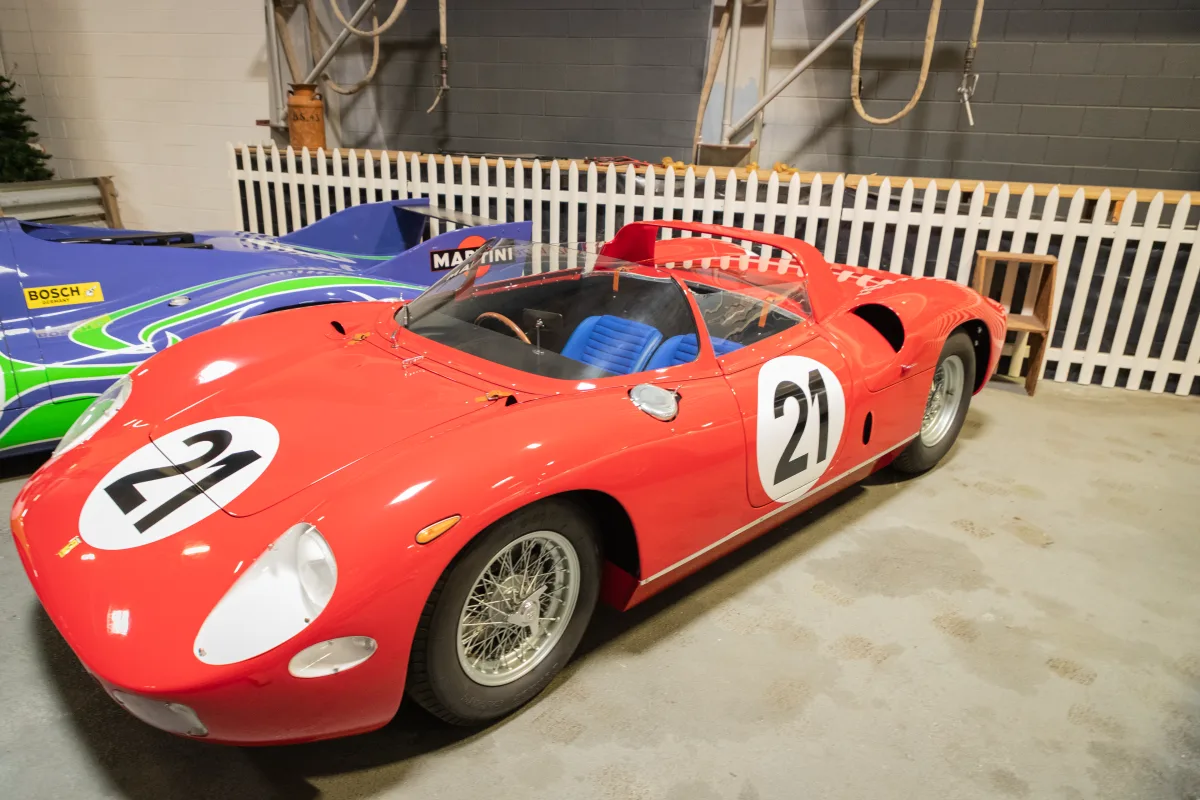
Ferrari 250 P: 1963 Le Mans winner with mid-mounted V12
Ferrari 250 P — 1963 sports prototype, the first Ferrari with a V12 engine behind the driver. It won the 24 Hours of Le Mans, Sebring, and Nürburgring, and here we delve into its construction and history.






250 P in brief
Ferrari 250 P — 1963 open-top sports prototype with a V12 engine behind the driver. This was the first Ferrari 'P' (Posteriore — 'rear') series, which essentially changed Ferrari's approach to racing cars.
Although the name might remind you of the 250 GT road cars, technically it differed from them significantly.
History and development
Until then, Ferrari had refused to move the V12 engine behind the driver, even though 'Cooper' had already won two consecutive Formula 1 championships. The 250 P emerged after the FIA introduced the prototype class in the 1963 World Sportscar Championship.
The car was designed by Mauro Forghieri. Four 250 P chassis were built, along with one development test car; after the 1963 season, all four were converted to 275 P or 330 P specifications.
Technology and achievements
The chassis features a tubular space frame, double wishbone suspension, rack-and-pinion steering, four disc brakes, a longitudinally mounted V12 with a five-speed gearbox and transaxle. The 3.0-litre single overhead camshaft 250 Testa Rossa-type engine was fed by six 'Weber 38 DCN' carburettors, producing around 310 hp at 7,500 rpm.
The 1963 250 P won the Le Mans 24 Hours, Sebring 12 Hours, and Nürburgring 1000 km races. Drivers included John Surtees, Ludovico Scarfiotti, Willy Mairesse, Lorenzo Bandini, and Pedro Rodríguez. In 1964, its successor, the 275 P, took the top three spots at Le Mans.
Where to see it and if it's available for purchase
Surviving 250 P cars are typically owned by collectors and some are displayed in museums or historic racing events.
They rarely come up for sale and prices are not publicly advertised. Moreover, some 250 P cars are now to 275 P or 330 P specifications, making a 'pure' 250 P particularly hard to find.


Versions and evolution
The 250 P marked the beginning of the full range of sports prototypes.
250 P
1963The original rear-engined V12 prototype.
- 3.0-litre V12, around 310 hp
- The first Ferrari with a V12 behind the driver
- Le Mans winner in 1963
275 P / 330 P
1964–1965Improved versions with larger engines.
- 275 P — 3.3-litre, 330 P — 4.0-litre
- Le Mans top three in 1964
- The same tubular frame
250 P and related cars
| Ferrari 250 P | Ferrari 250 LM | Ferrari 330 P | |
|---|---|---|---|
| Years | 1963 | 1963–1964 | 1964–1965 |
| Engine | 3.0-litre V12 | 3.3-litre V12 | 4.0-litre V12 |
| Body | Open prototype | Closed coupé (based on the 250 P) | Open prototype |
| Purpose | Factory team and NART | Customer racing | Factory team and NART |
The 250 P was the first of the line, with the 250 LM appearing as its closed-body version, and the 330 P taking over with a larger engine.
Pros
- The first Ferrari with a V12 behind the driver
- Mauro Forghieri design
- Victories at Le Mans, Sebring, and the Nürburgring in 1963
- Kicked off the successful P family
Cons
- Very rare — only four road-going examples
- Most converted to 275 P/330 P
- Built solely for racing
Frequently asked questions
How many Ferrari 250 P were made?
Four road-going examples and one prototype were produced.
Why is it called the 'P'?
'P' stands for 'Posteriore' — rear-engine.
How does it differ from the 250 GTO?
The 250 P is an open prototype with a central V12 and a spaceframe, while the 250 GTO is a front-engined GT car.
Updated 2026-10-21 · Trim levels and equipment vary by market and model year — check the equipment of the specific car. · Translated automatically


