 English
 Lietuvių
 Latviešu
 Eesti
 Polski
 Русский
 Українська
 Deutsch
 Nederlands
 Čeština
 Slovenčina
 Svenska
 Norsk
 Dansk
 Suomi


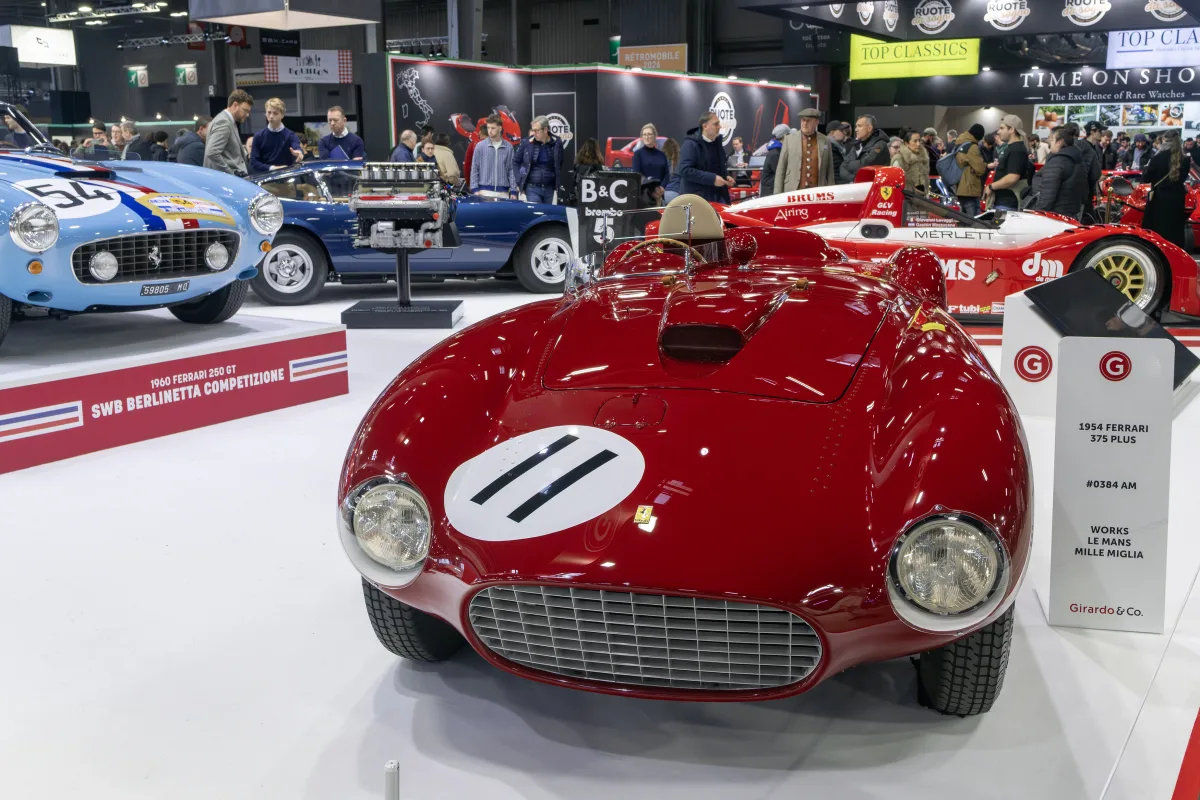
Ferrari 375 Plus: The Le Mans winner with nearly 5-litre V12
Ferrari 375 Plus — the 1954 sports racing car with nearly 5-litre Lampredi V12 engine. It won the 24 Hours of Le Mans and the Carrera Panamericana, and here we delve into its history, technology, and the unique cabriolet made for a king.






375 Plus in brief
Ferrari 375 Plus — the sports racing car produced in 1954, which was the first to receive nearly 5-litre Lampredi V12. The model competed in international races and won many prestigious events, including the 24 Hours of Le Mans and the Carrera Panamericana.
The body — a 'Pinin Farina' spyder based on the 375 MM style, but with a larger rear fuel tank bulge.
History and creation
The engine was developed based on the experience of the 375 MM and 375 Formula 1 cars: bore — 84 mm, stroke — 74.5 mm, displacement — around 4,954 cm³. New was also the 505 type steel tube frame.
The wheelbase (2,600 mm) remained the same as the 375 MM, but the rear axle became 'de Dion' type, which improved balance and grip. The brakes were still drum, and the fuel tank — 190 litres, very advantageous in long races.
Technology and achievements
Most cars developed around 330 HP at 6,000 rpm, some up to 345 HP, and the top speed reached around 280 km/h. The engine was fed by three 'Weber 46 DCF/3' carburetors.
The career started slowly — the car didn't finish either the Giro di Sicilia or the Mille Miglia. Nevertheless, in 1954, José Froilán González and Maurice Trintignant won the 24 Hours of Le Mans for the first time since Ferrari's 1949 victory, beating the factory Jaguar D-Type. Additionally, they won the Carrera Panamericana, the Buenos Aires 1000 km, the Agadir GP, and the Silverstone races.
Where to spot one and whether it's possible to buy
Some 375 Plus examples are displayed in museums and prestigious car concours, others in private collections. They also appear at classic car shows and fairs.
The model is rarely for sale, and the price is not publicly advertised. It's one of the most valuable 1950s Ferrari racing cars.


Versions and evolution
The 375 Plus examples were racing cars, but one unique road car is also known.
375 Plus spyderis
1954The main racing version with a Pinin Farina body.
- Approximately 5.0 L V12, approximately 330 HP
- De Dion rear axle
- Le Mans 24 Hours winner
Karaliaus Leopoldo III kabrioletas
1955A one-off two-seater cabriolet built on the 375 Plus chassis.
- Commissioned by King Leopold III of Belgium
- Pinin Farina grand tourer-style body
- First painted black, later red
The 375 Plus and Ferrari's close relatives
| Ferrari 375 Plus | Ferrari 375 MM | Ferrari 340 MM | |
|---|---|---|---|
| Year | 1954 | 1953–1955 models | 1953 model |
| Engine | Approximately 5.0-litre V12 | 4.5-litre V12 | 4.1-litre V12 |
| Produced | Limited run | 26 | 10 |
| Most famous fact | 1954 Le Mans winner | The mighty 'Bergman Coupé' | 1953 Mille Miglia winner |
The 375 Plus — the most powerful of the trio and the only one to win the 24 Hours of Le Mans.
Pros
- Le Mans 24-hour victory in 1954
- Nearly 5-litre Lampredi V12 engine
- De Dion rear axle and improved balance
- One-off cabriolet built for the king
Cons
- Extremely rare and expensive
- Drum brakes
- Built for racing, not daily driving
Frequently asked questions
Did the Ferrari 375 Plus win the Le Mans race?
Yes. In 1954, José Froilán González and Maurice Trintignant won the 24 Hours of Le Mans.
Why is it called the 'Plus'?
The name indicates it's a larger-displacement version of the 375 model — the engine is nearly 5 litres.
Is there a convertible version of the car?
There's a one-off cabriolet that was built for King Leopold III of Belgium by Pinin Farina and completed in 1955.
Updated 2026-10-21 · Trim levels and equipment vary by market and model year — check the equipment of the specific car. · Translated automatically


