 English
 Lietuvių
 Latviešu
 Eesti
 Polski
 Русский
 Українська
 Deutsch
 Nederlands
 Čeština
 Slovenčina
 Svenska
 Norsk
 Dansk
 Suomi


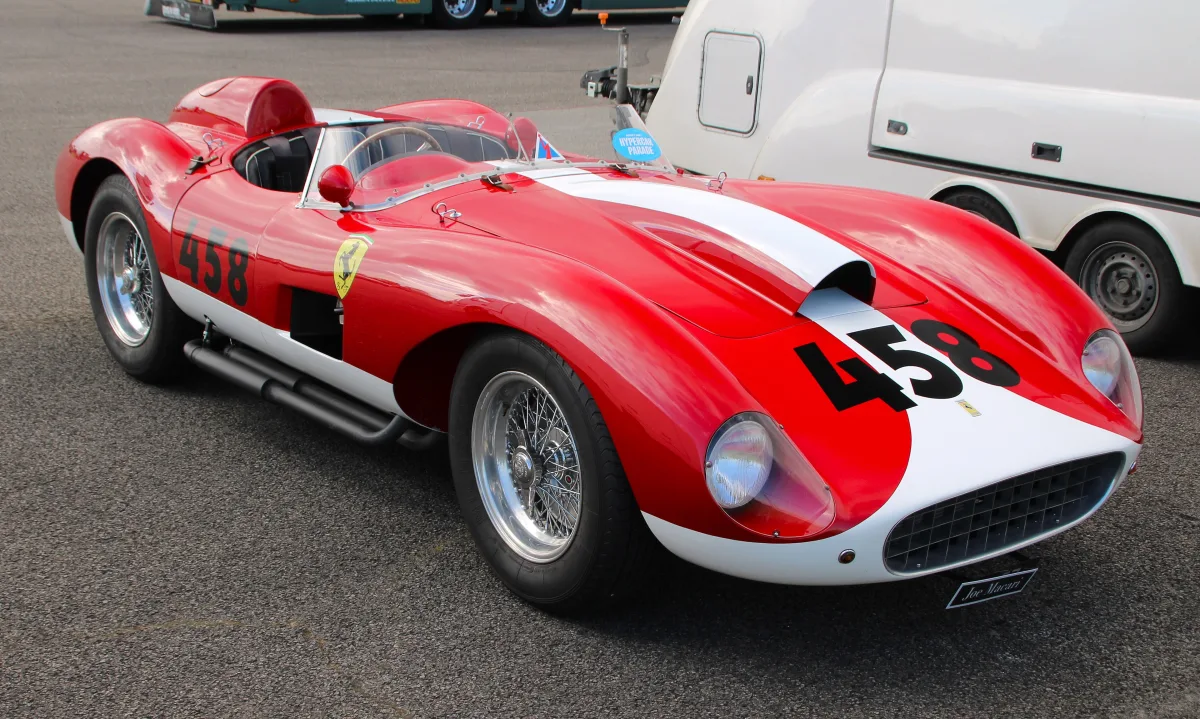
Ferrari 500 TRC: the final four-cylinder racing Ferrari
Ferrari 500 TRC — the 1956–1957 two-litre four-cylinder racing car tailored to international regulations. Here, we explore what set it apart from the 500 TR, what was changed, and the results it achieved.






The 500 TRC in brief
Ferrari 500 TRC — the 1956–1957 two-litre racing car with a four-cylinder engine. This was the last four-cylinder racing Ferrari produced in a series.
The name means 'Testa Rossa Competizione' modified according to Appendix C of the International Racing Code — the letter 'C' was added due to regulations.
History and development
This is the modified 500 TR version. According to Appendix C requirements, Ferrari widened the cabin, added passenger doors, fitted a full-width windscreen with wipers, a 120-litre fuel tank, and even a collapsible roof.
The Scaglietti-built body was similar to the 500 TR, but with a lower engine cover and slightly differently shaped wheel arches. The wheelbase — 2,350 mm — was inherited from the 860 Monza.
Technology and achievements
The four-cylinder two-litre engine, like the 500 TR, produced around 180 bhp, and the car weighed just about 680 kg. The suspension was coil springs all round, with a rigid rear axle.
Ferrari produced a total of 19 units of this model between 1956 and 1957. Although the factory never raced the 500 TRC as an official team, independent teams and drivers had success with it: in 1957 at Le Mans, one of them secured 7th place overall and won the 2,000 cm³ class, and in 1958 at Targa Florio, this class was also claimed by the 500 TRC.
Where to see it and if it can be purchased
500 TRC cars often participate in historic racing events, such as Goodwood, and classic car concours.
They rarely come up for sale, usually at specialist auctions or privately; prices are not publicly advertised and depend on the specific history of the car.


Versions and Evolution
Several types of cars were produced under this name.
500 TRC
1956–1957The main series consists of 19 built units.
- Approximately 2.0-litre four-cylinder, around 180 HP
- Modified according to Appendix C regulations
- Weight around 680 kg
625 TRC
1957A very rare variant — two 500 TRCs were converted to the 2.5-litre specification.
- Two examples
- The larger, 2.5-litre engine
- This one belonged to John von Neumann
500 TRC and similar models
| Ferrari 500 TRC | Ferrari 500 TR | Ferrari 860 Monza | |
|---|---|---|---|
| Year | 1956–1957 | 1955 | 1956 |
| Engine | 2.0-litre four-cylinder | 2.0-litre four-cylinder | 3.4-litre four-cylinder |
| Power | Around 180 hp | Around 180 hp | Around 280 hp |
| Key difference | Compliant with C-group regulations | The first 'Testa Rossa' | Larger engine, longer wheelbase |
The 500 TRC retained the lightweight 500 TR construction but gained a more comfortable and regulation-compliant cabin; the 860 Monza offered significantly more power but also a heavier weight.
Pros
- Lightweight and agile (around 680 kg)
- The elegant Scaglietti body
- Class victories at Le Mans and Targa Florio
- More practical than the 500 TR (doors, roof, washers)
Cons
- Only 19 units produced
- A prized collector's item
- A small engine compared to its V12 counterparts
Frequently asked questions
How many Ferrari 500 TRCs were made?
A total of 19 units were produced between 1956 and 1957
What does the 'C' in the name signify?
The letter 'C' indicates that the car is adapted to the requirements of Appendix C of the International Racing Code (wider cabin, doors, glass, larger tank, etc.)
Why is the 500 TRC known as the last four-cylinder Ferrari race car?
Because it was the last four-cylinder Ferrari race car produced in series.
Updated 2026-10-21 · Trim levels and equipment vary by market and model year — check the equipment of the specific car. · Translated automatically


