 English
 Lietuvių
 Latviešu
 Eesti
 Polski
 Русский
 Українська
 Deutsch
 Nederlands
 Čeština
 Slovenčina
 Svenska
 Norsk
 Dansk
 Suomi


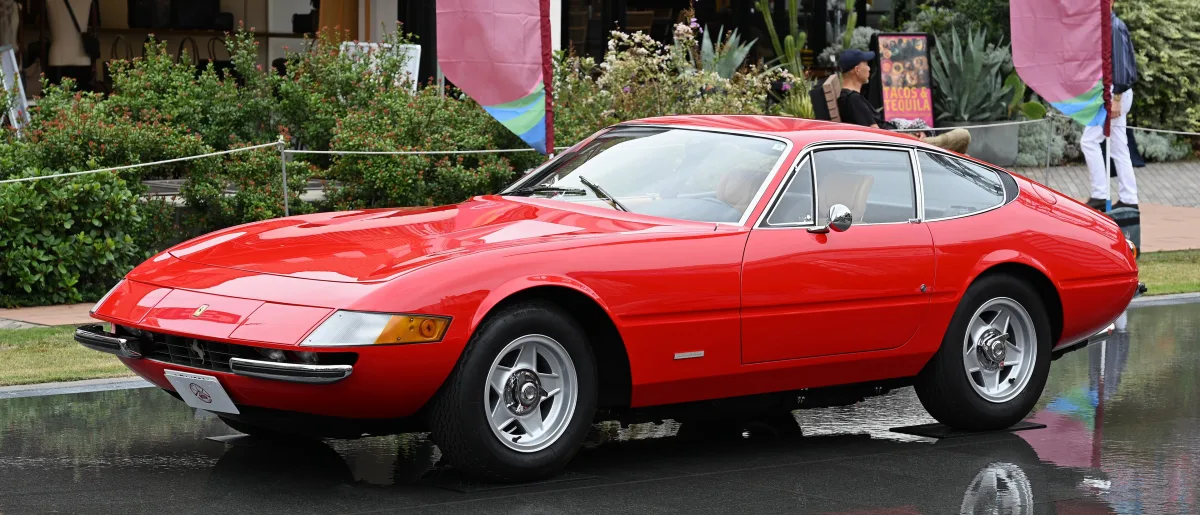
Ferrari Daytona (365 GTB/4): V12, Spider and collector's value
The Ferrari 365 GTB/4, unofficially known as the Daytona, produced from 1968 to 1973, is one of the most famous classic Ferraris with a front-mounted V12. We look at the coupé and Spider versions, the engine, gearbox, and what to check when evaluating such a collectible car.






Daytona in brief
The official name is Ferrari 365 GTB/4, but 'Daytona' stuck after Ferrari's 1967 victory in the 24 Hours of Daytona. The body was designed by 'Pininfarina', and the car is considered the last Ferrari berlinetta with a front-mounted V12 before the mid-engine 365 GT4 BB.
The Daytona stands out with its long hood, short rear end, and sporty stance. Today, it is one of the most valuable classic Ferraris, making it a rare sight on the market.
Versions and differences
The main version is the berlinetta (coupé) 365 GTB/4. In 1969, the open-top 365 GTS/4 Spider was introduced, of which very few were made. There were also 'Competizione' versions built for racing.
Early models had headlights behind a clear cover, while later versions switched to pop-up headlights. The choice largely depends on the body type, trim, and the car's history.
Engine and gearbox
The Daytona features a 4.4-litre V12 petrol engine, producing around 350 HP. The gearbox is a 5-speed manual, mounted at the rear axle (transaxle). There was no automatic option.
This is a powerful but technically simpler engine than later Ferraris. However, its maintenance and repairs are expensive, as specialist mechanics are required.
What to check when evaluating a Daytona
The most important thing is authenticity and documentation: body, engine, and chassis numbers, history, and restoration work. The price of this model greatly depends on its originality, so the inspection should be carried out by an independent Ferrari classic specialist.
Inspect the body for corrosion and poor repairs, the engine and gearbox, suspension and brakes. Before buying, also check if the car hasn't been converted to a different body type—such cases do occur.


Trim levels
Names and equipment vary by market and year; we list the most commonly found trim levels in Europe.
365 GTB/4 berlinetta
1968–1973The main closed coupé with a 4.4-litre V12.
- 4.4-litre V12, around 350 hp
- 5-speed manual gearbox (transaxle)
- Often features a leather interior
365 GTS/4 Spider
1969–1973Open body, produced in very limited numbers.
- Open body
- 4.4-litre V12
- Very rare
365 GTB/4 Competizione
Limited editionRace-prepped version
- Race-tuned
- More powerful engine
- A highly collectible car
Comparing Daytona editions
| GTB/4 | GTS/4 Spider | Competizione | |
|---|---|---|---|
| Who it's for | Most collectors | For open-top enthusiasts | For racing history buffs |
| Body style | Coupe | Convertible | Coupe |
| Engine | 4.4-litre V12 | 4.4-litre V12 | The more powerful 4.4-litre V12 version |
| Price in the used market (relatively) | €€€€ | €€€€ | €€€€ |
The original berlinetta with a full history is the most collector-friendly option. Spider and Competizione are rarer and even pricier choices.
Pros
- Classic Pininfarina design
- Powerful V12 and manual gearbox
- Collector value and prestige
- Long-term historical significance
Cons
- Very high price and limited supply
- Expensive maintenance and restoration
- Authenticity must be verified
Frequently asked questions
Why is the Ferrari 365 GTB/4 called the Daytona?
The name stuck after Ferrari's victory in the 1967 24 Hours of Daytona; the model is officially known as the 365 GTB/4.
Does the Daytona have an automatic gearbox?
No — it only has a 5-speed manual gearbox.
Was the Daytona open-top?
Yes, there was the 365 GTS/4 Spider, but very few were made.
Updated 2026-10-19 · Trim levels and equipment vary by market and model year — check the equipment of the specific car. · Translated automatically


