 English
 Lietuvių
 Latviešu
 Eesti
 Polski
 Русский
 Українська
 Deutsch
 Nederlands
 Čeština
 Slovenčina
 Svenska
 Norsk
 Dansk
 Suomi


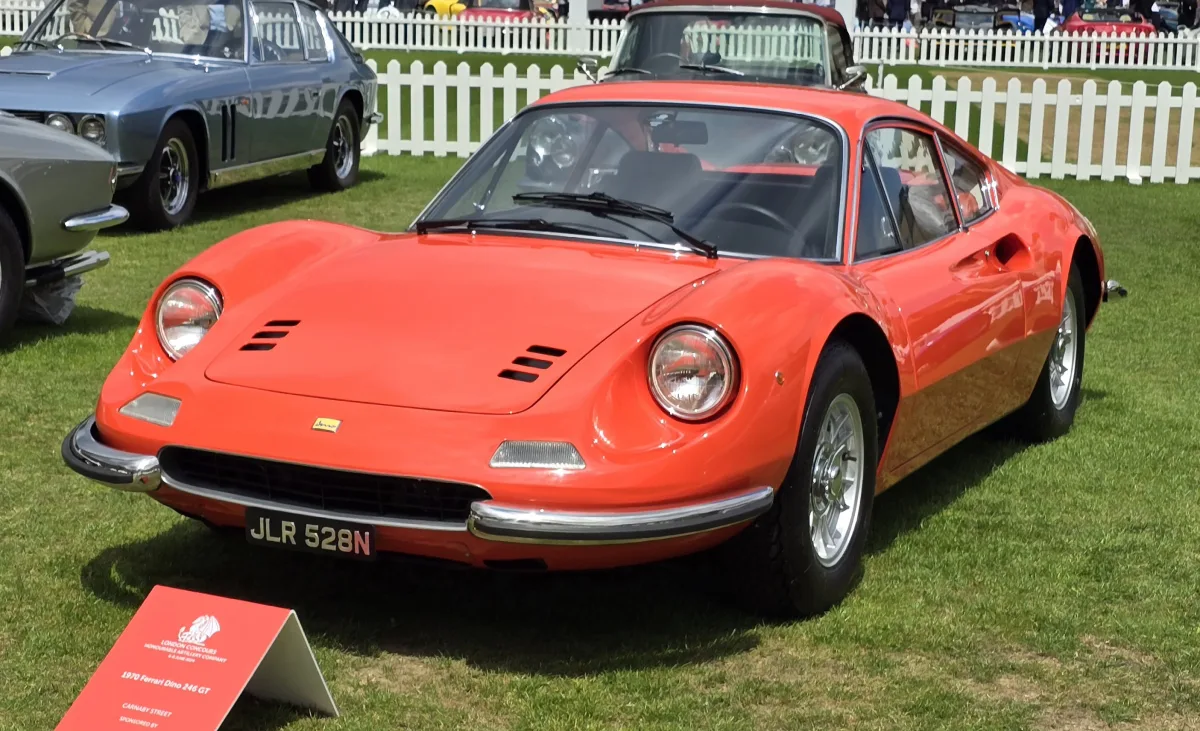
Ferrari Dino 246: generations, engine and what to know when buying
The Dino 246 GT and GTS are mid-engine sports cars produced from 1969 to 1974 with a 2.4-litre V6, sold under the Dino badge and considered the first Ferrari model produced in large quantities. We look at their generations, engine and what to check when buying.






Dino 246 in brief
The Dino name was given in memory of Enzo Ferrari's son Alfredo 'Dino' Ferrari, who developed the V6 engine. From 1967 to 1974, Ferrari produced mid-engine sports cars under the Dino badge: the 206 GT, 246 GT and 246 GTS. The Ferrari name was reserved for V12 and flat V12 models at the time.
The 246 is considered the first Ferrari model produced in large quantities. Its styling was created by Pininfarina, and the bodies were built by Scaglietti. The engines were made by Fiat, and some Fiat models were based on them.
Engine and tech
The 246 has a transversely mounted 2.4-litre (2419 cc) 65° V6 engine with two distributor drives and three Weber carburettors. It produces around 195 hp (143 kW) at 7600 rpm, with torque of around 226 Nm. The US-market version was detuned to around 175 hp.
The body was mostly steel (the 206 GT had aluminium), with a wheelbase of 2340 mm, 53 mm longer than the 206. The manufacturer quoted a top speed of around 235 km/h.
Generations — L, M and E
The first series (L) consisted of 357 examples built until the summer of 1970. It used the same central-locking wheels and 'fluttering hands' wipers as the 206 model.
Second series (M) — 507 units produced until July 1971, featuring five-spoke 'Cromodora' alloy wheels and parallel sliding windows. Third series (E) — minor gear ratio and fuel delivery differences, produced in much larger quantities as it began selling in the USA: 1431 GT coupé and 1274 GTS.
The 246 GTS (with removable roof) was produced only from 1972 to 1974. In total, 2295 GT coupés and 1274 GTS were made, amounting to 3569 cars.
What to know when buying a Dino 246
Before purchasing, check the VIN, body, and engine numbers, history, and, if possible, the 'Ferrari Classiche' certificate. There are many copies (replicas), so independent expertise is essential.
The body is mostly steel, so corrosion is the main issue: inspect the sills, door bottoms, wheel arches, and rear screen. Major engine and gearbox overhauls are expensive, so ask when they were last done.
These cars are sold through specialist dealers and auctions. When buying from abroad, check import documents and taxes in advance.


Series and versions
Series names and equipment vary by market; we outline the main Dino 246 versions.
246 GT — L serija
1969–1970The first series, closest to the 206.
- 357 cars produced
- Central locking wheels
- 'Floating hands' steering wheel
246 GT — M serija
1970–1971The second series with refreshed styling.
- 507 cars produced
- Five-speed “Cromodora” gearbox
- Parallel sliding doors
246 GT — E serija
1971–1974Third series, most produced.
- 1431 GT coupé
- Different gearbox and fuel delivery
- Launched in the USA
246 GTS
1972–1974Version with removable roof.
- Removable roof
- 1274 cars produced
- Based on the E series
Series comparison
| L serija | M serija | E serija | |
|---|---|---|---|
| Who it suits | For collectors seeking the earliest 246 | For those hunting down the transitional series | For those prioritising the offering |
| Produced | 357 units | 507 units | 1431 GT (excluding 1274 GTS) |
| Steering wheel | Central steering wheel | Five-spoke “Cromodora” wheels | Differs from earlier series |
| Price in the used market (relatively) | €€€ | €€€ | €€€ |
For most buyers, the E series is the easiest to find, while the L and M series are rarer and more collectible. The key is the condition of the bodywork and its originality.
Pros
- Stunning “Pininfarina” design
- Balanced mid-engine layout
- The first Ferrari produced in large numbers
- Lively, high-revving V6 engine
Cons
- Bodywork prone to rust
- Expensive engine and gearbox repairs
- Many copies around — independent inspection essential
Frequently asked questions
Is the Dino 246 a Ferrari?
This is a Ferrari-built car sold under the separate Dino marque, which lasted until 1976. It is often referred to as the Ferrari Dino.
How many 246s were made?
A total of 3569 cars: 2295 GT coupes and 1274 GTS.
What’s the difference between the L, M and E series?
They differ in wheels, headlights, engine cooling and fuel delivery. The first (L) is 357 cars, the second (M) is 507, and the third (E) is the most numerous and includes US sales.
Updated 2026-10-21 · Trim levels and equipment vary by market and model year — check the equipment of the specific car. · Translated automatically


