 English
 Lietuvių
 Latviešu
 Eesti
 Polski
 Русский
 Українська
 Deutsch
 Nederlands
 Čeština
 Slovenčina
 Svenska
 Norsk
 Dansk
 Suomi


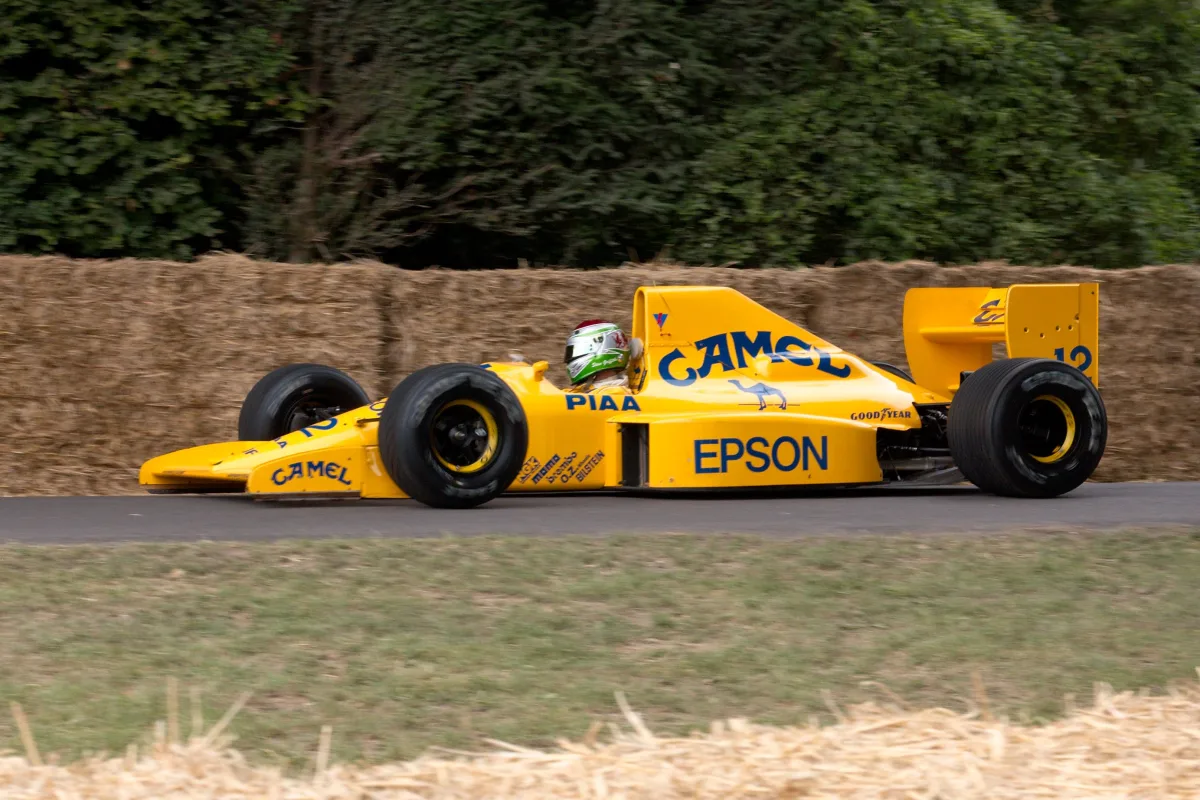
Lotus 101: The 1989 Formula 1 car with the Judd V8 engine
The Lotus 101 — the 1989 Team Lotus Formula 1 car with the Judd V8 engine, driven by Nelson Piquet and Satoru Nakajima. We look back at how it was created during the transition to naturally aspirated engines and why the season proved challenging.






Lotus 101 in brief
The Lotus 101 was the car with which the team competed in the 1989 Formula 1 World Championship. It was driven by three-time champion Nelson Piquet and Satoru Nakajima.
This is a race car, not a road model, so the article focuses mainly on its development and the significance of the season. The striking yellow Camel colour scheme became one of the most recognisable symbols of that year.
Design and technology
Gérard Ducarouge's departure in 1988 led to Frank Dernie being appointed as technical director, but the majority of the work was carried out by chief designer Mike Coughlan. The car was developed quickly, over a few weeks.
With the end of the 1.5-litre turbo era, the team opted for the Judd CV V8 naturally aspirated engine. To compensate for the power deficit, a five-valve cylinder head was attempted with Tickford, but this idea was later abandoned. The smaller engine allowed the car to be more compact and lighter.
Season
Initial optimism quickly faded: the Judd engine produced around 610 bhp — roughly 80 bhp less than the dominant McLaren Honda V10, and the Goodyear tyres were primarily suited to McLaren and Ferrari. In the first seven races, points were scored just once.
After the British Grand Prix, where Piquet finished fourth, the Chapman family convinced Peter Warr and chairman Fred Bushell to leave the team, with Tony Rudd taking over as managing director. At Spa, both Lotus cars failed to qualify for the first time since 1958, but by the end of the season, Piquet finished fourth in Japan and Nakajima did the same in Australia — Nakajima also set the fastest lap in the rain.
Value and availability
Over the season, the team scored 15 points — the most Lotus had earned in a year with naturally aspirated engines since the team's collapse at the end of 1994.
Surviving examples belong to collections and museums; at historic car events, such as Goodwood, you might spot one out on the track 101 times.


Versions
This is a race car, so there are no trims; we list the main variants.
Lotus 101
1989The sole 1989 version with the Judd V8 engine.
- Judd CV V8, 3.5-litre naturally aspirated
- Smaller and lighter than its predecessors
- Camel colour scheme
The Lotus 101 and close predecessors
| Lotus 100T | Lotus 101 | Lotus 102 | |
|---|---|---|---|
| Who it's for | Enthusiasts of racing history | Enthusiasts of racing history | Enthusiasts of racing history |
| Engine | Honda turbo V6 | Judd V8 | Lamborghini V12 |
| Season | 1988 | 1989 | 1990 |
| Market price (relatively) | Practically unattainable | Practically unattainable | Practically unattainable |
The Lotus 101 — a transitional era car: an underpowered engine and tires prevented it from achieving more, despite finishing the season in two fourth-place positions.
Pros
- Recognizable Camel color scheme
- A compact naturally-aspirated car
- The highest Lotus points tally in the era of naturally-aspirated engines
- Driven by three-time champion Piquet
Cons
- The engine was less powerful than rivals'
- Can't be driven on public roads
- The season was challenging
Frequently asked questions
What engine did the Lotus 101 have?
The Judd V8 3.5-litre naturally aspirated engine.
Who drove the Lotus 101?
Nelson Piquet and Satoru Nakajima.
How many points did the Lotus 101 score?
The team amassed 15 points during the 1989 season.
Updated 2026-10-21 · Trim levels and equipment vary by market and model year — check the equipment of the specific car. · Translated automatically


