 English
 Lietuvių
 Latviešu
 Eesti
 Polski
 Русский
 Українська
 Deutsch
 Nederlands
 Čeština
 Slovenčina
 Svenska
 Norsk
 Dansk
 Suomi


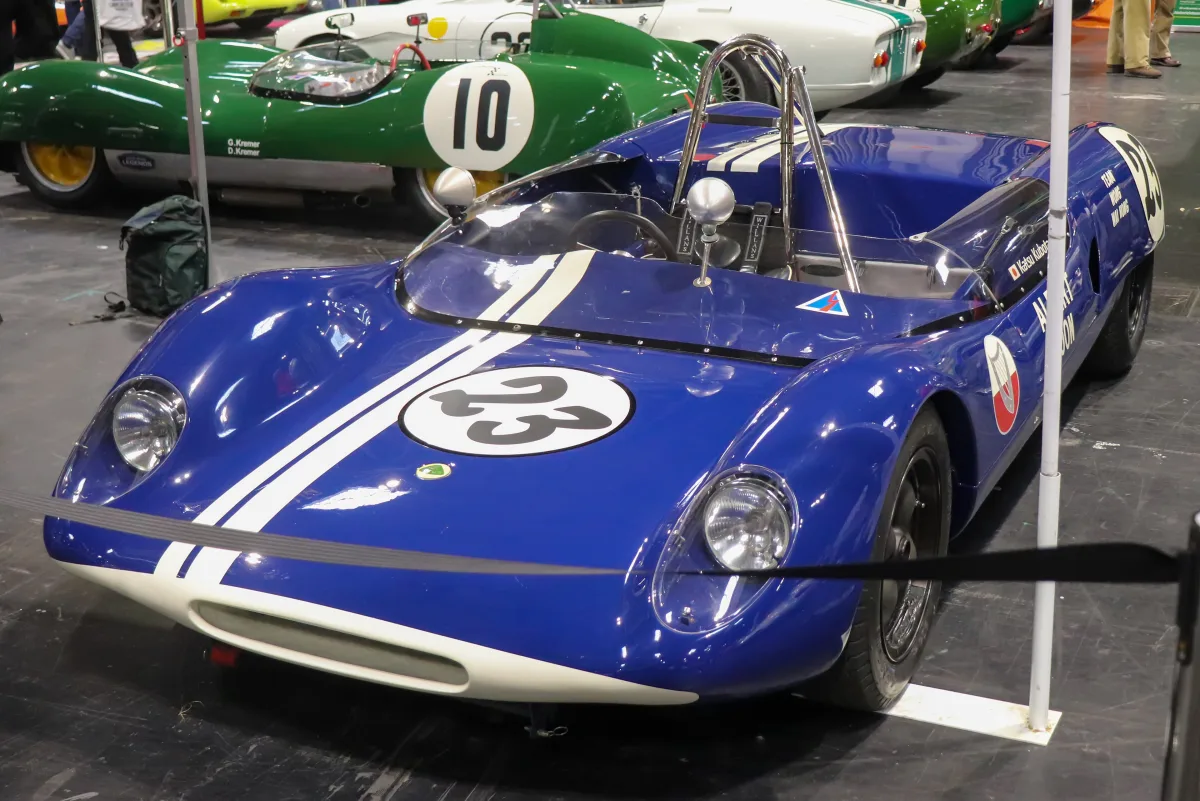
Lotus 23: 1962–1963 light sports racing car
The Lotus 23 is a small-displacement sports racing car designed by Colin Chapman for FIA Group 4 in 1962–1963. We look at its technology, debut at Nürburgring, and history in the Le Mans races.






Lotus 23 in brief
The Lotus 23 was a small-displacement sports racing car designed by Colin Chapman specifically for FIA Group 4 racing in 1962–1963. Officially, it was a two-seater.
Unlike the earlier Lotus 15 and 17, the engine was mounted behind the driver, similar to the Lotus 19.
The technology
To comply with FIA regulations, the car had to have the required boot space, windscreen wipers, indicators, headlight pairs, handbrake, and spare wheel. It used the wider Lotus 22 spaceframe with a fibreglass body.
Initially, 750–1300 cm³ engines with a Renault 4-speed gearbox were planned, but in production, the 5-speed Hewland Mk.III was mostly used. Weight was just around 450 kg.
The Nürburgring debut
The Lotus 23 made its debut on May 27, 1962, in the 1000 km race at the Nordschleife circuit. The small, roughly 100 hp car with the newly developed 1.5 l Cosworth Mk.X engine, based on the Lotus Twin Cam, and with Jim Clark at the wheel, pulled away from more powerful competitors right from the start.
Clark led by 27 seconds at the end of the first lap, but on the 12th lap, exhaust gases from a damaged exhaust collector disoriented him and he spun off the track. The other Lotus 23 with a pushrod Cosworth Mk.III engine won the 1-litre sports car class and finished eighth overall.
Le Mans and legacy
After success at Nürburgring, the two Lotus 23s were entered for the 1962 Le Mans race, but failed to pass technical inspection due to several technical requirements, including the spare wheel issue.
Lotus remains renowned as one of the most iconic small-displacement sports cars. Surviving examples (23, 23B, 23C) can be seen at historic racing events and in collections.


Versions
This is a race car, so there are no trims; we list the main variants.
Lotus 23
1962The initial version for Group 4.
- Spaceframe chassis, fibreglass body
- Small-displacement engines ranging from 750 to 1300 cm³
- Engine behind the driver
Lotus 23B
1962–1963Later version.
- The same core design principle
- Wheels as in the original 23 version
- A frequent participant in historic racing events
Lotus 23C
1962–1963Version with wider wheels.
- Wider 6-spoke wheels at the front and rear
- The same core design principle
- Later version
Comparing Lotus 23 variants
| Lotus 23 | Lotus 23B | Lotus 23C | |
|---|---|---|---|
| Who it's for | Historic racing | Historic racing | Historic racing |
| Wheels | 4-spoke at the front, 6-spoke at the rear | 4-spoke at the front, 6-spoke at the rear | 6-spoke at the front and rear |
| Market price (relatively) | €€€ | €€€ | €€€ |
All Lotus 23 variants are collector's items and historic racing participants; the choice depends on the specific car's provenance.
Pros
- Very light and fast for its time
- Legendary Nürburgring debut
- Central engine layout
- The popularity of historic racing
Cons
- Couldn't compete in the Le Mans race in 1962
- Buying is expensive and complicated
- Limited comfort
Frequently asked questions
What’s the fame of the Lotus 23?
It gained fame in its 1962 Nürburgring 1000 km debut, when Jim Clark in the wet easily outpaced much more powerful rivals.
Did the Lotus 23 compete in the Le Mans race?
Failed the technical inspection in 1962 because the spare wheel issue wasn’t resolved.
What size engines did the Lotus 23 have?
Initially, 750–1300 cm³ engines were planned, but a 1.5-litre Cosworth was used in the debut.
Updated 2026-10-21 · Trim levels and equipment vary by market and model year — check the equipment of the specific car. · Translated automatically


