 English
 Lietuvių
 Latviešu
 Eesti
 Polski
 Русский
 Українська
 Deutsch
 Nederlands
 Čeština
 Slovenčina
 Svenska
 Norsk
 Dansk
 Suomi


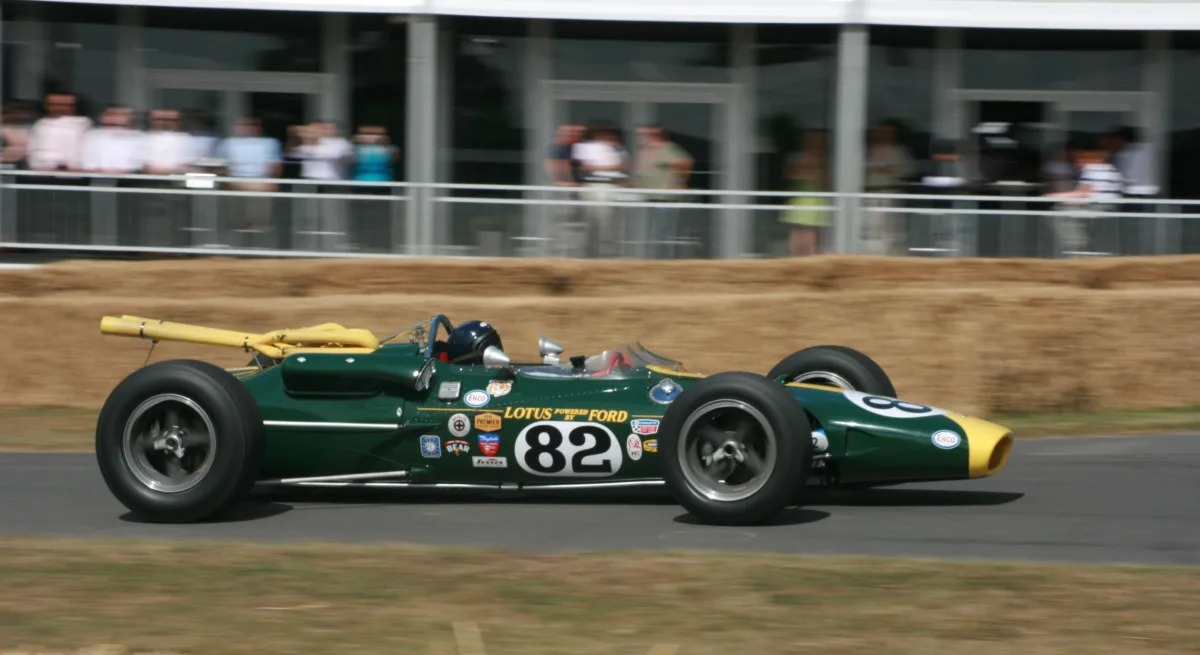
Lotus 38: the first rear-engined winner of the Indianapolis 500
The Lotus 38 — a 1965 Indianapolis 500 race car with a central engine designed by Colin Chapman and Len Terry, with which Jim Clark first won these races with a rear-engined car. We look at its technology and significance.






Lotus 38 in brief
The Lotus 38 was the first rear-engined (central) car to win the Indianapolis 500 — in 1965 with Jim Clark. Lotus used it in Indianapolis from 1965 to 1967; a total of 8 cars were produced, most for Lotus's own use, but a few were sold to other racers, including A. J. Foyt and Mario Andretti.
This is a race car, not a road model, so the article focuses mainly on its technology and significance.
Technology
The car was designed by Colin Chapman and Len Terry as a development of the earlier Lotus 29 and Lotus 34 Indy cars, but now with a full monocoque chassis. The engine is a four-cam Ford V8 with fuel injection, around 500 HP.
The car was significantly larger than contemporary Formula 1 cars. Its standout feature was the 'offset' suspension: the body was pushed to the left relative to the axles, using unequal-length wishbones. Theoretically, this was suited to oval tracks, but in practice, the handling was so unique that the idea didn't catch on.
The 1965 victory
In the 1965 Indianapolis 500, Clark qualified in second place, led for nearly the entire race, and won with an average speed of 150.686 miles per hour (around 242.5 km/h). This was the first time the Indianapolis 500 average speed exceeded 150 miles per hour.
The victory demonstrated that rear-engine cars could successfully compete at Indianapolis and marked the end of the front-engine 'roadster' era.
Later seasons and whether they can be seen
In 1966, the Lotus 38 returned to Indianapolis, but after a mix-up over the scoring pylon, Graham Hill took the win with a Lola. In 1967, Clark retired early due to an engine failure.
Surviving cars belong to museums and collectors; the Lotus 38 can be seen at the Goodwood Festival of Speed and other historic racing events.


Versions
This is a race car, so there are no trims; we list the main variants.
Lotus 38
1965–1967Indianapolis 500 car with a monocoque chassis.
- Four-speed Ford V8, around 500 bhp
- 'Lotus' suspension
- Just eight built
The Lotus 38 and its predecessors
| Lotus 29 | Lotus 34 | Lotus 38 | |
|---|---|---|---|
| Who's it for | For Indianapolis history enthusiasts | For Indianapolis history enthusiasts | For Indianapolis history enthusiasts |
| Chassis | Predecessor | Predecessor | Full monocoque |
| Engine | Ford V8 | Ford V8 | Ford V8, around 500 HP |
| Market price (relatively) | Practically unattainable | Practically unattainable | Practically unattainable |
The Lotus 38 — one of the most significant Indianapolis cars: it proved that the mid-engine layout is superior and changed these races.
Pros
- First win at Indianapolis with a rear-engine car
- Full monocoque chassis
- Jim Clark's success
- Major influence on later Indy cars
Cons
- Distinct handling due to the swing-axle suspension
- Can't be driven on public roads
- Buying one is practically impossible
Frequently asked questions
Did the Lotus 38 win the Indianapolis 500?
Yes, in 1965 with Jim Clark.
How many Lotus 38s were made?
Just eight cars in total.
Why is the Lotus 38 important?
It was the first rear-engined car to win the Indianapolis 500, and it marked the end of the front-engined 'roadster' era.
Updated 2026-10-21 · Trim levels and equipment vary by market and model year — check the equipment of the specific car. · Translated automatically


