 English
 Lietuvių
 Latviešu
 Eesti
 Polski
 Русский
 Українська
 Deutsch
 Nederlands
 Čeština
 Slovenčina
 Svenska
 Norsk
 Dansk
 Suomi


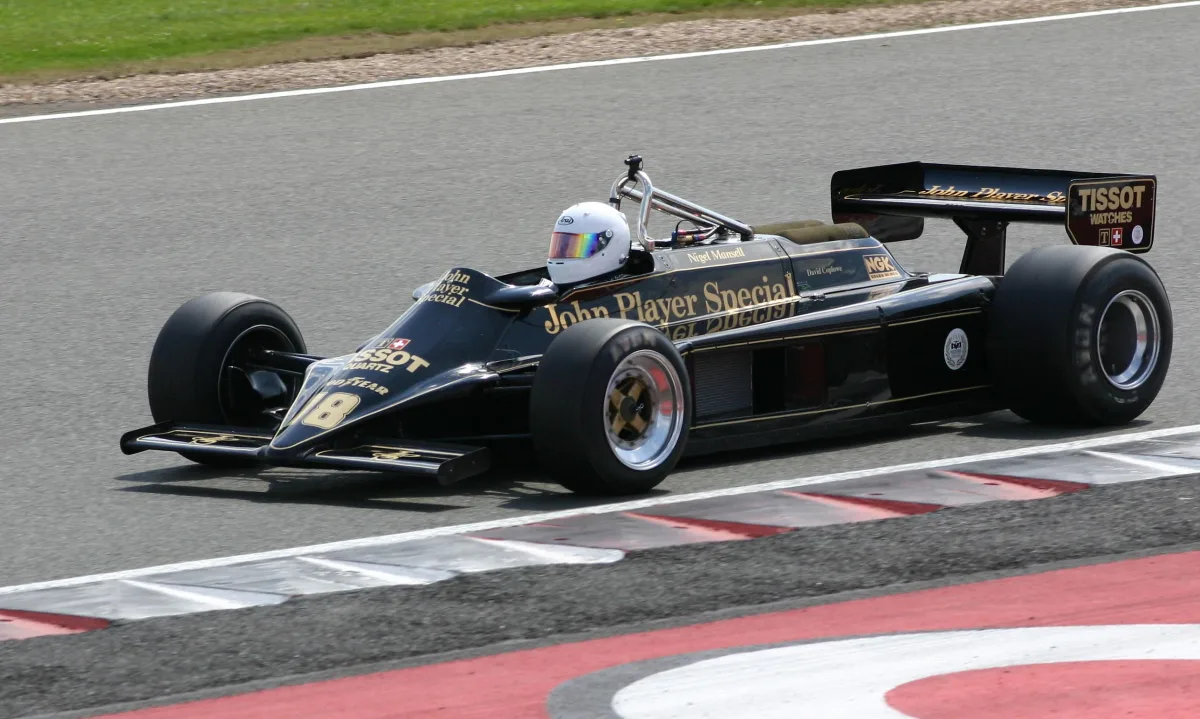
Lotus 87: 1981–1982 model Formula 1 car made of carbon fibre
The Lotus 87 was a Formula 1 car used in the second half of 1981 and the start of the 1982 season, featuring a carbon fibre and Kevlar chassis. This article looks at its origins from the Lotus 88 concept, its technology, and why it didn't live up to expectations.






Lotus 87 in brief
The Lotus 87 was a Team Lotus Formula 1 car used in the second half of 1981 and the early races of 1982. It was driven by Italian Elio de Angelis and future world champion Nigel Mansell.
This is a racing car, not a road model, so the article focuses mainly on its technology and place in Lotus history.
Origins and technology
The model was another step in Lotus's development of 'ground effect' cars. The previous Lotus 81 had an insufficiently rigid chassis compared to the dominant Williams FW07, so the team created a new chassis made of carbon fibre reinforced with Kevlar panels.
The chassis was initially designed for the ambitious double-chassis Lotus 88, but when that model was banned, it was quickly adapted for the more conservative 87. The car was powered by the Ford Cosworth DFV engine.
On the track
The car wasn't competitive enough to fight for wins, although the drivers managed to score points—13 points were earned with the 87. During the season, the team switched from Michelin to Goodyear tyres.
As Renault and Ferrari turbo engines became more reliable, it became clear that the 87 was too heavy, so for the start of the 1982 season, it was replaced by the lighter 87B specification, and soon after by the Lotus 91.
Significance and where to see one
The Lotus 87 was one of the first F1 cars to race with a carbon-fibre chassis: after the McLaren MP4/1, it is considered the second such car to compete in a race.
Surviving cars belong to collections and museums, and you might spot them in action at historic racing events, such as the Silverstone Classic.


Versions
This is a race car, so there are no trims; we list the main variants.
Lotus 87
1981The initial version with a carbon-fibre and Kevlar chassis.
- Ford Cosworth DFV engine
- Carbon-fibre and Kevlar chassis
- Chassis taken from the Lotus 88 project
Lotus 87B
1982 (first races)A lighter, updated specification.
- Lighter than the 87
- Used only in the first 1982 races
- Did not score any points
The 87 and other Lotus cars from that era
| Lotus 87 | Lotus 88 | Lotus 91 | |
|---|---|---|---|
| Who's it for? | For racing history enthusiasts | For tech history buffs | For racing history enthusiasts |
| Chassis | Carbon fibre and Kevlar | Double chassis | Carbon fibre and Kevlar |
| Racing pedigree | Yes | No, banned | Yes |
| Market price (relatively) | Practically unattainable | Practically unattainable | Practically unattainable |
The Lotus 87 is more conservative than the double-chassis 88, but it's a crucial step towards carbon fibre F1 cars and the foundation for the more successful 91.
Pros
- One of the first carbon fibre F1 constructions
- Born from the bold Lotus 88 project
- Driven by de Angelis and Mansell
- Recognisable John Player Special colour scheme
Cons
- Too heavy to handle turbo engines
- Never won a race
- Can't drive on some roads
Frequently asked questions
What's the connection between the Lotus 87 and Lotus 88?
The carbon fibre chassis was originally designed for the twin-chassis Lotus 88, and when that was banned, it was adapted for the 87.
Who drove the Lotus 87?
Elio de Angelis and Nigel Mansell.
What changes were made to the Lotus 87?
Initially, the lighter 87B specification, and later, the Lotus 91.
Updated 2026-10-21 · Trim levels and equipment vary by market and model year — check the equipment of the specific car. · Translated automatically


