 English
 Lietuvių
 Latviešu
 Eesti
 Polski
 Русский
 Українська
 Deutsch
 Nederlands
 Čeština
 Slovenčina
 Svenska
 Norsk
 Dansk
 Suomi


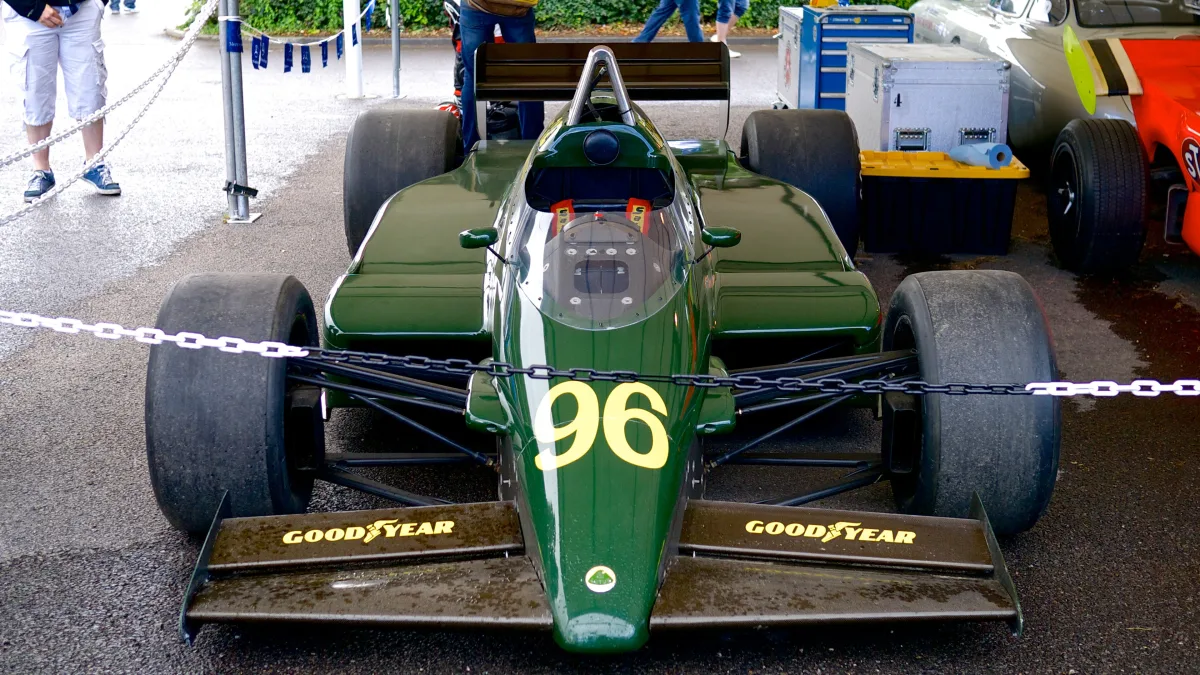
Lotus 96T: the sole Lotus Indycar prototype
The Lotus 96T was the final Team Lotus Indycar, designed based on the Formula 1 Lotus 95T and remaining as a single prototype. In this article, we look at the idea, the technical solution, and why the project failed.






The Lotus 96T in brief
The Lotus 96T was the last Team Lotus Indycar. It's a racing prototype, not a road car, so in this article, we delve into its history and technical solutions.
The project was conceived by former Formula 2 team owner Roy Winkelmann, based in the USA and eager to compete in the new CART series.
The idea and the technology
Winkelmann didn't want to buy ready-made March or Lola chassis, so he turned to Cosworth to build 'factory' engines and to Team Lotus and designer Gérard Ducarouge for a specially designed car. Ducarouge brought in Mike Coughlan for assistance.
The 96T chassis and suspension were similar to the 1984 Formula 1 Lotus 95T, but with a crucial change: since there was a real risk of crashing into a concrete wall at speeds over 320 km/h at Indianapolis, the chassis was reinforced.
Why the chassis was crucial
Since 1981, all Formula 1 Lotus cars had been built from layers of carbon fibre and Kevlar, with Nomex paper filler in between. The hollow section of the 96T was filled with a lightweight aluminium honeycomb core.
This provided additional strength without adding weight and became the basis for all subsequent Lotus Formula 1 chassis.
Why the project failed and where the car is now
Despite a promising start, the project was essentially killed off by a lack of enthusiasm from the CART community for the 'factory' team. As a result, sponsorship wasn't secured, and drivers were reluctant to risk their reputations by choosing an unknown European team.
The sole prototype is now in the Classic Team Lotus collection; it can be seen at historic events, such as the Goodwood Festival of Speed.


Versions
This is a racing car, so there are no trims; we list the main variants.
Lotus 96T
Mid-1980sThe sole Team Lotus Indycar prototype.
- Chassis based on the Lotus 95T
- Aluminium foil core filling inside the chassis
- One example produced
The Lotus 96T and its predecessor, the 95T
| Lotus 95T | Lotus 96T | |
|---|---|---|
| Who it's for | A Formula 1 season | Indycar / CART |
| Chassis | Carbon fibre and Kevlar with Nomex | A blend of Kevlar and aluminium honeycomb |
| Market price (relatively) | Practically unattainable | Practically unattainable |
The Lotus 96T never raced, but its chassis design left a mark on later Lotus Formula 1 constructions.
Pros
- An interesting technical solution — aluminium honeycomb
- One-off prototype
- Foundation for later Lotus F1 chassis
- Shows an ambitious Lotus idea for IndyCar
Cons
- Project never materialised
- Can't be driven on public roads
- Purchase is impossible
Frequently asked questions
Did the Lotus 96T ever race?
The project fell through, leaving just one prototype.
Where is the Lotus 96T?
The sole prototype resides in the Classic Team Lotus collection.
What sets the Lotus 96T apart from the 95T?
The chassis is similar but strengthened — the empty space between the layers is filled with an aluminium foil core.
Updated 2026-10-21 · Trim levels and equipment vary by market and model year — check the equipment of the specific car. · Translated automatically


